
Buy PDF guide

Buy PDF guide — 10.90 USD

PDF — 10.90 USD

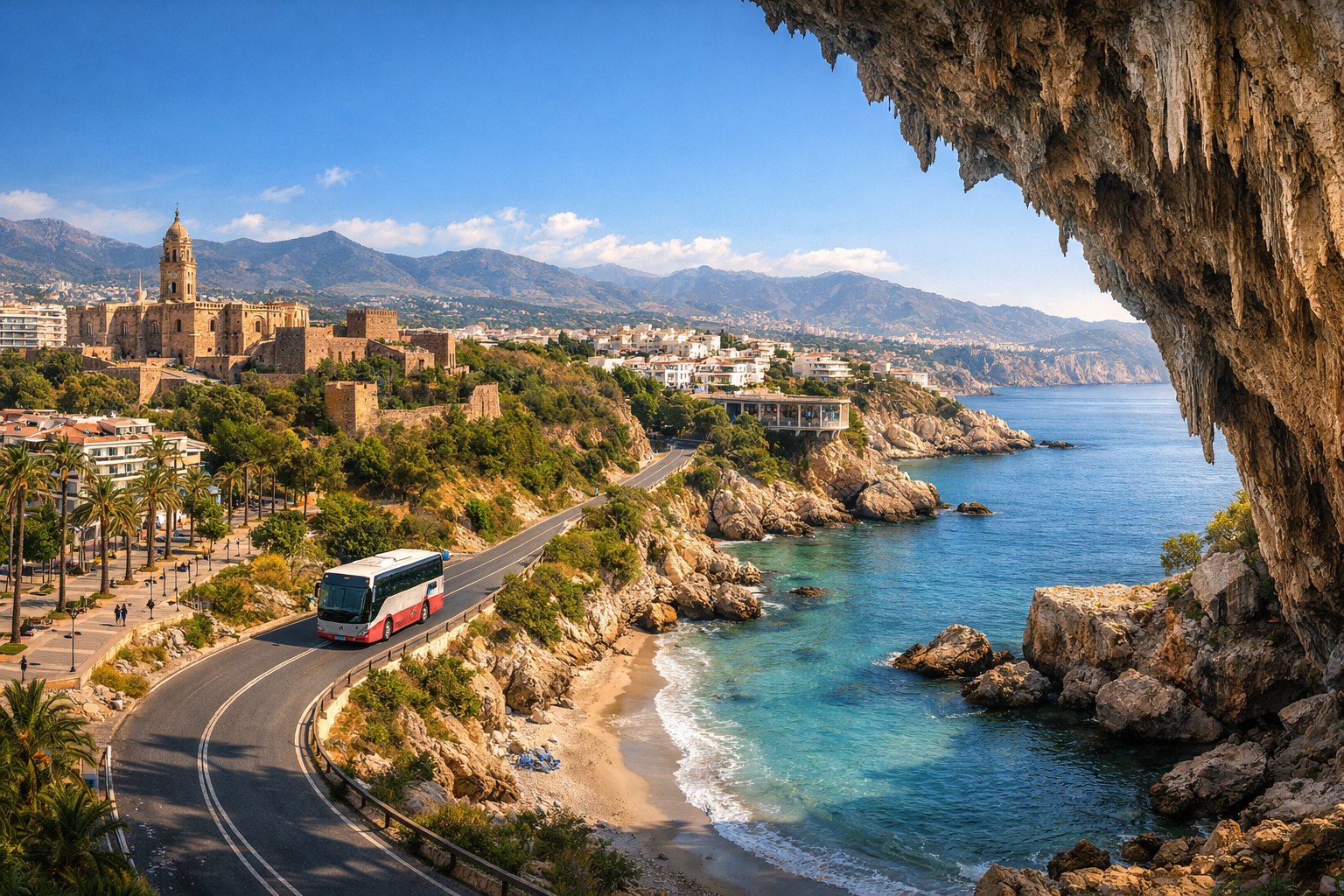
Spain, Malaga and Nerja. A budget vacation on the Costa del Sol coast with city beaches, fortresses, caves, and bus transfers.

Spain, Malaga and Nerja. A budget vacation on the Costa del Sol coast with city beaches, fortresses, caves, and bus transfers.

Soak up the Costa del Sol with a budget-friendly escape from Málaga to Nerja and back, where sunny city beaches meet hilltop fortresses and dramatic sea views. Wander Málaga’s lively streets, then head east to discover Nerja’s famous caves, whitewashed charm, and relaxed Mediterranean pace.

🧭 DAY-BY-DAY ROUTE

Ready-made country and city routes with daily plans, sights, transport and accommodation. Buy PDF guides for independent travel.

🧭 DAY-BY-DAY ROUTE


Day 1 — Málaga: historic center, cathedral, and an evening by the sea

  • 🚆 Arrival at Málaga-Costa del Sol Airport. The easiest way to reach central Málaga is by the Cercanías C1 train to Málaga Centro-Alameda station: the trip takes about 12–15 minutes including waiting time and leaving the station, and about 8 minutes to María Zambrano. An alternative is the Airport Express A bus to Alameda Principal and Paseo del Parque; this is a good option if you have light luggage and don’t want to change transport.

  • 🚶 It’s best to devote the first day to a gentle introduction to Málaga’s atmosphere without overloading it with museums or long outings. The historic center here is compact and very convenient for walking: narrow streets with stone facades unexpectedly open onto spacious squares, small churches, and lively terraces with glasses of vermouth and plates of tapas. The heart of the city is Málaga Cathedral, a huge Renaissance-Baroque church that locals affectionately call La Manquita, “the one-armed lady,” because its second tower was never finished. Inside, the cathedral feels not heavy at all, but rather bright and solemn: high vaults, warm stone, soft Andalusian light, and the sense that the city has lived around this space for centuries.

  • 🚶 After the cathedral, don’t rush — it’s exactly this unhurried pace that makes Málaga especially pleasant. Walk through Calle Larios and the neighboring lanes toward the port, peeking into inner courtyards, small shops, and pastry stores. Then it makes sense to continue to Muelle Uno and the urban beach area of La Malagueta. This is not a “wild” postcard with an empty shore, but a lively city coastline where the sea stands side by side with palm trees, cafés, runners, cyclists, and soft evening light. For a budget trip, this kind of end to the day is ideal: there’s no need to spend money on separate excursions, and the sunset by the water, the view of the yachts, and the silhouettes of the hilltop fortresses create a very complete first impression of the Costa del Sol.

  • 💤 Overnight in Málaga. After the flight and the walk, it’s better not to plan anything demanding: an early night will give you energy for the climb to the fortresses the next day.


Day 2 — Málaga: Alcazaba, Roman theatre, Gibralfaro, and La Malagueta beach

  • 🚶 The second day is Málaga in its historical vertical: from antiquity to the Islamic era, and then to panoramic views of the sea and the city. Start with the ensemble at the foot of the hill: here you will find the Roman Theatre and the Alcazaba next to each other. The Roman Theatre is a reminder of ancient Malaca, while the Alcazaba is one of the most beautiful urban Muslim fortresses in Andalusia, with powerful walls, bent entrances, courtyards, gardens, arches, and views over the port. It is not just a military structure, but a rare place where defensive architecture is combined with almost palatial refinement.

  • 🚶 From the Alcazaba, it’s worth climbing higher to Castillo de Gibralfaro. The walk up via Paseo de Don Juan Temboury and then up the hill takes about 20–30 minutes at an easy pace, with breaks for photos and breathers. You can also take EMT bus line 35, which connects the center with the castle roughly every half hour, but the walk is more scenic and reveals the city’s topography better. At the top, a very different Málaga awaits you: not only the sea, but also the rooftops of the old town, harbor cranes, the bullring, the straight lines of the waterfront, and the distant curves of the coast. This is the view that makes it especially clear why the fortress stood exactly here.

  • 🚶 After the historical part, give yourself a break and head down to La Malagueta. This city beach works especially well for a short budget route: there’s no need to travel far, the infrastructure is nearby, and after the heat and the stone climbs the sea feels like a reward. You don’t have to plan a full beach day here — just swim, lie down for an hour or two, and have lunch at one of the inexpensive places by the water. This balance between culture and rest makes the day feel lively rather than exhausting.

  • 🏛️ If you still have energy in the evening, you can briefly wander around the area near Alcazabilla and Plaza de la Merced — it’s pleasant here simply to stroll without a strict plan, taking in the evening atmosphere, street musicians, and the smell of fried fish.

Day 3 — Nerja: Balcón de Europa, city beaches, and the old town

  • 🚆 Transfer: Málaga → Nerja by ALSA bus. From Málaga Estación de Autobuses or from stops in the city/airport, buses run frequently; the journey usually takes about 45–60 minutes depending on the service and the number of stops. This is the most realistic and budget-friendly way to reach the eastern part of the Costa del Sol without renting a car.

  • 🚶 Nerja feels different from Málaga right away. There is less urban density, more white facades, sea air, and resort-town lightness, yet the town does not turn into a faceless beach zone. The main point of attraction is Balcón de Europa, the famous viewpoint on a cliff between the beaches, on the site of the former Castillo Bajo, which was built in the early 16th century. From here, the sea feels almost theatrical: below lie small coves, waves crash against the rocks, and the white town seems deliberately arranged so that every turn opens onto a new postcard view.

  • 🚶 Around Balcón de Europa, it’s very pleasant simply to get lost for half a day. Nerja’s old town is made up of white houses, wrought-iron balconies, bougainvillea, ceramic signs, and small squares where life moves more slowly than in capital cities or large resort areas. For a budget holiday, this is an especially rewarding place: many of the best experiences here are free — the walk itself, the views, the stairways down to the sea, benches at scenic points, evening music, and the rhythm of the resort town itself.

  • 🏖️ After your walk, have a light beach session at one of the city beaches in the center — Playa de Calahonda, Playa del Salón, or Burriana if you’re willing to walk a little farther. The central beaches are great because they are literally woven into the route: you don’t lose half a day on logistics, and can alternate swimming, coffee, walking, and resting in the shade. In the evening, Nerja is especially beautiful: the white walls turn pink at sunset, and people gather at the viewpoints simply to look at the sea — and that is already enough.

  • 💤 Overnight in Nerja. It’s better to stay here for at least one night: that way you won’t have to hurry back to Málaga, and you can start the morning of day four without an early bus.

Day 4 — Nerja and Maro: the Nerja Cave, museum, and sea

  • 🚆 In the morning, devote time to Cueva de Nerja — one of the most impressive caves in Spain. You can get there by bus from the Nerja area toward Maro and the cave, or by taxi/transfer if you want to save energy; the ride itself usually takes about 10–15 minutes from central Nerja, plus transport waiting time. Plan at least 1.5–2 hours for visiting the cave without rushing.

  • 🚶 Nerja Cave is a place that sharply changes the mood of the trip: from a sunny coast and beach relaxation, you move into a vast underground world where the space feels almost cathedral-like. What impresses here is not only the scale of the halls and the stalactites, but also the sense of antiquity itself — as if the sea and limestone had been having their slow conversation for thousands of years, and humans entered only for a brief moment. The cave is known not only as a tourist attraction, but also as an important natural and cultural site connected with archaeology, prehistory, and the study of underground landscapes.

  • 🏛️ After the cave, it makes sense to add the Museum of Nerja in the town center. This is a very successful combination: first you see the grand natural monument itself, and then you get the context — the history of the cave’s discovery, the development of the town, and finds connected with its past. The museum does not overload you, but ties together the sea, the rocks, ancient traces of human life, and modern resort Nerja. It’s convenient to allow another 45–60 minutes for this part of the route.

  • 🏖️ Leave the second half of the day free for relaxing by the sea. After the cave and the museum, it’s better not to overload the schedule: you can choose the central beaches again or walk to Burriana if you want a wider shore and a longer time by the water. This is the right balance for a 5-day trip: a насыщенная first half of the day and a calm, almost lazy evening by the sea.

Day 5 — Return to Málaga: a museum finale and botanical garden

  • 🚆 Transfer: Nerja → Málaga by ALSA bus, usually about 45–60 minutes. If your flight is not early and you have almost a whole day, it makes sense to return to Málaga in the morning and spend the end of the trip in a more urban, cultural way. If the flight is early, this day can be reduced to a direct transfer to the airport.

  • 🏛️ For the last day, it’s better to choose not fortresses and not long climbs, but one major museum focus. The best option is Museo de Málaga or Museo Picasso Málaga, depending on your interests. Museo de Málaga in the Palacio de la Aduana is great because it combines archaeology and fine arts and helps you bring together the whole regional context in your mind: Phoenicians, Romans, the Islamic era, Christian Málaga, painting, and urban memory. Museo Picasso Málaga, by contrast, provides a more personal and artistic finale — connected with the city’s most famous native son.

  • 🌿 If time allows and you want to end the trip not among stone quarters but surrounded by greenery, head to Jardín Botánico-Histórico La Concepción. This is one of the most beautiful botanical gardens in southern Spain: old stairways, palms, tropical plants, water features, shaded paths, and a feeling of almost countryside coolness. After the sun, the beaches, the buses, and the hills, this kind of finale is especially pleasant — like a soft exhale before the journey home.

  • ✈️ From central Málaga, the easiest way to get to the airport again is by Cercanías C1 or the Airport Express A bus. For an international flight, it’s worth allowing extra time: at least 2–2.5 hours before departure plus about 15–25 minutes for the trip to the airport depending on your starting point and chosen transport.

Flight tickets

eSIM for travel

Buy PDF guide

Buy PDF guide — 10.90 USD

PDF — 10.90 USD