
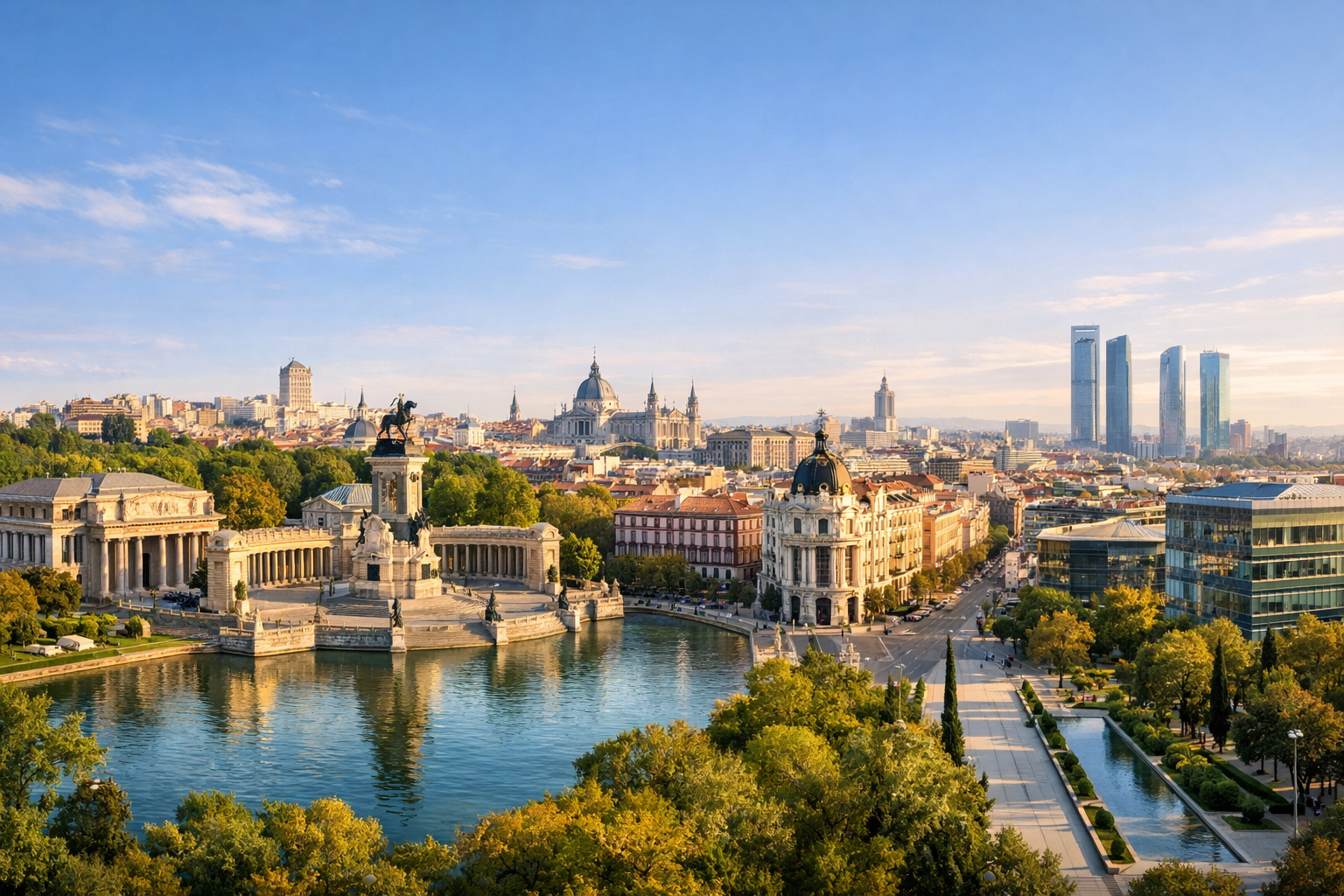
Day 1 — Madrid: the Paseo del Arte museum quarter
🚶 The first day is best devoted to Madrid’s most famous cultural corridor — Paseo del Arte, where the Prado Museum, the Thyssen-Bornemisza Museum, and the Reina Sofía Museum are located almost along the same axis. This is a rare route for a major capital where you can create a full and rewarding day without long transfers: wide boulevards, the avenues of Paisaje de la Luz, grand urban vistas, and the feeling that the history of Spanish art literally unfolds as you move along the avenue. For a calm pace in an adapted trip, it is better not to try to cover everything at once: start with the Prado in the morning, when there are fewer lines and it is easier to move through the galleries, then take a long break for lunch and rest, and devote the second half of the day to one of the two modern museums, choosing according to your energy and interests.
🏛️ Museo Nacional del Prado, Paseo del Prado s/n, 28014 Madrid. The Prado is not just Spain’s main museum, but one of the most important museums in Europe, where Velázquez, Goya, El Greco, Titian, and Rubens form an almost continuous visual narrative about power, religion, court life, and human character. For travelers with specific access needs, it is especially important to plan short thematic visits: for example, focus on several key rooms to avoid overload and fatigue. The museum states that it offers accessible services for visitors with disabilities and reduced mobility; in practice, this means it is worth arranging your visit in advance if you need specific assistance, accompaniment, a wheelchair, or clarification about a step-free entrance. Even in major museums, elevator demand and queues can vary depending on the time of day.
♿ In terms of accessibility for the day: the Paseo del Prado area is generally more convenient than the old center, with wide sidewalks and long straight stretches, but distances can feel greater than they look on the map. For wheelchair users and people with limited stamina, it is better to break movements into 10–15 minute segments. Adapted toilets are available in the Prado and neighboring museums; there are places to rest in the museum quarter, but at peak times there may be crowds at entrances, security checks, and cloakrooms. For blind and visually impaired visitors, it is important to check in advance what tactile or descriptive programs are available on the required date, and for deaf and hard-of-hearing visitors — whether subtitles, induction systems, sign language tours, or the option to book an interpreter in advance are available.
🏛️ Museo Nacional Centro de Arte Reina Sofía, Calle Santa Isabel, 52, 28012 Madrid. After the classical Prado, this museum changes the tone of the day: a former hospital complex with large volumes, modern galleries, and a powerful collection of 20th- and 21st-century art, especially compelling around Picasso’s “Guernica.” The museum has officially described accessible visits; if you need special assistance, a wheelchair, support for reduced mobility, or a sign language interpreter, it is best to write in advance. For people sensitive to sensory overload, it is useful to remember that the museum is large and acoustically quite lively in places, so it is more comfortable to choose 1–2 buildings rather than trying to see everything.
🍽️ For lunch and dinner on this day, it is sensible to choose venues in the Atocha area or near Neptune Square, where modern entrances and more spacious restroom areas are more common than in old taverns. Before visiting a restaurant, it is worth checking: whether there is a step at the entrance, the width of the restroom door, whether an assistance dog can enter, and whether there is a quiet table away from the dense flow of guests. A backup option is to have lunch in a museum café or in a large nearby hotel restaurant: this is usually more predictable in terms of elevators, seating, and acoustics.
🚇 Day logistics: from a hotel in the Atocha area or Paseo del Prado, it is convenient to get to the first stop by accessible EMT bus or a short taxi ride. The Madrid metro is useful, but not all stations are step-free, so for each specific trip check the accessibility of both the departure and arrival stations, as well as the operation of the elevator right before departure. If you arrive on this day, airport assistance should be booked at least 48 hours in advance, and the museum program should not be planned too tightly.