
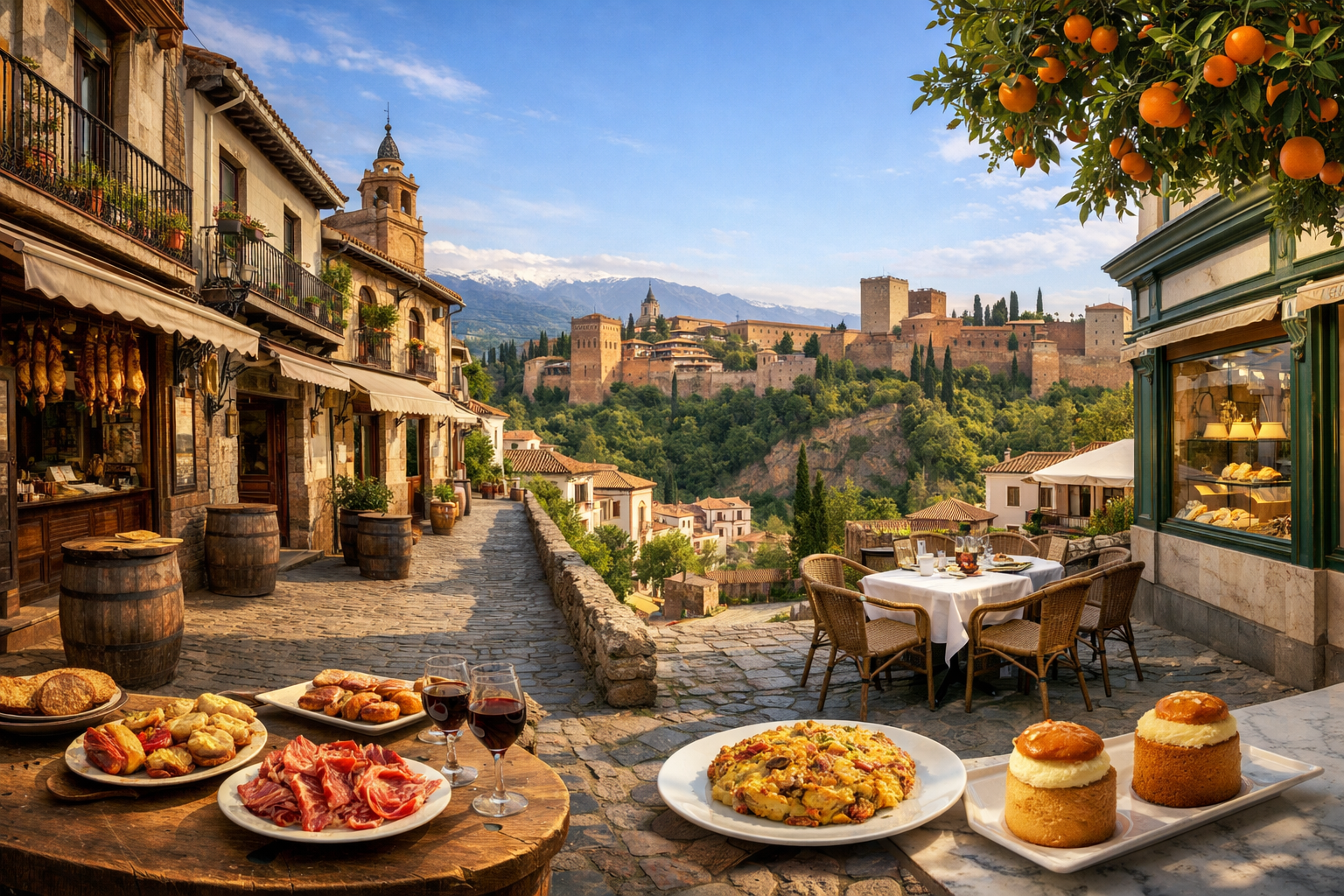
Day 1 — Granada: market, free tapas, Bodegas Castañeda, Los Manueles, and Casa Ysla
🚶 This day is designed as a gentle introduction to Granada’s gastronomic soul: no rush, short walks through the historic center, and a focus on what the city is truly famous for — the culture of free tapas, local sausages and cured meats, old taverns, sweet pastries, and markets where you can feel the real pulse of everyday Andalusia. The best base area for accommodation is between Plaza Nueva, Gran Vía, and Realejo: from there, the main food stops are 5–20 minutes on foot, and the evening tapas-bar format is easy to combine with a walk without needing to take a taxi.
🥬 Start the morning at Mercado San Agustín Gourmet, located right in the center near the cathedral quarter. This is not a museum-like market “just for pictures,” but a lively space where it’s easy to get your first sense of local products: olives, anchovies, cheeses, ham, seasonal vegetables, spices, and seafood. It is especially good for looking closely at regional specialties of Andalusia and the province of Granada: Trevélez ham, products from La Alpujarra, olive oil, preserves, and cheese stalls. The market format is convenient for travelers with different eating habits: you can choose something light, put together breakfast from several small items, or simply stick to coffee and fruit. It makes sense to allow 45–75 minutes for the market. If you want not just to look around but also to grab a bite on site, it’s better to come closer to late morning, when most stalls are already fully operating.
🚶 Walk from Mercado San Agustín → Bodegas Castañeda: about 7–10 minutes on foot along flat central streets. On the way, it’s pleasant to pass through the area around the cathedral and streets with traditional shops, where Granada feels not like a “checklist of sights,” but like a city with a strong bar and culinary memory.
🍷 Bodegas Castañeda is one of Granada’s most characteristic classic bodegas and a very good first stop for getting to know the local tapas gratis system. Here, the atmosphere matters no less than the food: wooden counters, a dense service rhythm, the feeling of the old center where people come not for a “formal dinner,” but for a real Granadan experience. The venue is open daily roughly from 11:30 to 01:00, so the most convenient time to come is either for an early lunch before the peak hour or later in the afternoon. A free tapa is usually served with your drink — this city custom is exactly what makes Granada’s gastronomy so appealing. As targeted orders here, it makes sense to try Trevélez ham and ask for traditional local snacks, and if there are vegetarians in your group, it’s worth asking about meat-free options: the venue states that vegetarian items are available. Plan 60–90 minutes for the visit, especially if you want not just to “drop in,” but to feel the bar’s rhythm.
🍖 Trevélez ham is not just a menu item, but an important part of the province’s gastronomic identity. This mountain-cured ham is connected with the high-altitude area of La Alpujarra and is valued for its clean, dry, noble flavor without excessive heaviness. In Granada, it is especially pleasant to try it not in isolation but in a classic bar setting: with a glass of wine, vermouth, or beer, when thin slices are served as part of an unhurried conversation rather than as a gastronomic attraction. If you want to appreciate the product better, don’t order too much at once: one or two local items plus the free tapa will give a more authentic rhythm than an overloaded table.
🚶 Walk from Bodegas Castañeda → Los Manueles (Reyes Católicos, 61): about 3–5 minutes on foot. This is a very convenient pairing for one gastronomic day: first bar culture with tapas, then a more complete seated meal in one of the city’s best-known historic restaurant names.
🍽️ Los Manueles is a restaurant with history since 1917 and one of the most reliable places if you want to try traditional Granada cuisine in the comfortable format of a full lunch or early dinner. The group has several addresses in the center, but for this route the restaurant at Reyes Católicos, 61, near Plaza Nueva, is especially convenient. The officially stated schedule is daily from 12:00 to 24:00. Here, you should intentionally order tortilla del Sacromonte, one of the city’s most characteristic dishes, connected with the Romani and neighborhood heritage of Sacromonte. Historically, it is a distinctive, character-rich tortilla, and even if the modern interpretation may differ slightly from place to place, this kind of traditional restaurant is exactly where it makes sense to try it as part of the local code. Los Manueles is also a convenient place to look for other Andalusian and Granadan dishes, and for guests with dietary restrictions there is an important plus: the restaurant specifically indicates the availability of options for people with intolerances and allergens. In high season, on weekends, and in the evening, it is better to book a table in advance.
🥘 Sacromonte tortilla is a dish that is not about “tourist photogenicity,” but about Granada’s old, rich, and at times bold cuisine. It was born in an environment where the whole product was respected and flavor was built not on luxury, but on depth and inventiveness. Even if you prefer more familiar flavors, trying this kind of tortilla in Granada is worth it at least once: it is one of those cases where the cuisine tells the story of a neighborhood and its history no worse than any tour. If you are unsure about the ingredients or want a milder version, simply ask the staff about the current version of the dish in that specific restaurant.
☕ After lunch, take a pause for a walk through the center — 20–40 minutes without a dense program. The best rhythm for a food tour in Granada is not to rush and to leave room for rest between tastings. You can walk through the cathedral area, Bib-Rambla square, and the shopping streets, where you can really feel the blend of old Andalusia, urban everyday life, and the constant movement between cafés, pastry shops, and tapas bars.
🍰 Closer to afternoon coffee time or early evening, stop by Casa Ysla — a historic name inseparably linked with pionono, the most famous sweet symbol of Granada and nearby Santa Fe. For this route, it is convenient to use one of the central Casa Ysla locations in the Bib-Rambla / Reyes Católicos / Gran Vía area, depending on which is closer to your hotel and current walk. There is no need to arrange a big dessert set here: coffee and one fresh pionono are enough. This small, juicy, syrup-soaked pastry with a creamy topping works best precisely as a short sweet accent after a rich gastronomic day. If you want to take home an edible souvenir, this is one of the best purchases you can make in Granada.
🧁 Pionono is a dessert that may seem modest in size, but it expresses the character of the local pastry tradition very precisely: richness, aroma, tenderness, and an almost ceremonial connection with coffee. In a good version, it should not be simply “very sweet”; it has its own texture, moisture, and creamy-caramel softness. If there are people in the group who do not eat gluten, dairy products, or eggs, it is better to keep in mind in advance that classic pionono is generally not suitable for them.
🌆 Leave the evening free for a second, lighter wave of tapas. You can return to the Plaza Nueva area and limit yourself to one more drink with a free tapa in one of the traditional bars, without overloading the day with another heavy dinner. This kind of finale makes sense both physically and culturally: in Granada, food is not just a list of dishes, but the rhythm of the city, where the bar counter, short stops, and conversations are no less important than a formal restaurant. If you prefer a less meat-focused scenario, in the central area the Los Manueles group also has a separate vegetarian-vegan concept, uVe, on Plaza de las Pasiegas, which can serve as a convenient backup option for part of the group.