
Buy PDF guide

Buy PDF guide — 6.90 USD

PDF — 6.90 USD

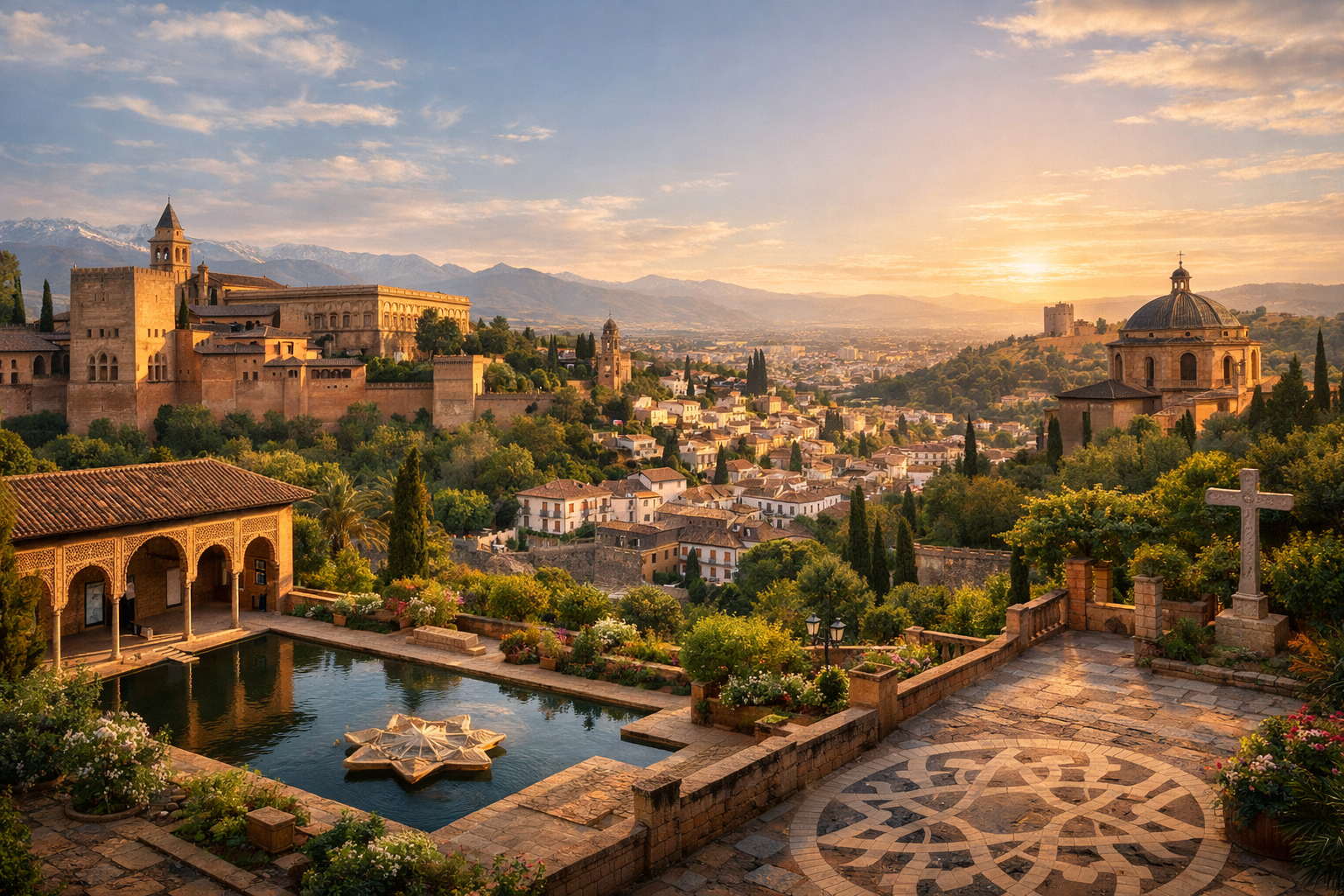
Spain, Andalusia. The Alhambra and the symbolism of East and West. Granada, the palaces of the Alhambra, gardens, and historic quarters in a journey about geometry, architectural symbolism, and the meeting of cultures.

Spain, Andalusia. The Alhambra and the symbolism of East and West. Granada, the palaces of the Alhambra, gardens, and historic quarters in a journey about geometry, architectural symbolism, and the meeting of cultures.

In Granada, the Alhambra rises above the city like a dream in stone, where intricate geometry, flowing gardens, and palace walls tell a story shaped by both East and West. Wander on through the white lanes of the Albaicín and the hillside of Sacromonte to feel Andalusia’s meeting of cultures in every view, courtyard, and sunset.

🧭 DAY-BY-DAY ROUTE

Ready-made country and city routes with daily plans, sights, transport and accommodation. Buy PDF guides for independent travel.

🧭 DAY-BY-DAY ROUTE


Day 1 — Granada: the Alhambra, Generalife, and the geometry of sacred space

  • 🚶 It makes sense to devote the first day to the Alhambra—not as “just a fortress,” but as a multilayered space where politics, poetry, water, the mathematics of pattern, and the symbolism of power come together. This is a real historic palace-fortress complex on Sabika Hill, including the Alcazaba, the Nasrid Palaces, the Palace of Charles V, gardens, and the Generalife. It is important to plan your visit in advance: entry to the Nasrid Palaces is tied to a specific time on the ticket, and you cannot be late. You should allow at least 4–6 hours for the whole complex without rushing, because this is not a one-hour museum, but an entire landscape of meanings, transitions, shadows, inner quiet, and the visual rhetoric of power.

  • 🚶 The esoteric angle here is built not on fantasies about “secret rays,” but on observing how Islamic architecture worked with the idea of an ordered cosmos. Ornaments, calligraphy, repeated star-shaped schemes, the proportions of courtyards, and water axes—all this can be seen as an artistic expression of the idea of harmony in the world. Historical fact: geometry, epigraphy, and the play of light with water are indeed important in Nasrid architecture. The interpretation that the entire Alhambra is an “esoteric map of the universe,” however, belongs to later symbolic readings and cultural mythology, not to a scientifically proven reconstruction of the intentions of all its creators.

  • 🚶 The Court of the Lions, the Court of the Myrtles, the Comares halls, and the Generalife are especially good for this kind of route: here you can see how water is used not only in a practical way, but also as a tool of contemplation, reflection, and rhythm. In Eastern and Sufi-tinged cultural optics, water is often understood as an image of purification, knowledge, and the garden as a reflection of paradise; this is an important cultural parallel, but not a reason to present it as a universal “secret code” of the complex. In the Generalife, the theme of the garden as a discipline of the senses is especially tangible: the sound of water, the shade of cypresses, transitions between closed and open space, and panoramas of the city and hills create an almost meditative rhythm of walking.

  • 🚆 Getting there: from central Granada to the Alhambra, the most convenient option is the city minibus C30, and line C32 runs between the Alhambra and Albaicín. If you are staying near the center, walking uphill is also possible, but it is an ascent and is better suited to a cool morning. After the visit, be sure to allow 60–90 minutes for rest and a late lunch: the site is large, summers are hot, and it is easy to get tired on the stone paths and stairways.

  • 🚶 In the second half of the day, it is worth visiting the Alhambra Museum inside the Palace of Charles V. This helps “ground” your impressions: after the poetics of the spaces, you see material culture—architectural details, objects of Islamic art, décor, and context. For an esoteric tour, this is an important balance: first the experience of the place, then the historical framework. If you still have energy, end the day at a quiet viewpoint by the wooded slopes of the Alhambra, without trying to take in everything at once. The Alhambra requires a contemplative pace, not a collector’s one.

  • ⚠️ Practicalities and accuracy: buy tickets in advance on the official website, keep an ID document with you, and follow the route indicated on your ticket. For conservation and safety reasons, some parts of the complex are sometimes temporarily closed or operate under a modified scheme. Legends about the palaces’ “hidden messages,” “magical acoustics,” and “secret codes of conquest” may be mentioned as part of the cultural imagination around Granada, but not as proven fact.


Day 2 — Granada: Albaicín, Bañuelo, Dar al-Horra, and the meeting of East and West

  • 🚶 The second day is devoted to the old Albaicín—the quarter where the city is best read as a palimpsest. This is a historic district on the hills opposite the Alhambra, with a medieval street layout, cármenes, miradores, and traces of the Andalusian past. It is here that the theme of the meeting of East and West becomes not an abstraction, but urban fabric: formerly Islamic Granada, the subsequent Christian rebuilding, new meanings in old walls, bell towers, and courtyards. It is best explored on foot, but remember that the area is steep, cobbled, and uneven—you need grippy, comfortable shoes.

  • 🚶 Start with El Bañuelo on Carrera del Darro—one of the best-preserved hammams of the Andalusian period in Spain. Historically, this is an 11th-century public bath, not a “temple of initiation” in an occult sense. But for the cultural history of the body and ritual, this place is genuinely important: washing, steam, passage between rooms of different temperatures, and muted light through star-shaped openings in the vaults created an experience of purification and social encounter. Modern esoteric interpretations like to see in such spaces an “alchemy of the elements”—water, air, stone, warmth; this is a beautiful interpretation, but it remains a modern reading, not a confirmed function of the monument.

  • 🚶 Then climb to Palacio de Dar al-Horra—a real palace from the Nasrid period, associated with Aixa, the mother of Boabdil. Here the intimate, inward scale of Andalusian architecture is felt especially clearly: not imperial display, but a closed, contemplative organization of space around a courtyard, light, and air. In esoteric terms, this palace is interesting as a place of female presence in the history of power and as an architecture of shelter, observation, and the inner world. However, any stories about “women’s secret schools” or “sacred initiations” within these walls should be treated as legendary and literary speculation.

  • 🚶 After that, head toward the viewpoints of Albaicín, including Mirador de San Nicolás. The view of the Alhambra from here has become almost a ritual, but in an esoteric journey it matters not as a photo stop, but as a visual meditation on the city’s duality: palace and quarter, hill and valley, Islamic heritage and Christian overlay, the red fortress and the white walls of Albaicín. At sunset it is especially crowded here, so for a calmer experience it is better to come either earlier or be prepared to share the space with many visitors and street musicians.

  • 🚆 Day logistics: from the center, it is convenient to walk to Carrera del Darro, and for the climb into the upper parts of Albaicín you can use minibuses C31/C32 if you want to save your energy. Between points, allow real breaks: 15–20 minutes for coffee, water, and rest after the climbs, plus at least an hour for a leisurely lunch below or in one of the cármenes with a view. Albaicín does not like haste—the value of the route here lies in the labyrinth of transitions, not in the number of boxes ticked.

  • ⚠️ Cultural note: this is a residential quarter, so you need to respect the quiet, not block narrow passages for photos, and not treat every closed door as a “secret portal.” Legends about hidden Moorish treasures, underground passages, curses of exile, and the “memory of stone” are part of local folklore and the tourist narrative. They may beautifully accompany a walk, but they do not replace historical facts.

Day 3 — Granada: the cathedral center, the Royal Chapel, Realejo, and Sacromonte

  • 🚶 The third day reveals the western, post-Nasrid, and already Christian symbolic axis of the city. Start with Granada’s cathedral center and the Royal Chapel. This is not “esotericism” in the cheap sense of the word, but a chance to see how the new власти re-sacralized the city’s space after 1492. The Royal Chapel, where the Catholic Monarchs are buried, is a place of memory, dynastic symbolism, and ritual affirmation of victory. Nearby, Granada Cathedral shows a different language of form: Renaissance and Christian, with a different vertical of meaning and a different idea of light and solemnity.

  • 🚶 For the theme of “East and West,” this is a key day: you literally move from Andalusian geometry and the intimacy of courtyards to Christian monumentality and the public representation of faith. If in the Islamic architecture of the Alhambra the sacred is often dissolved in pattern, calligraphy, water, and inner rhythm, here it is expressed through the altar, axis, dome, chapels, and funerary memory. In popular mystical literature, Granada is sometimes described as a city of “changing egregores” and “rewiring of the sacred grid.” This is the metaphorical language of modern spiritual interpretations, not a historical category.

  • 🚶 Next, head to Realejo and Fundación Rodríguez-Acosta. This is one of the most suitable places for a subtler esoteric accent in Granada: a carmen, gardens, terraces, stairways, underground galleries, and a symbolist atmosphere of the early 20th century. Here it is no longer medieval religion, but an artistic world in which personal mythologies, allusions, intellectual play, and a taste for half-hints can genuinely be read. The space is often perceived as an “initiatory garden” or a “labyrinth of images”—this is an acceptable interpretation of art and symbolism, but not a museum-established fact about a secret society or an occult function of the place.

  • 🚶 Toward evening, it makes sense to climb in the direction of Sacromonte. This district is famous for its cave houses, flamenco tradition, and the distinctive topography of its slopes. For an esoteric route, it is interesting as a place with a strong legendary aura: stories of Romani magic, night rituals, amulets, shrines, and the special “wild” spirituality of Sacromonte are rooted in the area’s cultural mythology. But it is important to keep the frame: above all, this is a living urban environment with a specific social history, not a backdrop for romantic fantasies about Europe’s “secret East.”

  • 🚆 In practical terms, the day is laid out very conveniently: in the morning, the center and chapel are within walking distance, then 20–30 minutes on foot or a short taxi/bus ride to Realejo, and Sacromonte can be reached by minibus C34 or with a partially uphill walk. Plan a slightly gentler pace for this day and a final dinner with a view of the illuminated Alhambra: after three days of symbolic contrasts, it provides a beautiful conclusion to the route.

  • ⚠️ Important norms: in churches and the chapel, observe the dress code and silence, check the photo rules, and in the residential parts of Sacromonte do not enter private property or photograph people without consent. Stories of “power places,” unusual energy, prophetic dreams, and mystical coincidences are acceptable here only as personal impressions and local folklore, not as scientifically confirmed properties of the space.

Flight tickets

eSIM for travel

Buy PDF guide

Buy PDF guide — 6.90 USD

PDF — 6.90 USD