
Buy PDF guide

Buy PDF guide — 14.90 USD

PDF — 14.90 USD

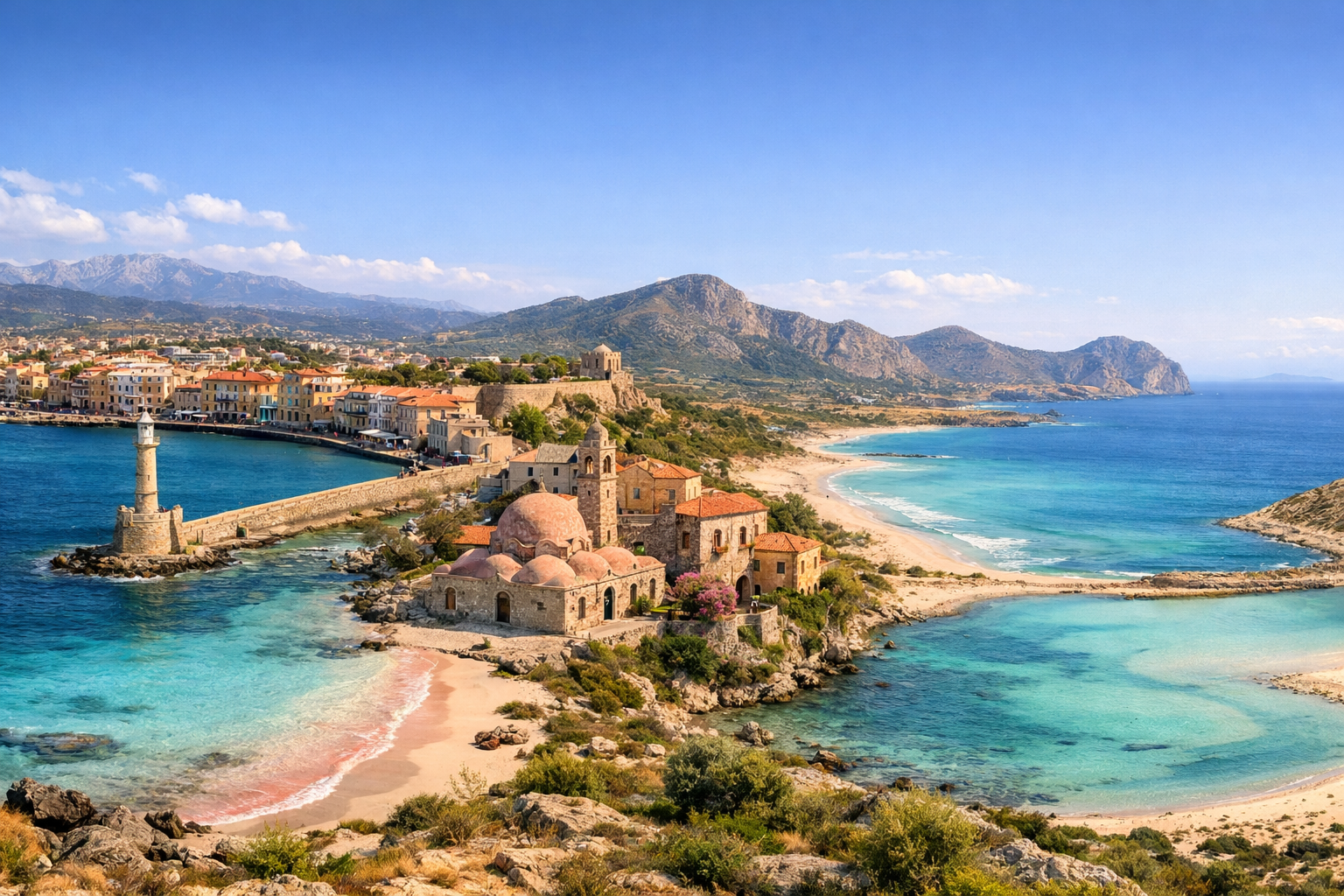
Greece, the island of Crete. A beach trip around Chania with relaxation on the beaches of Elafonissi, Falassarna, and Balos, walks through the old town, and drives along the western coast.

Greece, the island of Crete. A beach trip around Chania with relaxation on the beaches of Elafonissi, Falassarna, and Balos, walks through the old town, and drives along the western coast.

Discover western Crete through Chania, where Venetian lanes and harbor views set the tone for slow island days. From the pink-tinged sands of Elafonissi to the wide sunsets of Falassarna and the striking lagoon at Balos, this beach escape blends effortless relaxation with scenic drives along Crete’s rugged coast.

🧭 DAY-BY-DAY ITINERARY

Ready-made country and city routes with daily plans, sights, transport and accommodation. Buy PDF guides for independent travel.

🧭 DAY-BY-DAY ITINERARY


Day 1 — Chania: the old town, Venetian harbor, and the first day by the sea

  • ✈️ Arrival at Chania Airport and transfer to the city. The center is easy to reach by KTEL bus or a pre-booked transfer; the trip usually takes about 30–40 minutes, depending on traffic and time of day. For a beach itinerary, Chania is especially convenient as a base: from here, it is realistic to make day trips to Elafonisi, Falasarna, and the Balos area without constantly changing hotels.

  • 🚶 Chania Old Town is one of the most atmospheric places in Crete, where Venetian facades, Ottoman details, narrow stone alleys, and sea light create a very cinematic impression. Start your walk at the Venetian Harbor and lighthouse, then slowly wander into the quarters behind the waterfront: there are many houses with wooden balconies, quiet courtyards, workshops, cafés, and small squares. This is not an open-air museum in the sense of being “perfectly restored,” but a living old town with everyday life, flowers in the windows, laundry on the balconies, and a constantly changing rhythm. In the evening the harbor is especially beautiful, when the stone and water take on warm golden tones, and a walk along the sea becomes a gentle introduction to the whole beach holiday ahead.

  • 🏖️ For the first swim, it is best to choose the city beach of Nea Chora. This is a practical and safe start to the route: it is easy to walk there from the center, the entry into the water is usually clearer and calmer than on the wild open stretches of the western coast, and nearby there are tavernas, showers, sunbeds, and shade from umbrellas. Even if the sea at the farther points on the route is windy that day, Nea Chora often remains a sensible backup option. At the same time, do not expect a “bounty picture”: this is a city beach, but it is very convenient for acclimatization, a short rest after the flight, and a first sunset by the water.

  • 🌊 Important beach logic for the whole route: the west and southwest of Crete are sensitive to wind, so conditions at each beach can differ noticeably even on the same day. In the warm season, the water is usually most comfortable for long swims from late spring to early autumn, but the actual feeling depends on the wind, waves, and time of day. On open beaches like Falasarna there may be surf, while in shallow lagoons like Elafonisi the water warms up quickly, but the sun is very strong there and natural shade is limited. Before every trip, you should check the wind forecast, flags, local warnings, and sea conditions, and if there is a red or prohibiting signal, do not go into the water.


Day 2 — Elafonisi: pink sand, lagoon, and careful swimming

  • 🚌 It is best to plan the trip from Chania to Elafonisi early in the morning. KTEL has direct seasonal buses, and you should allow about 1.5–2 hours each way; by car it is comparable, but with more flexibility for stops. The route goes through the western part of Crete and gradually leads into more open and dry landscapes, so the road itself becomes part of the experience.

  • 🏖️ Elafonisi is not just a beach, but a large coastal area with a lagoon, sandbars, very shallow transparent water, and distinctive pale pink shades of sand and crushed shells. The main charm of the place is that you can not only swim here, but also wander for a long time through the warm water, moving between patches of sand and shallows. In good weather, the sea looks almost unreal in color: from pale turquoise to bright azure. But Elafonisi should not be seen as an “always perfectly calm postcard”: it is a protected natural area, very popular in high season, and in strong wind or with large crowds, the feeling of seclusion quickly disappears.

  • 🌊 For a beach day here, safety details matter. The inner lagoon is often suitable for calmer swimming and relaxing with children thanks to the shallow water, but on the outer sections and in more open water the conditions can be completely different: stronger wind, more noticeable waves, and in some places a current. It is better to stay in clear and visible areas, not walk far over rocky sections barefoot, and not underestimate the shallows: the surface looks “tame,” but behind the calm picture the wind and water conditions can change quickly.

  • ☀️ Practical tip for the day: there is little natural shade at Elafonisi, so an umbrella, water, sun protection, and footwear for short walks over hot sand are highly desirable. There is infrastructure in season, but at peak hours the beach gets very crowded, so it is better to arrive early, swim in the first half of the day, then take a long lunch break, and only after that return to the water. In the evening — return to Chania.

Day 3 — Chania without rushing: sea by the city, old quarters, and rest between longer trips

  • 🚶 After the long trip to Elafonisi, it makes sense to have an easier day without major transfers. The morning can begin with a walk through the Splantzia district, the Jewish quarter, the inner lanes of the old town, and the waterfront toward Firka Fortress. Chania is especially good at a slow pace: here there is no need to “finish off a checklist of sights”; it is more interesting simply to dissolve into the rhythm of the city, watching how the historical layers — Venetian, Ottoman, Greek — can be read directly in the architecture.

  • 🏖️ For a beach-style day, Agioi Apostoloi or Chrissi Akti west of the center are ideal. These are convenient city and suburban beaches that are easy to reach by bus, taxi, or even, if you wish, by a long walk/short ride. Their advantage is simpler logistics, organized sections, cafés, sunbeds, showers, and the possibility to choose a bay according to the actual wind. If there are waves on the open coast, these semi-sheltered spots often turn out to be the best solution for swimming.

  • 🌴 Agioi Apostoloi is good because it is not one long open shore, but several coves between which you can switch depending on sea conditions. For a beach trip, this is a very valuable quality: if the wind strengthens on one side, swimming on the other may be noticeably more comfortable. Chrissi Akti is wider and roomier, but in windy weather its openness is felt more strongly. In both cases, you should not rely only on the “picture” in the morning — the sea can change by midday, so it is useful to assess the flags, the surf, and the behavior of local swimmers.

  • 🌇 In the evening, leave time for the old harbor, ice cream, or dinner by the water. A day like this is no less important to the route than the famous beaches: it reduces travel fatigue, gives the body time to recover from the sun, and allows you to feel Chania not as a transit base, but as a full part of the vacation.

Day 4 — Falasarna: a wide sandy shore and one of Crete’s best sunset seas

  • 🚌 A trip to Falasarna from Chania is also possible by KTEL bus; the journey usually takes about 1.5 hours, by car about the same or slightly less depending on the starting point and stops. This is one of the most convenient “big beach” destinations in western Crete if you want a long sandy shore and a more open sea landscape.

  • 🏖️ Falasarna is sharply different from Elafonisi. There is less lagoon softness here and more of the feeling of a true open sea: a wide beach, a long strip of pale sand, space, horizon, and wind. The water color is also impressive, but the character of the beach is different — more energetic, sometimes more severe. On a calm day this is one of the best beaches in the region for long swims and walks along the water’s edge; on a windy day it can turn into a place with noticeable waves and a surf zone, where a more cautious approach is needed.

  • 🌊 That is exactly why Falasarna requires attentiveness. You should not promise yourself “definitely a whole day in perfectly flat sea”: its open exposure makes the beach sensitive to winds, and the waves here are not always decorative, but quite real. If the sea is rough, it is better to limit yourself to short entries near the shore, not swim far, and use the day more as a beach-and-viewpoint day than for sporty swimming. But in moderate conditions, the transparent small waves, sunset light, and the scale of the landscape are especially beautiful here.

  • ☀️ Infrastructure on the organized sections is usually available in season, but natural shade is limited, and the sandy space is very exposed to the sun. The ideal rhythm is an early arrival, swimming before peak heat, a long lunch and rest break, then returning to the sea closer to evening. If you have a car, you can stay for sunset: Falasarna is considered one of the most beautiful sunset beaches in western Crete. After sunset — drive back to Chania.

Day 5 — Balos: lagoon, cruise from Kissamos, and a day that requires checking the wind

  • ⛴️ A day at Balos is best planned via Kissamos and the official sea cruise. From Chania, you can get to Kissamos by KTEL bus or by car in about 45–60 minutes, then transfer to the boat. This is the most realistic and widely used option for an ordinary traveler. It is important to keep in mind that sailings and even the possibility of going out to sea depend on weather and wind, so Balos is not the kind of day you should consider “absolutely guaranteed” without rechecking the day before and in the morning.

  • 🏖️ Balos is one of the most photogenic places in Crete: a pale sandy spit, a turquoise lagoon, color transitions from milky blue to rich emerald, and the famous feeling that the sea here looks painted in watercolor. But in reality, Balos is not a resort beach with urban infrastructure, but a natural area with a wilder logic. There is no point expecting lots of amenities, shops, and full “beach service” on the level of city coves.

  • 🌊 In terms of safety and comfort, Balos requires a realistic assessment of conditions. The lagoon part often looks very calm and shallow, however weather during sea excursions can change, and your return depends on the boat schedule. In strong wind, boarding, the crossing, or the stay itself may be less comfortable than the photos suggest. If you are prone to seasickness, it is better to prepare in advance. For swimming here it is especially important not to go far, not to ignore the crew’s instructions, and to keep in mind that in some places the bottom and depth change gradually, but not always equally conveniently.

  • 🎒 For Balos, it is worth bringing water, a hat, sun protection, and as few extra things as possible. There is little shade, the day is long, and the route is tied to the boat’s departure and return. If sea conditions are unfavorable and the cruise is canceled, the best replacement for the same day is a calm beach rest around Kissamos or a return to the urban coves near Chania, rather than trying at any cost to find questionable workaround options.

Day 6 — Western coast by car: Kissamos, coastal stops, and a flexible beach day

  • 🚗 This day is best suited to a car or a pre-booked private transfer, because the point of the route is not one place, but a chain of stops along the western coast. If you rent a car, today is ideal for exploring the Kissamos area, the coastal stretches along the way, and choosing a beach based on the actual weather rather than a rigid bus schedule. For Crete, this is a very sensible strategy: the sea dictates the plan more strongly than the map.

  • 🏖️ You can build the day like this: in the morning drive to Kissamos, take a short walk along the waterfront and have a coffee, then choose one of the coastal spots farther west or north depending on the wind. If Falasarna was too wavy the previous day, you can return here for a shorter swim. If you want a calmer scenario, it is better to look for sheltered sections closer to coves and town beaches. A day like this is especially valuable because it lets you adapt to the reality of the sea, rather than to the expectation of “definitely seeing everything.”

  • 🌿 On the way, you can add not only the sea, but also short panoramic stops, villages, or wineries/tavernas on the return. Western Crete is beautiful precisely in motion: dry hills, olive groves, steep descents to the water, small churches, pale stone, and the constantly changing shade of the sea. This is not a “city sightseeing” day, but a route of sensations — salty air, hot wind, coffee in a small port, and a slow return to Chania by evening.

  • ⚠️ If you are driving, you should not plan an overly packed schedule with several mandatory swims and a long dinner after sunset far from the city. Roads in western Crete are winding in places, and fatigue after sun and sea builds up unnoticed. It is better to choose 2–3 quality stops, keep a запас of water and time, and preserve the day as relaxed rather than record-breaking in the number of places.

Day 7 — Halepa, a museum finale, and farewell sea in Chania

  • 🏛️ It is good to dedicate the last day to a calmer pace: the Halepa district, the Archaeological Museum of Chania, and a farewell walk by the sea. After several beach days, this kind of finale works beautifully — it ties the vacation into a complete story, where Crete is remembered not only for its lagoons and sand, but also for the depth of its culture. The new Archaeological Museum of Chania is located in the historic Halepa district and helps you see western Crete not just as a resort, but as a place with a very long memory — from prehistoric eras to antiquity.

  • 🚶 Halepa differs from the Old Town in atmosphere: there is less tourist density and more of a feeling of an old aristocratic suburb with mansions, diplomatic history, and quiet streets above the sea. After the museum, you can walk to the water, pause for coffee, and then decide depending on your energy whether you want one more swim. If you want a final beach accent, choose the easiest and clearest option near Chania — Nea Chora, Agioi Apostoloi, or Chrissi Akti — depending on the wind and your flight time.

  • 🌊 Final beach tip for the whole route: in Crete, flexibility is more valuable than a rigid list. Even in peak season, water temperature, waves, currents, drifting seaweed, the presence of jellyfish, visibility in the water, and transport availability can change very quickly. The most successful beach days usually belong to those who check actual conditions in the morning, respect flags and warnings, and are ready to replace an open location with a more sheltered one.

  • ✈️ Transfer to the airport and departure. If the flight is early, it is better not to overload the last day with long trips. If the departure is in the evening, you can leave only a light walk and a short swim without the risk of being late because of traffic, heat, or changes in the transport schedule.

Flight tickets

eSIM for travel

Buy PDF guide

Buy PDF guide — 14.90 USD

PDF — 14.90 USD