
Buy PDF guide

Buy PDF guide — 12.90 USD

PDF — 12.90 USD

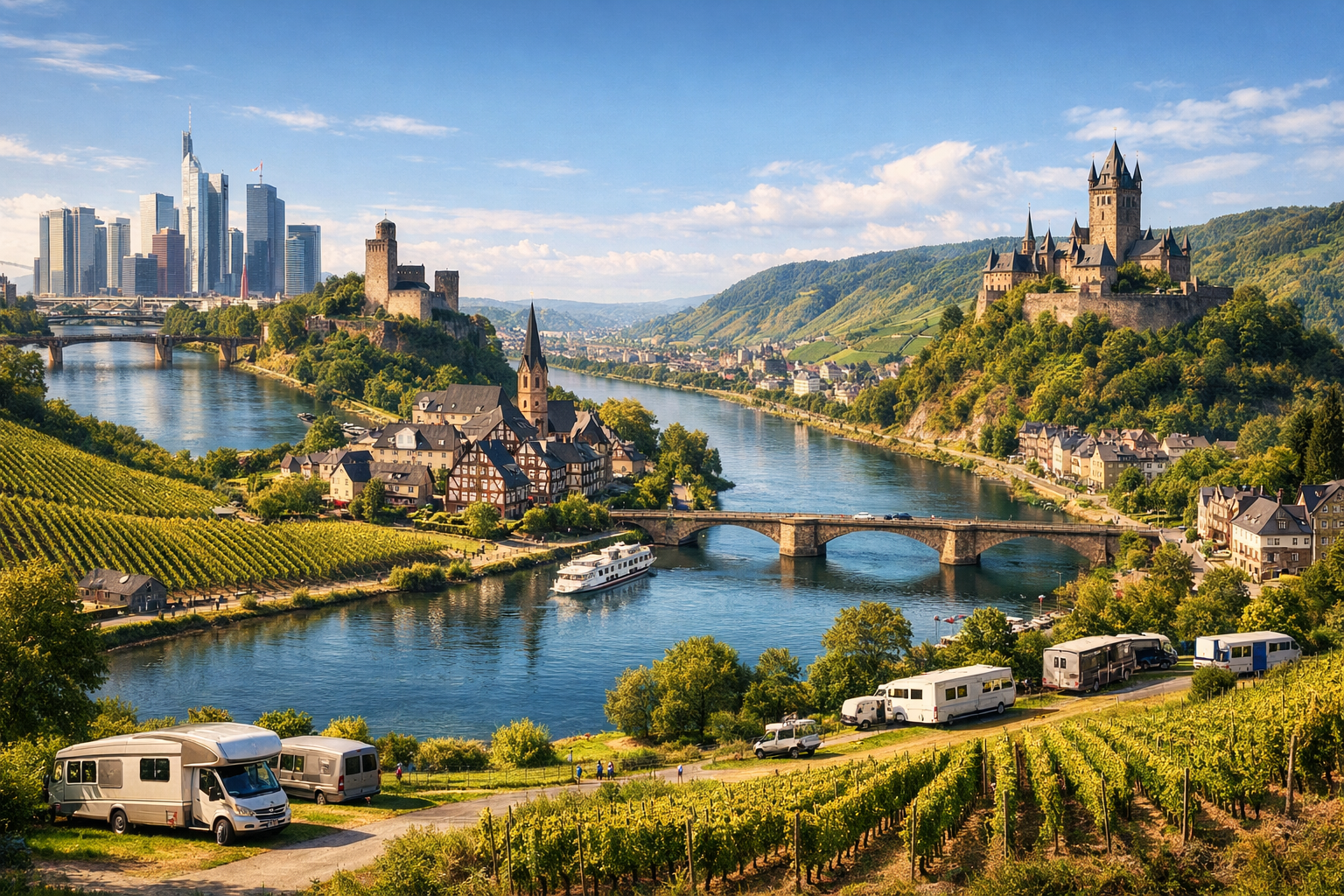
Germany along the wine roads - Frankfurt - Rhine - Moselle - Trier - Campsites by the rivers, winery stopovers, parking lots by castles

Germany along the wine roads - Frankfurt - Rhine - Moselle - Trier - Campsites by the rivers, winery stopovers, parking lots by castles

Follow the wine roads from Frankfurt through the Rheingau, along the castle-crowned Middle Rhine and the looping Moselle all the way to historic Trier. Sleep by the rivers in peaceful campsites, pause at welcoming wineries, and wake up beside hilltop castles in one of Germany’s most scenic road trips.

🚗 DAY-BY-DAY ROUTE

Ready-made country and city routes with daily plans, sights, transport and accommodation. Buy PDF guides for independent travel.

🚗 DAY-BY-DAY ROUTE


Day 1 — Frankfurt → Rüdesheim am Rhein: a gentle start through the Rheingau

  • 🚗 Start in Frankfurt, where it is convenient to pick up the car at FRA airport and leave the city westbound toward the Rheingau. Finish in Rüdesheim am Rhein. Roughly 48 km, pure driving time about 45–55 minutes. Main stops along the way: a short pause in Wiesbaden or by the vineyards of Eltville, then entry into the Rheingau via B42/B42a with beautiful views of the Rhine. In Rüdesheim, it makes sense to leave the car in a city parking lot and explore the old center, Drosselgasse, and the promenade on foot. If you want a “castle-like” accent already on the first day, you can go up to Niederwald-Denkmal and the viewpoints above the river. Overnight stay — in Rüdesheim: a hotel in the historic center or the official riverside campsite Campingplatz Rüdesheim am Rhein. Road nuances: after picking up the car, check the Umweltplakette emissions sticker, especially if you plan to enter major cities; in the old center of Rüdesheim the streets are narrow, so it is better not to try driving right up to the hotel without confirmed parking. The day is realistic for an average driver: a short transfer after the flight, straightforward roads, minimal stress, and an early immersion into the wine region.


Day 2 — Rüdesheim → Bacharach/Trechtingshausen → Braubach/or back to Rüdesheim: a day of Middle Rhine castles

  • 🚗 It is convenient to make both the start and finish of the day from Rüdesheim, with a loop outing through the Middle Rhine. Approximate mileage is 55–65 km depending on the ferry and the chosen bank, with pure driving time of about 1–1.5 hours. Main stops: the Bingen–Rüdesheim car ferry for a scenic change of riverbanks, Burg Rheinstein or Burg Reichenstein near Trechtingshausen, then Bacharach or Braubach with a view of Marksburg. This is not a day for a long haul, but for a relaxed scenic drive along the UNESCO section of the Upper Middle Rhine Valley. It is best to park in official parking lots near the towns and castles, rather than trying to leave the car in narrow roadside pull-offs on B9/B42. Road nuances: the ferry schedule may change depending on weather and demand, so it is better to treat it as a beautiful option rather than a strict deadline; along the Rhine there are many photo points, but you should stop only where it is clearly allowed. Overnight stay again in Rüdesheim — this keeps the route compact and comfortable. The day is realistic because the drives are short, the castles are logically arranged along the river, and the driver does not get tired from constantly changing bases.

Day 3 — Rüdesheim → Burg Eltz → Cochem: transition from the Rhine to the Moselle

  • 🚗 Today the route is already noticeably more road-focused, but still comfortable: start in Rüdesheim, finish in Cochem on the Moselle. Roughly 135–145 km, pure driving time about 2–2.5 hours. Main stops: approach Burg Eltz via Wierschem and walk from the parking lot to one of Germany’s most cinematic castles, then enter the Moselle valley and enjoy evening Cochem with views of the vineyard slopes and Reichsburg. Burg Eltz has official parking areas; the website lists the navigation address as Burg Eltz, Wierschem, parking is paid, and a shuttle runs from Parkplatz 1 about every 10 minutes. This is important: you do not drive up to the fortress itself, vehicles are left only in the parking lot. In Cochem, it is convenient to check into a hotel with river views or a campsite/parking area near the Moselle in the evening. Road nuances: the local roads to Eltz are narrower and more wooded than along the Rhine, but not extreme; in wet weather and at dusk it is better to drive calmly because of cyclists, tourists, and limited visibility. The day is realistic: one main transfer, one major castle stop, and an early arrival in Cochem without night driving.

Day 4 — Cochem and the wine bends of the Moselle: Bremm, Beilstein, or a leisurely day by the river

  • 🚗 Start and finish — Cochem. Mileage 45–60 km, pure driving time about 1 hour. This is the ideal wine day by car, with short outings and plenty of stops. Main points: Reichsburg Cochem in the morning, then one or two calm drives along the river — for example, to Beilstein for an almost “postcard-perfect” village and wine terraces, or to Bremm and its famous steep Calmont vineyards, but without extreme uphill driving. On the way, you can choose small winery stops and official parking areas by the promenades, so you do not have to try parking on the narrow streets of old villages. If you want a more active option, you can replace one wine stop with the Geierlay Suspension Bridge in the Hunsrück: there is an official visitor parking lot from Mörsdorf, and then you will have to walk to the bridge. Overnight stay — in Cochem, so there is no need to unpack the suitcases. Road nuances: Moselle roads are scenic but narrow, often with bicycle traffic and local restrictions in villages; in summer, parking in central Cochem fills up earlier, so it is better to arrive at Reichsburg before the peak middle of the day. The day is realistic for an average driver because these are radial outings with the option to easily shorten the program depending on how you feel and the weather.

Day 5 — Cochem → Trier: Roman heritage and the wine capital of the Upper Moselle

  • 🚗 Start — Cochem, finish — Trier. Roughly 80–90 km, pure driving time about 1.25–1.5 hours through the Moselle valley. Main stops: a scenic transit through the valley with a stop in Bernkastel-Kues or at one of the riverside viewpoints, then arrival in Trier — Germany’s oldest city with a powerful Roman layer. After checking in, it is best to leave the car in the hotel parking lot or a city car park and continue on foot to Porta Nigra, Hauptmarkt, Dom, and Kaiserthermen. The Trier Tourist Information website has a separate section on parking, which is convenient for planning in advance. Overnight stay — in central Trier or at a riverside campsite in the Konz area where the Saar and Moselle meet, if you want a more nature-based base. Road nuances: in Trier, as in other historic cities in Germany, it is better to check parking before entering the center; you do not need a car for the city sightseeing itself. The day is realistic: a short transfer, early arrival, and a full evening in the city without exhausting time behind the wheel.

Day 6 — Trier → Frankfurt: a calm return via the autobahns

  • 🚗 Final day — return from Trier to Frankfurt or directly to FRA airport. Roughly 185–195 km, pure driving time about 2.25–2.5 hours, usually via A1/A60/A61/A3 or similar combinations depending on traffic. Main stops: morning coffee and a short farewell look at the Moselle, then a service stop on the autobahn for fuel and car return in Frankfurt. If the flight is not early, you can add a short lunch stop around Mainz or Wiesbaden, but without overloading the day. Road nuances: in Germany many autobahns are free for passenger cars, but even on sections without a formal speed limit it is still wise to keep a reasonable speed; closer to Frankfurt there may be dense traffic and roadworks, so for the car return it is better to allow at least 1.5–2 hours of buffer before the rental deadline or flight. Before returning the car, fill the tank according to the full-to-full policy and photograph the bodywork. The day is realistic because it is one straightforward motorway transfer without trying to squeeze in major new sights on departure day.

Flight tickets

eSIM for travel

Buy PDF guide

Buy PDF guide — 12.90 USD

PDF — 12.90 USD