
Buy PDF guide

Buy PDF guide — 8.90 USD

PDF — 8.90 USD

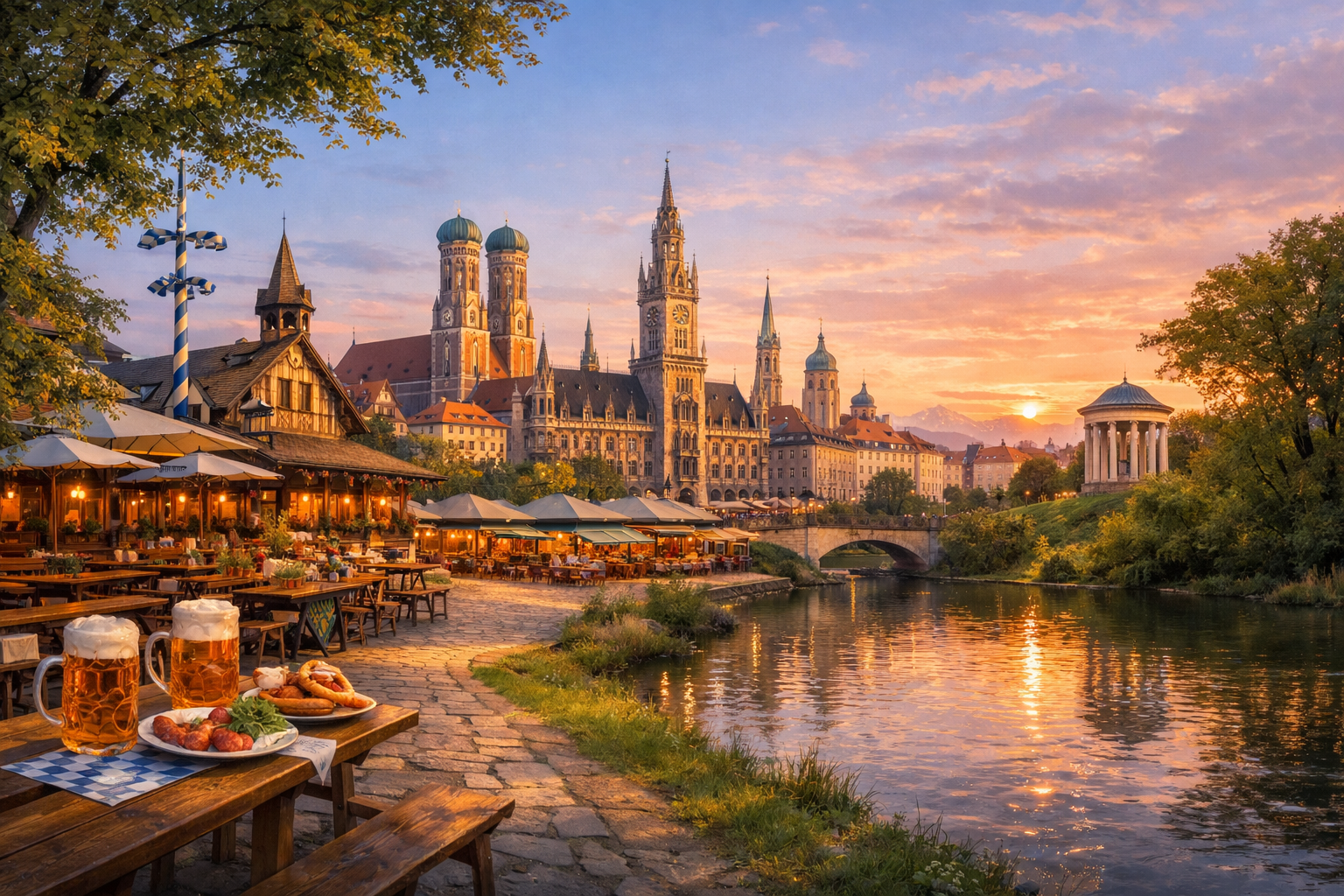
Germany, Munich. Munich through beer culture — historical beer traditions, beer gardens, Bavarian cuisine, markets, the English Garden, and peaceful evening walks.

Germany, Munich. Munich through beer culture — historical beer traditions, beer gardens, Bavarian cuisine, markets, the English Garden, and peaceful evening walks.

Munich blends centuries-old beer traditions with leafy beer gardens, bustling markets, and hearty Bavarian cuisine. Spend the day wandering through the English Garden and lively old streets, then ease into a peaceful evening with a local brew as the city slows to a glow.

🧭 DAY-BY-DAY ROUTE

Ready-made country and city routes with daily plans, sights, transport and accommodation. Buy PDF guides for independent travel.

🧭 DAY-BY-DAY ROUTE


Day 1 — Old Munich: beer history, Viktualienmarkt, and Hofbräuhaus

  • 🚆 It is convenient to plan your arrival in Munich via MUC Airport: the quickest and calmest way to the city center is by S-Bahn on lines S1 or S8 to Marienplatz or Hauptbahnhof, and the trip usually takes about 35 minutes. For your arrival day and city travel, the Airport-City-Day-Ticket is a convenient option, as it covers the journey from the airport and travel around the city for the rest of the day. You do not need a car for this route: central Munich is very comfortable for walking, and after beer tastings you should choose only walking, public transport, or a taxi.

  • 🚶 Start your route at the Bier- und Oktoberfestmuseum, located at Sterneckerstraße 2. This is one of the best entry points into the subject of Munich brewing: the museum explains not only beer making as a craft, but also how Munich became the “beer capital,” why Oktoberfest became such an important cultural phenomenon, and how the city’s dining traditions changed over time. The exhibition is especially good because it connects everyday history, economics, festivals, and urban identity into one vivid story. For friends and couples, this place works as a gentle introduction to the entire tour: first you understand the context, and only then do you consciously taste the flavors of the city. The museum is usually open Monday to Saturday from 11:00 to 19:00, closed on Sundays and public holidays, and tours and tastings are best booked in advance.

  • 🚶 After the museum, walk about 8–10 minutes to Viktualienmarkt, the main gastronomic market of old Munich. This is a very important stop specifically for a beer-focused route: here you can clearly read everyday Bavarian cuisine, which has historically gone hand in hand with beer. In the shops and at the stalls, you can assemble the perfect “pairing board” for future tastings: obazda, radish, cheeses, meat delicacies, pretzels, and seasonal snacks. The market atmosphere is especially pleasant in the warm season: lots of light, lively city sounds, and the feeling that Munich eats and relaxes without rushing. It is a good place for an early lunch without overdoing it: white sausages, a light snack, and a soft drink or one small serving of beer if you still have a full program ahead.

  • 🚶 In the second half of the day, walk 7–10 minutes to Hofbräuhaus München, Platzl 9 — the city’s most famous historic beer hall. Yes, it is touristy, but it should not be skipped on a first introduction: this is where you especially feel the scale of Munich’s beer culture, its rhythm, music, huge halls, the collective energy of long tables, and the classics of a Bavarian feast. Officially, the restaurant is open daily from 11:00 to 00:00, the kitchen usually until 22:00, and the last drink service until 23:30. If you want a more comfortable evening visit, it is better to reserve a table in advance, especially from Thursday to Sunday and in high season. Here it is worth trying one of the house classics — the pale lager Hofbräu Original, the dark Dunkel, or the wheat Weisse — but do not turn the visit into a marathon: it is better to choose one or two carefully selected samples per person and focus on the experience.

  • 🌆 End the day with a calm walk around the Platzl area and toward Maximilianstraße or along the quiet streets of Altstadt-Lehel. This is a good evening not for rushing, but for enjoying the city after first meeting its beer legend: stone facades, soft light, the echo of footsteps in the old center, and the pleasant aftertaste of a classic Munich evening. After visiting a beer hall, do not use a car or motorcycle — it is better to walk back to the hotel, take the U-Bahn/S-Bahn, or call a taxi.


Day 2 — Augustiner, Bavarian cuisine, and an evening at Augustiner-Keller

  • 🚶 Start the morning without an early tasting: after a substantial first day, it is better to opt for a light pace and a good breakfast, then head to Augustiner Stammhaus, Neuhauser Straße 27, in the central pedestrian zone. The history of Augustiner is especially important for understanding Munich: it is the city’s oldest brewing tradition, and for many locals Augustiner is associated with the most genuinely “their own,” unpretentious, and very Bavarian style of beer-focused Munich. The Stammhaus combines a restaurant, a historic atmosphere, and a rare sense of continuity — as if you did not simply come for a drink, but stepped into a long-running urban ritual.

  • 🍽️ At midday, take a substantial gastronomic break at Augustiner Stammhaus. According to official information, the restaurant section usually operates Monday to Saturday from 11:00 to 00:00 and Sunday from 11:00 to 22:00; the beer hall has a separate schedule and may be closed on Sundays, so it is best to check the seating format in advance. This is an especially good place to try beer together with food: Augustiner Helles opens up next to roast chicken, schnitzel, or a classic Bavarian plate, while richer options pair more interestingly with roast dishes, sausages, or cheese-based dishes. For friends, it is convenient to order different styles and exchange small sips, while for couples, a slow tasting with one set of snacks for two works well.

  • 🚶 After lunch, leave 2–3 hours for rest, shopping in the center, or a short walk through the old streets without alcohol. This is an important part of an easy route: a beer tour should not be a nonstop succession of mugs. Munich reveals itself better when there are pauses between visits, along with water, coffee, and calm city air. If you want to add some cultural context, you can walk to the outside of Frauenkirche, the courtyards of the Residenz, or simply sit unhurriedly in a square overlooking city life.

  • 🍺 In the evening, head to Augustiner-Keller, Arnulfstraße 52 — one of Munich’s most beloved venues in the beer garden + historic hall format. From the center it is easy to get there by public transport in 10–15 minutes or by taxi in a short ride; from Hauptbahnhof the trip is especially simple. According to official information, the beer garden usually operates from 11:00 to midnight, and the restaurant from 10:00 to 01:00, but the garden schedule may depend on the weather and occupancy, so it is best to check the current status before you go. This is exactly the place where you most clearly understand the difference between a tourist postcard and a real local habit: chestnut trees, long tables, unhurried conversations, evening air, and a very natural coexistence of food, beer, and a strolling mood.

  • 🌙 For the evening here, it is ideal to order one Augustiner variety from the wooden cask or a classic pale lager, add some Bavarian snacks, and not rush. If you are traveling from May to October, evenings like this become the heart of the trip: not a noisy bar marathon, but a gentle beer garden experience that brings together friends and couples. After dinner, return only by public transport, on foot, or by taxi. Avoid driving completely after tastings.

Day 3 — The English Garden, Chinesischer Turm, and Giesinger Bräu

  • 🌿 This day is best devoted to a fresher, more walkable side of Munich. Start with the English Garden — one of Europe’s main urban parks and a key stage for open-air beer culture. The point of this stop is not only the greenery: it is here that you most clearly see how beer in Munich is connected not so much with nightlife itself as with daytime relaxation, summer, meetings, conversation, and urban freedom. In the park, it is pleasant to walk slowly, without a fixed program, pausing by the avenues, meadows, and water.

  • 🍺 The main point of the day is Biergarten am Chinesischen Turm, Englischer Garten 3, 80538 München. This is one of the city’s most famous beer gardens, seating thousands of guests and functioning like a large summer living room under the trees. According to official information, in good dry weather it is usually open: from 11:00 Monday to Friday, and from 10:00 on weekends; in cold or unstable weather the schedule may change, and sometimes only the kiosk operates. So for a May–October route it is an excellent stop, but before heading out you should definitely check the current hours. There is no need for a heavy tasting here: one mug or a small serving of beer is enough to feel the beer garden culture itself — democratic, sunny, friendly, and very Munich.

  • 🚶 After the beer garden, take a long relaxed walk through the English Garden. For friends, this is a great moment for conversations and photos; for couples, one of the most beautiful gentle scenes of the whole tour. You can walk toward Kleinhesseloher See, sit by the water, and let your body rest after the lunchtime tasting. This rhythm helps avoid overloading the route with alcohol and preserves exactly that sense of balance that makes Munich in summer worth the trip.

  • 🍺 In the evening, switch to a more modern urban beer scene and head to one of the Giesinger Bräu Stehausschank locations. The most convenient for this route is Sendlinger-Tor-Platz 10, where the venue usually operates daily from 12:00. The format here is different: this is no longer a grand historic beer hall or a classic shady garden, but a livelier, more urban, modern way to drink local Munich beer. Giesinger is interesting because it shows a new wave of urban craft-regional identity: respect for the Bavarian foundation, but with freer presentation and a more contemporary audience.

  • 🚶 Go there by U-Bahn, tram, or taxi, and after the tasting return the same safe way. You can finish the evening with a short walk around the Sendlinger Tor area and then toward Asamkirche or the quiet streets of Glockenbachviertel. If you want to drink responsibly, keep to a simple rhythm: water between servings, food before and after, do not mix too many styles in a row, and keep the total volume moderate. In Germany, drinking alcohol in public places is culturally acceptable, but moderation is what makes this kind of tour truly enjoyable.

Day 4 — Theresienwiese, festival culture, and a final Munich evening

  • 🎡 Dedicate the last day to the festival dimension of Munich beer. Start in the Theresienwiese area and thoughtfully walk through the space where Oktoberfest takes place. Even outside festival dates, this place functions as an important cultural stage: here it is easiest to understand the scale of the phenomenon and how the city festival, breweries, music, costume, food, and collective memory turned into one of Bavaria’s most recognizable symbols. If you are planning your trip specifically for festival season, keep in mind: the official Oktoberfest 2026 runs from September 19 to October 4. During festival days, logistics change radically, bookings are needed in advance, and visits to the tents are best planned with precise time slots and backup options.

  • 🏛️ For the daytime program nearby, Deutsches Museum Verkehrszentrum, Am Bavariapark 5, 80339 München, is an excellent fit. Formally, it is not a beer museum, but it helps make the fourth day lighter and more varied: here you can take a break from tastings while also seeing important urban context in mobility and infrastructure, without which modern festival Munich would not exist. The museum is usually open daily from 09:00 to 17:00. It combines well with a walk through Theresienhöhe and the surrounding area, and in bad weather it is an especially strong backup option.

  • 🍽️ For a final late lunch or early dinner, return to the center and choose a calmer format of traditional Bavarian cuisine with good beer than on the first day. If you want to end the tour classically and in a convenient location, you can once again choose the Platzl area and focus not on a “must-do checkbox,” but on the taste: order a regional helles again, try a seasonal variety, or emphasize non-alcoholic beer if by the fourth day you need a gentler rhythm. For friends, this is a good moment to sum up favorite styles, and for couples, to arrange a beautiful final dinner in the center of the old town.

  • 📌 If your trip falls in the second half of September or early October, the fourth day can be adapted to Oktoberfest: arrive at Theresienwiese early, avoid peak hours, know in advance that it is harder to enter the large tents in the evening without a reservation, and remember that the first beer serving on opening day begins only after the official ceremonial opening. During the festival period, it is especially important to keep a comfortable pace, agree on a meeting point in advance, and after visiting the tents return only by S-Bahn, U-Bahn, tram, on foot, or by taxi.

  • 🌆 The finale of the journey is a calm evening walk without haste: Isartor, the old streets of Altstadt, the embankments, and the soft light of evening Munich. This kind of ending brings the whole tour together well: you have seen the museum context, historic beer halls, a large beer garden, the modern local scene, the market, the park, and the city’s festival geography. This is exactly the Munich that suits friends and couples best in the May–October season: delicious, green, cultural, and very human.

Flight tickets

eSIM for travel

Buy PDF guide

Buy PDF guide — 8.90 USD

PDF — 8.90 USD