
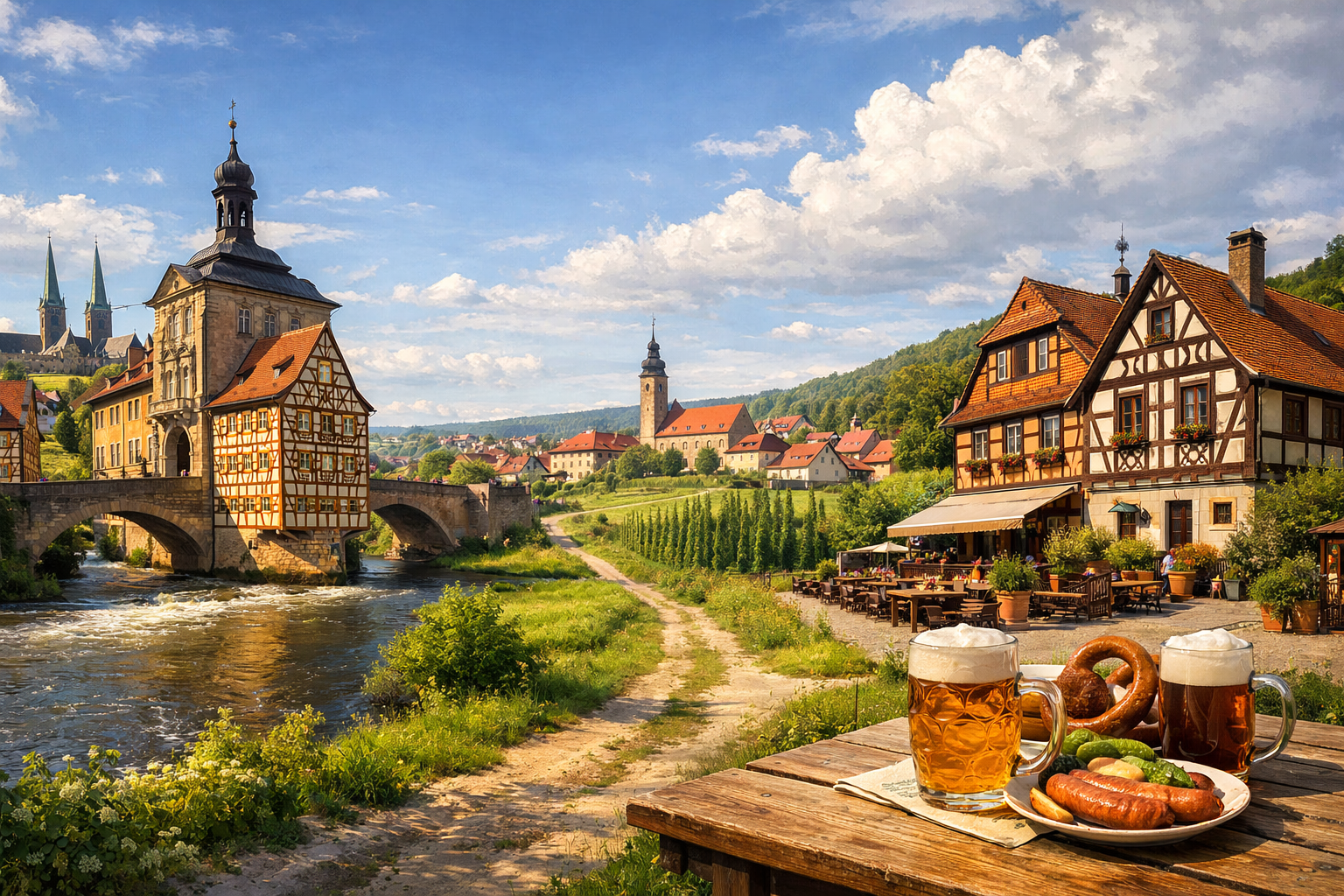
Day 1 — Bamberg: smoked beer, brewing museum, and historic beer taverns
🚶 Begin your introduction to Bamberg as one of the beer capitals of Franconia: this is a rare European city where the old center with its cathedral, bridges, steep lanes, and river views blends with a living beer culture rather than a museum backdrop. What makes it especially interesting here is not simply to “drink beer,” but to feel how brewing has shaped the city’s rhythm, gastronomy, and even the architecture of its neighborhoods for centuries. For this route, it is best to stay in Bamberg itself and get around on foot: that way the day will be full but logical, without rushing and without needing to get behind the wheel after tastings.
🏛️ In the morning, head to Fränkisches Brauereimuseum, Michelsberg 10f, 96049 Bamberg. The museum works especially well as the first stop of the route: it helps “tune your palate” and understand how the Franconian tradition differs from more commercial beer culture elsewhere in Germany. The exhibition covers the craft, old technologies, the evolution of brewing processes, and the role of malt, yeast, barrels, and tavern culture. Its location on Michelsberg adds atmosphere in itself: the way up already feels like a walk through old monastic Bamberg. In the April–October season, the museum usually operates on a limited schedule, so it is best to plan the visit for the first half of the day and definitely check opening hours and tour availability for your date in advance.
🍺 After the museum, walk down into the old town to Schlenkerla, Dominikanerstraße 6, 96049 Bamberg — a legendary historic Rauchbier tavern, without which any introduction to Bamberg would be incomplete. Here you should try the local Rauchbier style itself — smoked beer with the distinctive aroma of smoked malt, in which some notice smoked ham, while others pick up campfire, bread crust, and dried spices. It is important to come here not for a “quick check-in,” but for the full experience: old wooden interiors, the dense Franconian tavern atmosphere, and the feeling that the style lives not in a tasting room but in the city’s everyday culture. If you want a table at a convenient time, especially on Friday, Saturday, and during high season, book ahead.
🚶 Next, it’s a good idea to take an unhurried walk through the streets around Domplatz and the river quarters so there is a natural break between tastings. Bamberg is ideal for exactly this rhythm: short walks, historic facades, bridges over the Regnitz, and small squares help keep the day from becoming overloaded with alcohol and preserve your appetite for the next stops. If you want a cultural pause, you can drop by Historisches Museum Bamberg, Domplatz 7, 96049 Bamberg: this is no longer a beer venue, but a historical framework for understanding the city and its princely, ecclesiastical, and civic identity.
🍺 In the second half of the day, continue with a more “classic” Franconian line at Brauerei-Gasthof Fässla, Obere Königstraße 19-21, 96052 Bamberg. This is a good place to switch from smoky profiles to more traditional regional styles: Lager, Helles, and sometimes stronger seasonal beers. Fässla offers a different angle on Bamberg — less theatrical, more everyday and local. It is an excellent stop for feeling the difference between the smoked specialty and what the region’s residents actually drink as their regular table beer.
🌇 At sunset, finish the day at Spezial-Keller, Sternwartstraße 8, 96049 Bamberg. This is one of the most atmospheric historic beer spots on a hill, where people come not only for the beer but also for the view of the city towers and red-tiled roofs. In spring, summer, and early autumn, it is especially pleasant to sit outside here: this format conveys Franconian Keller culture best, where beer is tied to the garden, the slope, the view, and a long bright evening. Here you can gently compare your impressions of the city’s beer styles, have the final tasting of the day, and then walk back down to your hotel. After tastings, do not use a car or motorcycle: on this route, it makes sense to end the evening only on foot or by taxi.
⚠️ Practical note for the day: in Germany, alcohol consumption is linked to age restrictions; hard liquor requires full legal age, and there are separate rules for beer and wine for younger people, so use 18+ as a safe standard for the entire route. Plan all tastings in moderation: it is better to order 0.3 l pours or share servings between two people, and be sure to alternate with water and food. Before the trip, double-check official opening hours, tour days, kitchen service, venue holidays, and reservation policies — even very famous Franconian beer venues may temporarily close the hall, museum section, or production area.