
Buy PDF guide

Buy PDF guide — 6.90 USD

PDF — 6.90 USD

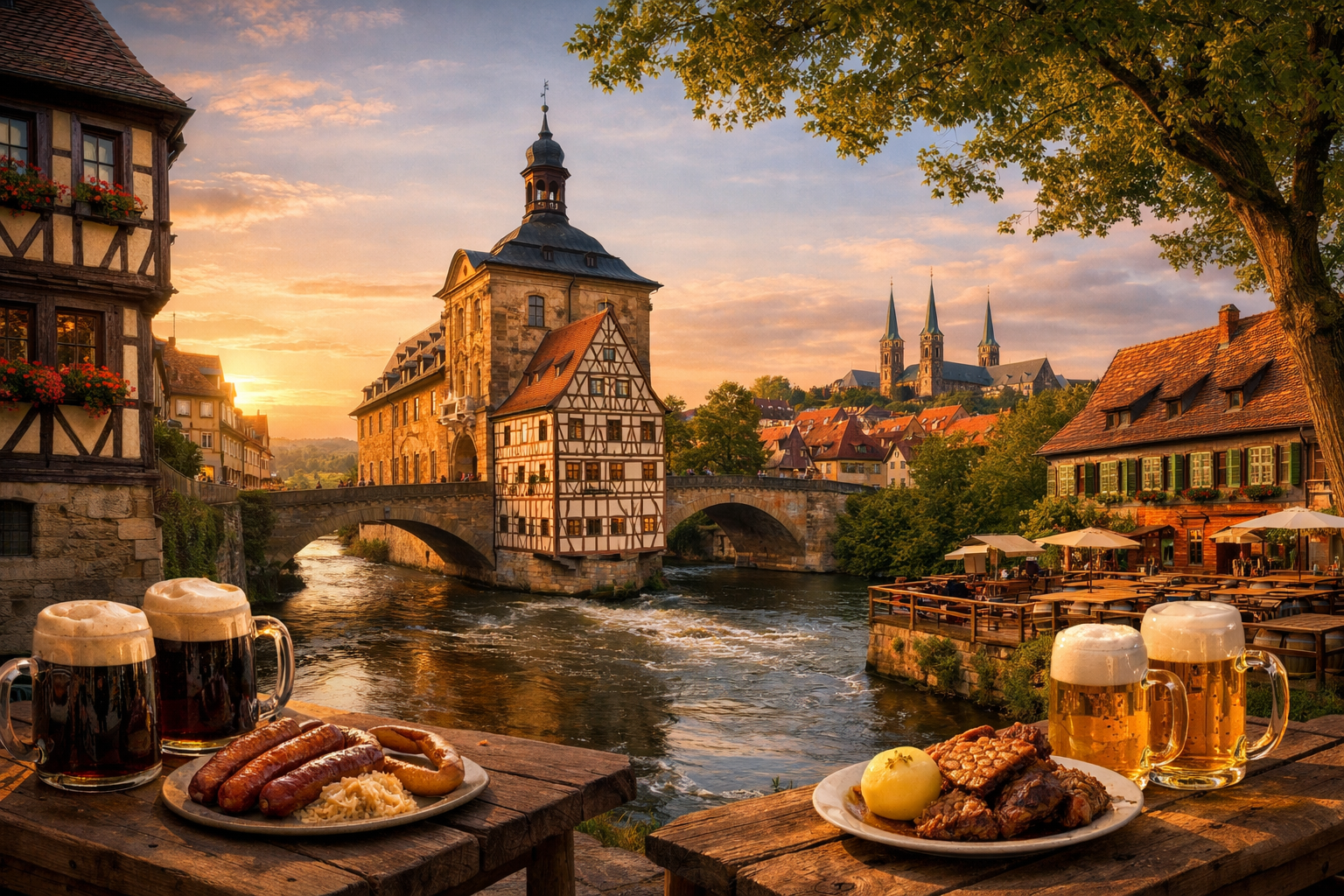
Germany, Franconia. A beer journey through Bamberg with visits to Schlenkerla, Spezial-Keller, and the Fässla brewery, getting acquainted with smoked rauchbier and Franconian cuisine.

Germany, Franconia. A beer journey through Bamberg with visits to Schlenkerla, Spezial-Keller, and the Fässla brewery, getting acquainted with smoked rauchbier and Franconian cuisine.

Wander through Bamberg from its historic lanes to the heights of Michelsberg, where Franconia’s deep-rooted beer culture comes to life. Along the way, discover smoky rauchbier at Schlenkerla, classic pours at Spezial-Keller, and the character of Fässla, all paired with hearty Franconian cuisine.

🧭 ROUTE BY DAY

Ready-made country and city routes with daily plans, sights, transport and accommodation. Buy PDF guides for independent travel.

🧭 ROUTE BY DAY


Day 1 — Bamberg: first introduction to rauchbier, Schlenkerla, and the old town

  • 🚆 It’s best to plan your arrival in Bamberg by train: the city is compact, the historic center is convenient for walking, and for a beer tour this is also the most sensible way to get around. From the station, many hotels and the first beer stops are within a 10–25 minute walk. If you fly in via Nuremberg, it’s convenient to continue to Bamberg by train so you’re not dependent on a car from the very start.

  • 🏨 Check in and take a short rest. For this route, it’s especially convenient to stay either near the station, so you can quickly reach Fässla and the Bahnhof area, or closer to the old town, so you can walk back from the historic beer halls in the evening. After the journey, leave yourself at least 1–1.5 hours for rest, water, and a light snack: rich tastings of Franconian beer are much more enjoyable without rushing.

  • 🚶 During the day, start with a walk through Bamberg’s historic center — a city that is rightly considered one of Franconia’s main beer capitals. Narrow streets, stone facades, church silhouettes, and old taverns create the rare feeling of a living medieval city rather than a museum piece. Bamberg is famous not only for the number of traditional breweries, but also because its local beer culture is woven into the urban fabric: beer here is not a “tourist attraction,” but part of everyday identity.

  • 🍺 The main stop of the day is Schlenkerla, a historic smoked-beer brewery and tavern at Dominikanerstraße 6. This is one of Germany’s most famous beer venues, where Bamberg reveals itself through its signature style — Rauchbier, or smoked beer. The taste is sharply different from a familiar lager: the aroma brings notes of wood smoke, toasted bread crust, ham, caramelized malt, and a dry, almost gastronomic finish. This is exactly the place to understand why rauchbier inspires either instant love or sincere surprise: it does not try to please everyone, but tells the story of an old technique of drying malt over an open fire.

  • 🍽️ At Schlenkerla, it makes sense to order not only a tasting, but also a full dinner. Smoked beer pairs especially well with Franconian cuisine: roast pork, sausages, dumplings, cabbage, rich sauces, and rustic snacks. Such a dinner works as a gastronomic introduction to the region: hearty food softens the alcohol load, while the combination of smoke in the glass and smoke in the flavor of the meat creates a very complete, almost “archival” taste of Franconia.

  • ⏰ Schlenkerla is usually open daily year-round roughly from 9:30 to 23:30, with the kitchen from 11:00 to 22:00, but be sure to double-check official hours, holiday changes, and table reservation options before your trip. For an evening visit, booking is especially advisable: the place is legendary, and in high season or on Fridays and Saturdays the best tables are taken quickly.

  • 🥨 After dinner, take a calm walk through the evening old town: via Cathedral Hill, the lanes around the town hall, or the banks of the Regnitz. On the first day, don’t try to visit all the breweries at once: it’s much better to have one meaningful tasting and save energy for the next two days. Return to the hotel only on foot, by bus, or by taxi. Driving after tastings is excluded on this route.

  • 🔞 In Germany, buying and drinking beer is allowed from age 16, but for most travelers it is safer and simpler to plan the whole tour as an adult gastronomic route 18+. Always carry ID, especially if you look young. The point of this day is not the number of glasses, but getting to know the style, history, and rhythm of local beer culture.


Day 2 — Bamberg: Fässla, Brauerei Spezial, Spezial-Keller, and the Franconian beer panorama

  • 🍺 It’s best to start the morning without alcohol: a hearty breakfast, water, coffee, and an unhurried walk to the area near the station. The first beer stop of the day is Brauerei-Gasthof Fässla at Obere Königstraße 19–21, just a few minutes on foot from the main station. This is one of Bamberg’s classic addresses, where you can especially feel the city’s everyday beer culture: not ceremonial, but alive, working, and very Franconian.

  • 🏭 Fässla dates back to the 17th century and is famous for its traditional Franconian approach to beer and food. Here it’s worth trying not only the house specialties, but also paying attention to the difference between softer malty profiles, pale lager, and the region’s typical dry, highly drinkable style of fermentation and aging. Even if Schlenkerla gave you a bold and smoky start, Fässla is where you understand that beer-loving Bamberg is not limited to one rauchbier: it also has a more “everyday,” friendly face.

  • ⏰ Fässla is usually open Monday to Saturday roughly from 8:30 to 23:00; on Sundays and holidays there is a short morning window without a full kitchen; on weekdays kitchen hours are usually split into daytime and evening blocks. This matters for planning: if you want proper hot Franconian food rather than just beer and snacks, check the official schedule in advance. Outside kitchen hours, the venue may allow a cold snack or your own Brotzeit according to current house rules.

  • 🚶 Then continue the day toward Brauerei Spezial — the second most important name for getting to know Bamberg’s smoky heritage. Together with Schlenkerla, Spezial is considered a guardian of the very old open-fire malt-drying technique, which means the term “Bamberg smoked beer” has a genuinely artisanal rather than marketing basis. If Schlenkerla is often seen as a powerful and iconic symbol, many appreciate Spezial for its softer, finer, and more delicate smokiness.

  • 🍺 A comparative tasting of Schlenkerla and Spezial is one of the most interesting moments of the entire tour. Here you can literally feel how the same historical principle produces two different characters: one beer seems fuller, meatier, and more dramatic, the other drier, subtler, calmer, and almost “tea-smoky.” This is an excellent moment to jot down impressions at a relaxed pace: what feels more gastronomic, what is more drinkable, which style pairs better with a snack, and which is more interesting as a standalone glass.

  • 🌳 In the second half of the day, climb up to Spezial-Keller — a classic Franconian keller and beer garden on a hill. In Franconia, the word Keller is not just a basement, but an entire cultural form: historically, beer was lagered in cool cellars cut into hillsides, and over time open-air gardens for drinking and relaxation grew around them. These places are especially important in summer: under chestnut trees, with a view of the city, a glass of local beer, and simple but perfectly fitting food, a completely different travel rhythm reveals itself.

  • 🌆 Spezial-Keller is valued not only for the beer, but also for the panorama of Bamberg. This is one of those rare cases where a viewpoint is not just a “tick on the sightseeing list,” but a real part of beer culture. It’s best to plan the climb closer to evening, when the heat drops, the city below softens in golden light, and the tasting itself feels more relaxed. Against the backdrop of roofs, towers, and green slopes, a glass of Franconian beer feels especially natural.

  • 🥾 Before climbing to the keller, it’s useful to pause for water and a light meal. Don’t try to turn the day into a marathon of liters: a beer tour benefits from moderation. A practical plan for the second day is one full glass or tasting-size pour at Fässla, then a break, a walk, food, and only after that another tasting stop. After the keller, it’s best to walk back down into the center, or if tired, take a bus or taxi.

  • 📌 For Brauerei Spezial, Spezial-Keller, and possible brewery tours, always check current opening hours, seasonal garden opening dates, private events, and reservation rules right before your trip. In Bamberg, even very famous long-established venues can temporarily change their schedule, close part of their spaces, or operate depending on the weather.

Day 3 — Bamberg: Franconian Brewing Museum, Michelsberg, museum history, and a calm finale to the tour

  • 🏛️ Dedicate the third day to brewing history and a calmer pace. The main stop is Fränkisches Brauereimuseum, the Franconian Brewing Museum, at Michelsberg 10f. It is located on Michelsberg and perfectly complements the first two days: after getting to know the taste, it is time to understand the craft, equipment, storage, malt, fermentation processes, and the everyday side of old Franconian beer culture.

  • 📚 This museum is especially good because it does not pull beer out of context. It is not only about the drink itself, but also about the monastic, urban, and artisanal history of the region, about the role of breweries in the economy, daily life, and social rituals. For Bamberg, this is essential: here beer is not just a product, but part of local memory, almost a language through which the whole city can be read.

  • ⏰ The museum usually operates seasonally, from April to October: Wednesday to Friday roughly from 13:00 to 17:00, and on Saturdays, Sundays, and public holidays from 11:00 to 17:00. Group tours may be available by arrangement outside standard hours. That is why the third day should be planned flexibly: be sure to check the official calendar before your trip, because museum hours, events, and access to certain areas may change.

  • 🚶 The climb up to Michelsberg itself deserves special attention. It is one of those Bamberg routes where the city gradually opens up in layers: below remain the beer streets and riverside quarters, higher up appear monastic and panoramic spaces, and the whole tour gains a beautiful conclusion. After the museum, it is worth walking around the former monastery complex and the viewpoints to see Bamberg not as a set of venues, but as a complete landscape of beer, stone, and hills.

  • 🍺 If you want a final tasting, keep it short and deliberate — for example, go back for one last glass of your favorite style or choose a calm lunch in one of the city’s historic beer halls. On this day, it is especially nice to sum up your personal impressions: which version of rauchbier you liked more, how keller culture differed from city taverns, how Franconian cuisine enhanced the taste of beer, and whether you feel like exploring other local styles — Kellerbier, Helles, Ungespundet, or Bock.

  • 🧳 Before departure, leave yourself enough time for rest and packing. If your train leaves in the evening, it’s best to finish tastings no later than midday. This kind of ending keeps the trip pleasant and collected rather than overloaded. To get to the station, use a walking route, city bus, or taxi. If you are heading to Nuremberg Airport, it is convenient to first take a train to Nuremberg and then switch to city transport, a taxi, or a pre-booked transfer.

  • ⚠️ An important rule for the whole tour: official opening hours, tour days, museum access, beer gardens, and possible reservations should be checked shortly before the trip. Even very stable venues may temporarily close the hall, kitchen, museum area, or production for repairs, private events, and seasonal breaks. And once again: after tastings — only on foot, by public transport, train, taxi, transfer, or with a pre-arranged sober driver.

Flight tickets

eSIM for travel

Buy PDF guide

Buy PDF guide — 6.90 USD

PDF — 6.90 USD