
Buy PDF guide

Buy PDF guide — 3.90 USD

PDF — 3.90 USD

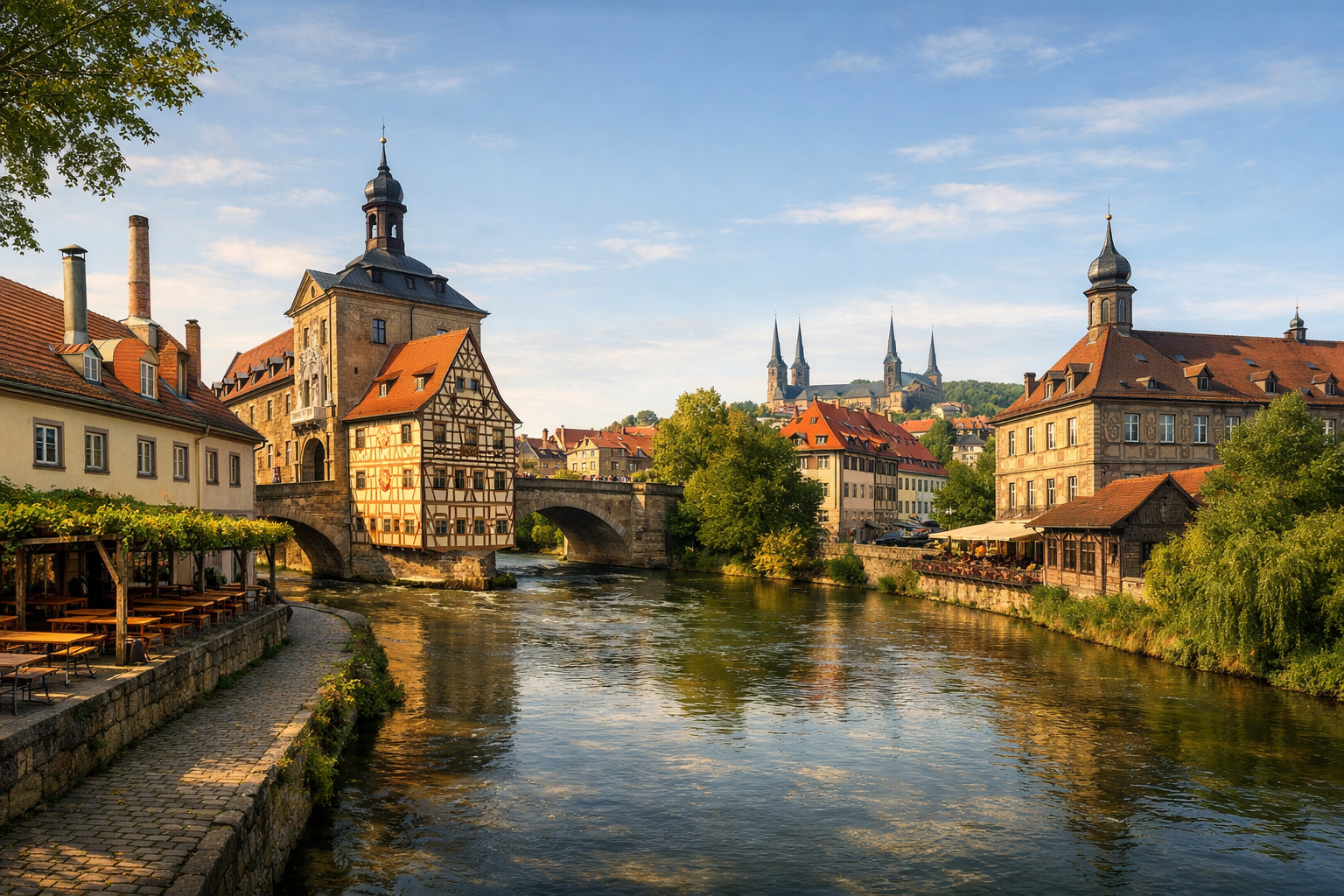
Germany, Franconia. Route through Bamberg's family breweries with visits to Brauerei Keesmann, Brauerei Mahrs Bräu, and Klosterbräu Bamberg.

Germany, Franconia. Route through Bamberg's family breweries with visits to Brauerei Keesmann, Brauerei Mahrs Bräu, and Klosterbräu Bamberg.

Discover Bamberg through the warm taverns and timeless brewing traditions of Franconia. In just two days, this route leads you from the characterful pours of Keesmann and Mahrs Bräu to the historic charm of Klosterbräu, where family breweries keep the region’s beer culture wonderfully alive.

🧭 DAY-BY-DAY ROUTE

Ready-made country and city routes with daily plans, sights, transport and accommodation. Buy PDF guides for independent travel.

🧭 DAY-BY-DAY ROUTE


Day 1 — Bamberg: the family breweries of Wunderburg, Keesmann, and Mahrs Bräu

  • 🚆 It’s best to plan your arrival in Bamberg for the morning. If you’re flying via Nuremberg, the most logical connection is this: metro from the airport to Nürnberg Hbf, then a regional or high-speed train to Bamberg Hbf. In total, the trip from Nuremberg Airport to Bamberg usually takes about 1 hour 20–40 minutes depending on the connection, and from the station it’s easy to walk to the Wunderburg district, take a bus, or grab a short taxi ride. For a beer route, this matters: from your first glass until the end of the day, it’s better not to drive, so the whole program is built around walking and public transport.

  • 🏨 After checking in, devote the first half of the day to getting to know the Wunderburg district — this is where Bamberg’s everyday, living beer culture is especially easy to feel. It’s not a polished postcard, but a real urban neighborhood where historic breweries stand alongside residential streets, old façades, and traditional beer halls where generations of locals drank “their” beer not as a box to tick, but as part of daily life.

  • 🍺 The first essential stop is Brauerei Keesmann, Wunderburg 5. This is one of Bamberg’s most respected family breweries, especially famous for its Herren Pils — a dry, precise pils with a very Franconian character that is often held up as an example for lovers of classic German beer. It’s worth taking your time here: order a small tasting of 2–3 styles to feel the difference between pils, helles, and seasonal brews. The atmosphere at Keesmann is not about spectacle or a tourist attraction, but about confidence in craftsmanship: wooden interiors, simple Franconian cuisine, a dense local crowd, and the feeling that you’ve found yourself not in a trendy bar, but in a real beer house with history. The venue usually operates on weekdays roughly from 10:30 to 22:00, and on Saturdays until mid-day, but before your trip be sure to recheck the official schedule, seasonal closures, and kitchen hours.
  • 🥨 An early Franconian-style lunch goes perfectly with Keesmann: Schäuferla, sausages, Brotzeit, Obatzter, or a lighter snack with your pils. The important thing is not to turn the first visit into a marathon: for a comfortable beer day, it’s better to limit yourself to one proper meal and small tasting pours, saving energy and attention for the next breweries.

  • 🚶 From Keesmann to Mahrs Bräu is only a short walk — about 5–10 minutes within the same district — so it’s an ideal transition without transport. Mahrs Bräu, Wunderburg 10, is another iconic family brewery in Bamberg, where you should especially try the famous unfiltered a U (Ungespundet), meaning a beer with gentle natural carbonation and a rounder, breadier, more lively profile. For understanding the Franconian tradition, this is almost an essential style: less “sharp” than pils, with a very food-friendly and cozy character. The venue itself combines the reputation of a legend with working-day ease — beer enthusiasts, locals, and travelers all come here to experience not a staged setting, but Bamberg’s real beer environment.
  • 🍻 It’s worth lingering at Mahrs Bräu until evening. Usually the Wirtshaus and Biergarten operate from mid-day on Mondays, longer from Tuesday to Saturday, and with shorter daytime hours on Sundays; at the same time, the website notes that standard reservations may be limited for small parties, and by phone they primarily accept group bookings from 20 people. This means that for an independent trip, it’s better to come either early or at a relaxed time, and to check all current reservation rules right before traveling.

  • 🏛️ If you want a break between tastings and don’t want to overload the day with alcohol, add a calm walk back toward the center: through the island part of the city to the Regnitz embankments, old bridges, and quarters with half-timbered houses. This pause is not only beautiful, but practical: alternating breweries with a walk, water, and food makes the route much more comfortable.

  • 🌙 In the evening, you can end the day with a gentle introduction to Franconia’s regional styles: ask the staff what seasonal beers are on tap, and pay attention to the differences between Pils, Helles, Ungespundet, Weizen, and Bock. In Franconia, the beer experience is not only about “how much to try,” but also the ability to read the local tradition through a glass. After the tastings, return to your hotel on foot, by city bus, or by taxi. Driving a car or motorcycle after visiting breweries is excluded on this route.


Day 2 — Bamberg: Klosterbräu, the beer museum, the historic center, and the Rauchbier context

  • ☀️ It’s best to start the second day later and more calmly: a hearty breakfast, water, a short walk through the old town, and only then the next tasting. Bamberg is beautiful because its beer culture is woven into the city’s architecture and rhythm: monastic heights, bridges, baroque façades, former warehouse and craft quarters — all of this creates a backdrop in which beer is perceived as part of the place’s history, not as a separate attraction.

  • 🍺 The main stop of the day is Klosterbräu Bamberg, Obere Mühlbrücke 1–3, the city’s oldest brewery. Its location by the water and next to Bamberg’s old core makes the visit especially atmospheric: here it is easy to imagine the centuries-long continuity of urban beer life. In the Gaststätte, try the darker and more traditional styles associated with local taste: Schwärzla, Braunbier, and, if available, local variations of smoked beer. Unlike the more “sharp-charactered” pilsners of the first day, here the route becomes deeper and more historical: dark malt tones, breadiness, caramel softness, and that very Franconian gastronomic profile that opens up especially well with meat dishes and simple country cooking.
  • 🕰️ According to the published schedule, the Klosterbräu Gaststätte usually operates from Wednesday to Friday roughly from 14:00 to 23:00, and on weekends from 11:00 to 23:00; the kitchen has separate hours, and the beer garden is also seasonal. For a traveler, this is critical: if your 2-day route falls, for example, on Monday–Tuesday, day 1 and day 2 may need to be swapped or adjusted. Before traveling, be sure to check the official website for closures, private events, kitchen changes, brewery tours, and reservation conditions.

  • 🏛️ After or before lunch, head to the Fränkisches Brauereimuseum at Michelsberg 10f. This is one of the best places to connect tastings with context: the former vaulted rooms of the old monastery brewery, along with the exhibition on malt, fermentation, storage, barrels, bottling, and brewing craft, make the museum an important “frame” for the whole trip. Here you especially understand why Franconia sees beer not as a trendy product, but as a cultural layer connected with monasteries, urban guilds, cellars, agriculture, and the seasonal rhythm. The museum is usually open from April to October: on Wednesdays to Fridays during the day, and on weekends from an earlier time; group tours are possible by arrangement. That is exactly why this visit should also be rechecked in advance.
  • ⛰️ Michelsberg itself is worth lingering at longer: it is both a panoramic point above the city and a logical place for a pause between beers. The climb helps “switch” the route from tasting mode to a contemplative one: from above, Bamberg reveals itself as a true historic city of Franconia, where church ensembles, bridges, and rooftops are tightly interwoven with the brewing tradition.

  • 🔥 If you want to end the tour not only with the three essential breweries, but also with an understanding of the region’s uniqueness, devote the evening to the theme of Rauchbier — the famous Franconian smoked beer with which Bamberg is associated worldwide. Even if you do not include a separate long tasting at yet another brewery, it is useful to know that the local beer scene is famous precisely for its variety: from the clean and dry Keesmann Herren Pils to the soft Mahrs a U and the more historically “dark” profile of Klosterbräu, while smoked beer adds aromas of campfire, ham, wood smoke, and old malt to this palette. This contrast makes Bamberg an ideal city not for one “best” glass, but for a comparative beer journey.
  • 🎉 If your trip falls during city events, it makes sense to check the calendar of Bamberg Tourismus and local breweries: the region sometimes has seasonal Bockbier releases, local festivals, gastronomic evenings, special pours, and events at Keller venues. But even without a festival, Bamberg itself works as a “living festival” of Franconian beer — compact, walkable, насыщенный and very authentic.

  • 🚖 End the day as responsibly as possible: after the museum and tastings, return to the hotel on foot, by VGN/Stadtwerke bus, or by taxi. For a late departure the next day, it’s also better to book a transfer to Nuremberg Airport in advance or plan your train via DB/VGN. The route is designed for adult travelers, Germany’s legal drinking age must be respected, and the pace of tastings should remain moderate.

Flight tickets

eSIM for travel

Buy PDF guide

Buy PDF guide — 3.90 USD

PDF — 3.90 USD