
Buy PDF guide

Buy PDF guide — 8.90 USD

PDF — 8.90 USD

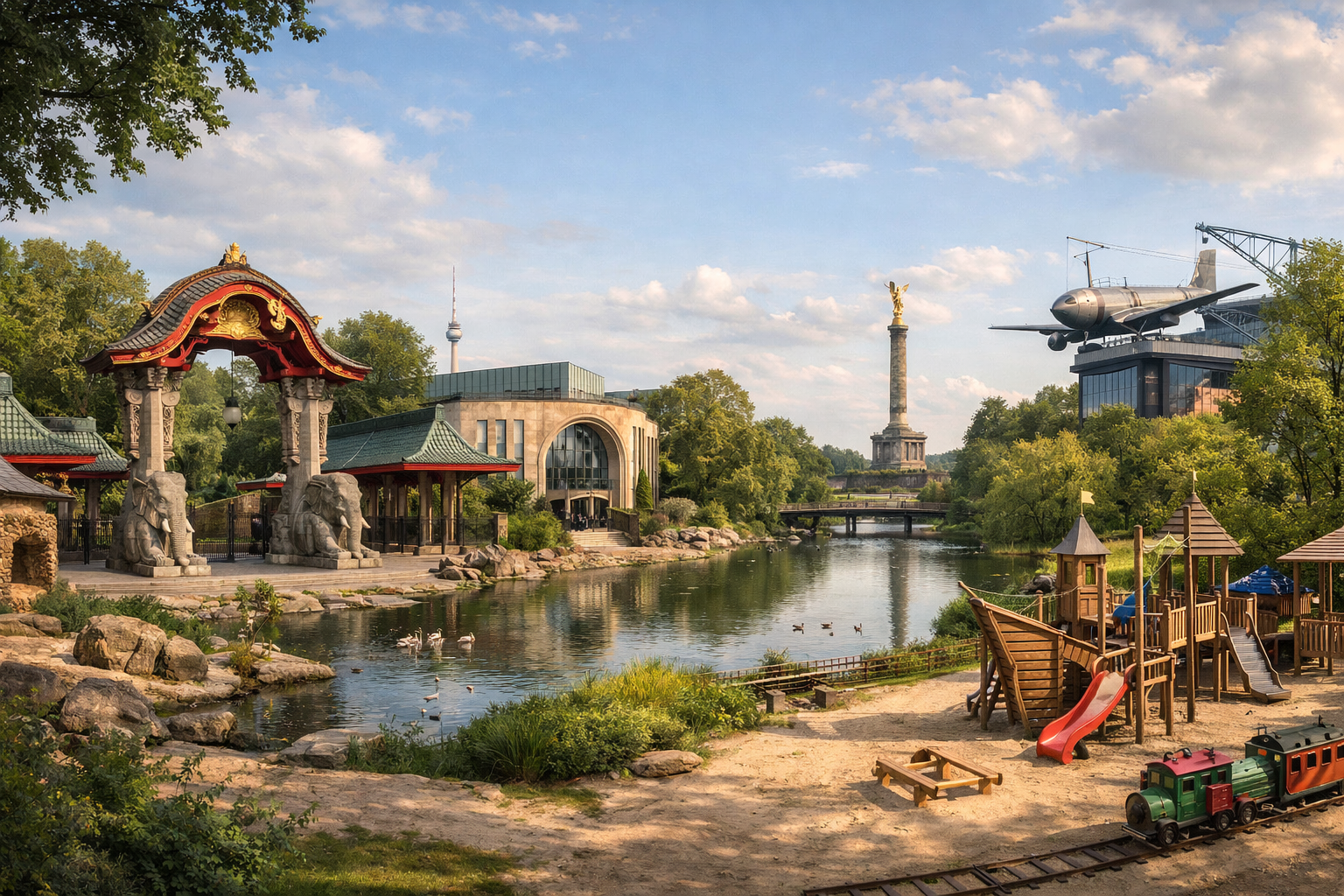
Germany, Berlin. A leisurely route through the Berlin Zoo, aquarium, Tiergarten Park, playgrounds, and the children's halls of the German Museum of Technology. Children's age: 1–3 years.

Germany, Berlin. A leisurely route through the Berlin Zoo, aquarium, Tiergarten Park, playgrounds, and the children's halls of the German Museum of Technology. Children's age: 1–3 years.

Berlin is made for easy little adventures, with gentle strolls from the zoo to the aquarium and plenty of space to roam in leafy Tiergarten. For toddlers, it’s a lovely mix of animals, playground breaks, and hands-on discovery in the children’s halls of the German Museum of Technology.

🧭 DAY-BY-DAY ROUTE

Ready-made country and city routes with daily plans, sights, transport and accommodation. Buy PDF guides for independent travel.

🧭 DAY-BY-DAY ROUTE


Day 1 — Berlin: Berlin Zoo without rushing

  • 🚶 Start the trip with the gentlest and most toddler-friendly day — a relaxed introduction to Berliner Zoo. It is one of Europe’s best-known urban zoos, located in the Zoologischer Garten area, and for children aged 1–3 it is especially good because there is no need to “see everything.” It is better to build the route in short loops: enter in the morning while it is cooler and the animals are more active, choose 2–3 key zones, then take a long lunch break and, if needed, return for another hour. This rhythm helps avoid overtiredness, meltdowns, and sensory overload.

  • 🦒 For ages 1–3, the best animals are the large and easy-to-recognize ones: giraffes, elephants, marine mammals, penguins, birds, and areas where the child does not need to stand and wait for long. Do not try to walk the entire zoo in a full circle: for a family with a stroller, it is more realistic to plan 3–4 hours of actual time inside with plenty of stops for snacks, toilet breaks, and unhurried looking around. Most movement around the grounds is stroller-friendly, but the day should still be kept physically light.

  • 🍎 In practical terms, this day works well like this: after breakfast at the hotel, head to Zoologischer Garten station or to the entrance from Hardenbergplatz/Elefantentor, go in at opening time, and spend the first half of the day inside. Then have a calm lunch in or near the zoo and return to the hotel for a nap if your child usually sleeps in a bed. If your toddler falls asleep easily in the stroller, you can simply do a long quiet walk through the shaded parts of the zoo and finish the day earlier.

  • 🚻 For a family-format outing, this is one of the most convenient locations of the trip: it is important to agree in advance that the adults will not rush, will move at the child’s pace, and will be ready to pause every 45–60 minutes. Toilets and food points should be used proactively, not at the last minute. For children of this age, it is also useful to carry a light change of clothes, wipes, water, a small snack, and a stroller rain cover.

  • ⚠️ Restrictions and important notes: this route does not include any rides with height or age requirements, because the main goal of the day is watching animals and having a safe walk. If temporary children’s activities are running on the grounds, participation rules, minimum age, and operating times should be checked separately before the visit. Animal houses and food areas usually close earlier than the zoo itself, so it is better not to stretch the second half of the day too long.

  • 🚇 Logistically, this is a very convenient day: from the Potsdamer Platz area to Zoologischer Garten, public transport usually takes about 25–30 minutes with a short walking segment, and from the Kurfürstendamm area it is noticeably less. On the S-Bahn, U-Bahn, and buses, one stroller can be carried free with a valid ticket, and children under 6 travel free, which makes Berlin especially comfortable for a short family trip.


Day 2 — Berlin: Aquarium Berlin and a quiet walk through Tiergarten

  • 🐠 The second day is best devoted to a combination of two calm formats: in the morning — Aquarium Berlin, and after lunch — a green walk through Tiergarten. This contrast usually works very well for toddlers: first a compact and visually engaging indoor location with lots of movement, light, and bright fish, then a large park with fresh air, shade, and the chance to simply move at your own pace.

  • 🌊 Aquarium Berlin is great for ages 1–3 because the impressions here are concentrated and easy to understand: aquariums at eye level, bright fish, corals, amphibians, and other small animals. For toddlers, it is important not to drag out the visit: 60–90 minutes is usually more than enough. A long route through every floor with detailed reading of signs is more for adults; for a family with a small child, it is better to choose the liveliest and clearest pace, sometimes simply returning to the tanks the child liked most.

  • 🌳 After the aquarium, it is convenient to head toward Tiergarten and take a slow walk through one of central Berlin’s most pleasant green areas. For families with a stroller, this is an especially good option from April to October: wide paths, plenty of shade, the chance to have a calm snack on a bench, and no need to stick to a strict schedule. The most child-friendly format here is not a “route for the sake of the route,” but a walk in short sections with the option to turn back at any time.

  • 🛝 There are several large playgrounds in Tiergarten, and one of the notable ones is near John-Foster-Dulles-Allee. For children aged 1–3, a playground is not a “must-do checkpoint,” but rather a nice way to end the day: 20–40 minutes of free play after a nap and a snack usually works better than trying to spend half the day there. Be sure to assess the surface, the height of the equipment, and how crowded the playground is on site; some structures may be designed for older children.

  • 🍽️ A practical rhythm for the day: aquarium in the morning, then an early lunch in the zoo/Kurfürstendamm area, followed either by a stroller nap in Tiergarten, or a return to the hotel for quiet time and another outing to the park closer to the evening. This split makes the day genuinely easy rather than just formally full. For toddlers aged 1–3, this is especially important: after indoor impressions, they almost always need a free phase without noise or queues.

  • ⚠️ Restrictions and safety: on this day, do not plan rentals, water activities, or tall play structures. At playgrounds, watch for mixed age groups: older children run fast, while toddlers lose balance easily. After rain, some dirt and park sections may be wet, so it is more convenient to have a stroller rain cover and spare socks/trousers.

Day 3 — Berlin: German Museum of Technology and the children's Spectrum halls

  • 🚂 The third day is best spent at Deutsches Technikmuseum Berlin — one of the best options in Berlin for families who want not only to walk around, but also to let their child safely look at large objects: airplanes, trains, machinery, models, and spacious museum interiors. The main address of the complex is Trebbiner Straße 9, and the Science Center Spectrum and part of the museum grounds are located at Möckernstraße 26. The two parts are close to each other, but they have separate entrances, so with a toddler there is no need to try to cover everything in one go.

  • 🧩 For ages 1–3, it is especially important to choose not the “most famous” sections of the museum, but those where the child can look at large objects, walk only short distances between points, and get a quick visual response. In the main building, trains, airplanes, ships, machinery, and large halls where you can move with a stroller without rushing usually work well. Then, if the child is in a good mood, you can move on to Science Center Spectrum and choose only part of the interactive zones.

  • 🔬 Spectrum is a space with hands-on exhibits, but age should be considered honestly: a significant part of the interactives is more interesting for older children. For toddlers aged 1–3, this section is better as a short introduction to bright, safe, and visual effects with an adult, rather than as a long independent program. If the museum calendar includes temporary sessions, demonstrations, or family activities, be sure to check age restrictions in advance: some events are intended for ages 5+, 6+, or older.

  • 🛋️ The ideal rhythm of the day is this: first half — the main museum building, then a calm lunch and a long break; after rest — a short visit to Spectrum or a walk around Gleisdreieck. It is very important to give yourself permission to cancel the second part without feeling that you “missed out.” For a small child, even one substantial museum block is already a full day.

  • ♿ From the point of view of family logistics, the museum is convenient: it is easy to reach by U-Bahn and S-Bahn, and the complex itself is mostly accessible for visitors with strollers and wheelchairs, with a few exceptions. This is one of those days when it is especially convenient to come by public transport rather than taxi: the area is well connected by Möckernbrücke, Gleisdreieck, and Anhalter Bahnhof.

  • ⚠️ Restrictions and warnings: do not promise the child that they can “touch everything” — some exhibits are for viewing only, and some interactives require height, hand strength, or the ability to understand instructions. On weekdays, group visits to Spectrum require advance registration at certain hours, and seasonal family programs may have separate rules. For toddlers, it is best to choose only 2–3 halls at most and leave time for a snack, the toilet, and simply riding in the stroller through quiet corridors.

Day 4 — Berlin: Gleisdreieck Park, playground, and a calm finish

  • 🌿 The final day is best kept as gentle and airy as possible: no new complicated museums, long queues, or strict timing. The ideal option is to devote it to Gleisdreieck Park and short family stops around Potsdamer Platz / Kreuzberg. After the previous three days, this is usually exactly the rhythm a child needs: a bit of walking, a bit of playground time, a bit of food, and plenty of free time.

  • 🚶 Park am Gleisdreieck is great because it is modern, spacious, and stroller-friendly. It is easy to organize a walk here “according to how everyone feels”: stroll along the smooth paths, stop at a playground, watch cyclists and city life, and then return to the hotel without stress for luggage or quiet time. For a family with a toddler, this is far more valuable than trying to squeeze in one more major attraction “just to tick the box.”

  • 🛝 At the playgrounds, stick to the 1–3 age range: sand areas, low slides, toddler swings, short play episodes under constant supervision. If the child wakes up in a bad mood or the weather lets you down, the day can easily be reworked: you can simply keep one walk, one lunch, and an early departure to the airport. This reserve of flexibility is an important part of a well-designed family route.

  • ☕ This day is also convenient for practical tasks: buy snacks for the road, stop by a pharmacy, pack calmly, and get to the hotel or station without rushing. If your flight is in the evening, you can do a morning walk in the park and return to the hotel for luggage. If your flight is during the day, it is better not to plan anything at all apart from a short outing near the hotel.

  • 🚆 It is convenient to get to BER from central Berlin by public transport. For a family with a stroller, it is more practical to allow extra time and choose a clear direct option: FEX, a regional train, or the S-Bahn depending on where you are staying. From the Potsdamer Platz area, the trip to the airport usually takes about 20 minutes on a fast train plus transfers, while from the Zoo/Kurfürstendamm areas it is worth allowing a larger overall buffer because of the connection.

  • ⚠️ Final rule of the day: do not add one more heavy sightseeing stop “for goodbye.” For children aged 1–3, a calm final day almost always makes the whole trip better — fewer tears, less rushing, a calmer journey to the airport, and a better chance that the impressions of Berlin will remain warm for both parents and child.

Flight tickets

eSIM for travel

Buy PDF guide

Buy PDF guide — 8.90 USD

PDF — 8.90 USD