
Buy PDF guide

Buy PDF guide — 10.90 USD

PDF — 10.90 USD

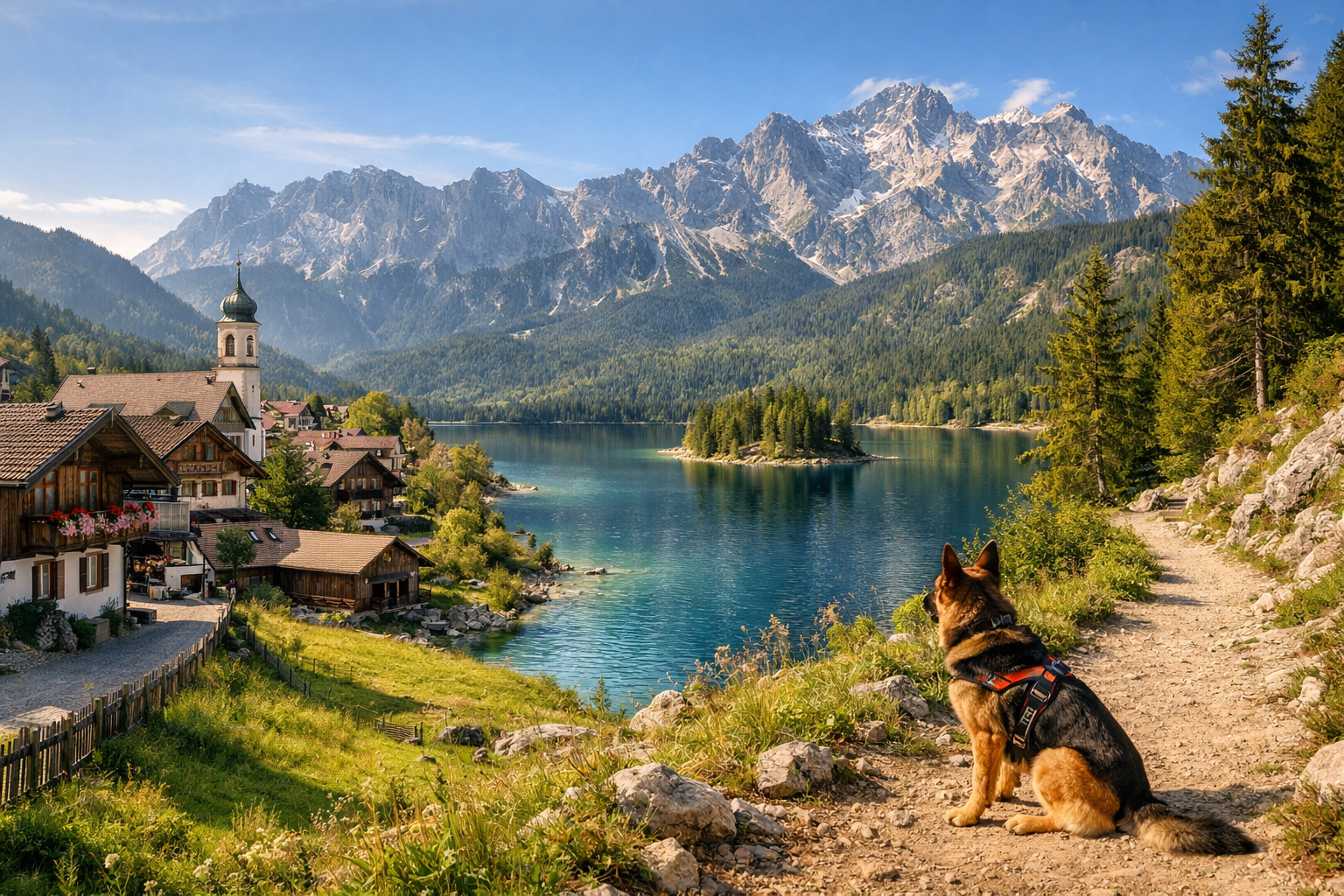
Germany, Bavarian Alps. Traveling with a dog through Garmisch-Partenkirchen, Lake Eibsee, and accessible trails at the foot of the Zugspitze

Germany, Bavarian Alps. Traveling with a dog through Garmisch-Partenkirchen, Lake Eibsee, and accessible trails at the foot of the Zugspitze

Discover the Bavarian Alps with your dog at your side, from the storybook streets of Garmisch-Partenkirchen to the crystal-clear waters of Lake Eibsee. Gentle, accessible trails around Grainau and at the foot of the Zugspitze make it easy to soak up mountain views, fresh air, and alpine charm together.

🧭 DAY-BY-DAY ROUTE

Ready-made country and city routes with daily plans, sights, transport and accommodation. Buy PDF guides for independent travel.

🧭 DAY-BY-DAY ROUTE


Day 1 — Munich → Garmisch-Partenkirchen: a gentle start in an alpine valley

  • 🚗 After landing in Munich or picking up your car in the city, head to Garmisch-Partenkirchen — the drive usually takes about 1.5–2 hours depending on traffic. This is one of the most comfortable options for traveling with a dog: you can make short bathroom stops, avoid adapting to transfers, and arrange your things right away so your pet feels calm. The town itself lies in a wide mountain basin, where traditional Bavarian facades, flower-filled balconies, and broad views of the Wetterstein massif create the feeling of a resort that doesn’t push the pace. On the first day, don’t overload the route: after check-in, it’s better to choose an easy adaptation walk through central Garmisch and along quieter streets or riverside paths so your pet can get used to new smells, altitude, sounds, and water.

  • 🐾 Traveling with an animal on this day: as a basic rule, think in terms of dogs and cats, although the route itself and the region’s infrastructure are best suited specifically for dogs. For air travel to Germany, the rules depend on the airline: with Lufthansa, small dogs and cats may travel in the cabin if the total weight of the animal and soft carrier does not exceed 8 kg; larger animals may fly in the heated cargo hold if conditions are met. For Deutsche Bahn rail travel, small animals about the size of a domestic cat, placed in a closed container, are usually carried free of charge as hand luggage; larger dogs need a separate ticket, a leash, and a muzzle. For buses and long-distance carriers, the rules vary: on FlixBus, ordinary pets are generally not transported, except guide dogs and certain assistance animals. That is exactly why the car + walks format is optimal for this tour. Even if you hardly plan to use public transport, it’s still best to definitely bring a muzzle.

  • 📄 Veterinary and entry requirements: for moving dogs, cats, and ferrets within the EU and entering Germany, microchip identification, valid rabies vaccination, and correct veterinary documents are required. For travel within the EU, an EU Pet Passport is usually used; when entering from some non-EU countries, an Animal Health Certificate may be required instead. If you are traveling in transit through other countries, double-check their rules separately in advance. A classic safe minimum before the trip: microchip, valid rabies shot, parasite treatment as recommended by your vet, enough food for the first few days, addresses of the nearest veterinary clinics, and copies of documents in both paper and digital form.

  • 🏥 It’s useful at the start to note the nearest veterinary points: Tierarztpraxis Dr. Saur in Garmisch-Partenkirchen is presented as a practice with emergency service, and Tierarztpraxis Werdenfels is convenient as another address within the route’s base area. In the evening, take a short walk and rest early: alpine air and a new environment tire dogs no less than people, so it’s best to end the first day quietly.


Day 2 — Eibsee: a circular walk by water and forest

  • 🚗 From Garmisch-Partenkirchen to Eibsee it’s a short drive: usually about 15–20 minutes by car to the Eibsee/cable car station area near Grainau. Eibsee is one of Germany’s most beautiful lakes, lying right at the foot of Zugspitze. The water here changes color from clear green to deep turquoise, and the forest route around the shore makes this place almost ideal for a walk with a dog. The circular trail around the lake is considered relatively accessible and in the summer season is suitable for an unhurried route of easy or easy-to-moderate difficulty. This is not “sport at any cost,” but a day for contemplation: wooden boardwalks, shaded sections, open panoramas of rocky mountain walls, and little coves where it is especially pleasant to pause.

  • 🐕 Eibsee is very convenient for traveling with a dog, but it’s important to remember the rules of specific services around the lake. On walking sections, it’s best to keep your dog on a leash, especially near the hotel, parking areas, piers, crowded viewpoints, and during high season. If you plan to ride the historic excursion boat Reserl, a muzzle is required for dogs; if a muzzle is not suitable because of the dog’s muzzle shape, an appropriate carrier bag or crate is usually required. There may be restrictions for wet dogs before boarding, so it’s better to plan swimming after the boat ride rather than before it.

  • 🏖️ Beaches and dog swimming areas around Eibsee should be seen as natural shores rather than guaranteed official dog-beach zones in the urban sense. Rules for access to the water, swimming, boats, decks, and specific shoreline sections may change, so before your trip it’s best to confirm them on site with the area administration or at Eibsee Hotel. In this route, it makes sense to focus on the walk, short pauses by the water, photos, and rest rather than long swimming sessions. If your dog is active and loves water, bring a towel and a collapsible bowl, and make sure its paws do not get too cold during long stays in the chilly lake.

  • 🅿️ Public parking is available at Eibsee in the Eibsee/Zugspitzbahn area, but in good weather and on weekends it can get very crowded. It’s better to arrive early and allow time to find a space. After the walk, you can return to Garmisch-Partenkirchen for a calm dinner and a second short walking outing already in town. This is a good day not to go beyond 8–10 km on foot if your dog is not used to mountain surfaces.

Day 3 — Grainau and the foot of Zugspitze: gentle trails, spa park, and checking the cable cars

  • 🚗 Today’s route is built around Grainau and calm approaches at the foot of Zugspitze. From Garmisch-Partenkirchen to Grainau it’s about a 10–15 minute drive. This is a very good point for those who want to feel close to Germany’s highest peak without heading into serious mountain trekking. Start with an easy walk through the village itself and Kurpark Grainau: well-kept paths, a neat resort rhythm, and beautiful views of the massif make this a good “warm-up” before a longer walk. Then you can choose one of the easier nearby routes along lower trails and forest paths without aggressive elevation gain.

  • 🚠 If you really want to add a cable car as part of the experience, do so only after separately checking animal access for the exact date and the specific lift. In the region, Bayerische Zugspitzbahn Bergbahn AG allows dogs on cable cars and the cogwheel railway, and a separate ticket is required for the dog. But that does not mean every section is equally comfortable for every pet. At the summit and on technical platforms there may be metal, grates, steps, and noise, and at viewpoints there may be wind and crowds. For sensitive dogs, senior pets, and animals unsure on their paws, it is better to stay at the foot of the mountain and enjoy viewpoints from below. If you do go up, bring water, a leash, and a muzzle in advance, and assess whether the surface may injure paws.

  • 🐾 Rules for this day: on walks in Grainau and in the spa park, a dog is generally appropriate on a leash; on public transport in the region and on trains, it is better to keep a muzzle with you even when no one asks you to put it on constantly. If you use a regional bus as a backup option, remember that animal transport rules may depend on the line operator and local regulations, so the conditions should be confirmed directly before the trip. For this route, a car remains the most comfortable scenario.

  • 🌲 The point of the day is not to “gain altitude,” but to gather the right alpine mood without overload: moist conifer air, the sound of streams, quiet villages, meadows, and a view of the stern walls of Zugspitze from below, where the mountain seems especially monumental. In the evening, it is convenient to return to base early, check paws, dry the coat, let your pet rest, and prepare for a more impressive nature day tomorrow.

Day 4 — Partnachklamm and surroundings: dramatic nature without strenuous hiking

  • 🚗 From the center of Garmisch-Partenkirchen, the drive to the approach area for Partnachklamm is short, then a walking approach to the gorge entrance follows. Partnachklamm is one of the region’s most spectacular natural sites: a narrow passage between powerful rock walls, the roar of icy water beneath your feet, damp air, droplets on stone, and the feeling that you are walking inside a living mountain. Even a short passage makes a strong impression, yet it does not require full alpine climbing experience. For a traveler with a dog, this is one of the best ways to see the drama of the Alps in the format of a half-day walk.

  • 🐕 Dogs on a leash are allowed in Partnachklamm, and a separate entrance ticket is charged for them. However, the route requires a sensible assessment of your pet’s condition: inside it may be slippery, noisy, darker in places, and cool, and the flow of people in the middle of the day can be dense. If your dog is timid, reactive, or nervous around water and narrow spaces, come as early in the morning as possible or after the main daytime flow. Strollers are not allowed, and in the alpine section around the gorge temporary restrictions and detours may apply due to works or safety measures, so the current passage scheme should be checked right before the visit.

  • 🦴 After the gorge, do not force a difficult route uphill. It is better to choose a gentle continuation of the walk through accessible terrain or return to calmer paths in the lower part of the valley. For dogs, this is much safer than long ascents over rocky sections. It is important to remember your original rule: avoid difficult rocky routes. In wet weather, Partnachklamm is especially beautiful, but also more slippery, so sure-footed walking, a comfortably sized leash, and a spare towel are essential.

  • 🏥 Since the day is slightly more active, keep the contacts of veterinary clinics in Garmisch-Partenkirchen at hand in advance in case of paw chafing, scrapes, or overheating. After the route, it’s good to spend a calm evening at Lake Riessersee or in a quiet part of town, without long transfers. The day should end with recovery, not another big activity.

Day 5 — Garmisch-Partenkirchen: cultural walk, park, buffer time for rest, and departure

  • 🚶 Leave the final day more flexible and relaxed. Start with a walk through the historic part of Partenkirchen with its Lüftlmalerei facades, then, if you wish, stop by the Olympic ski jump as an iconic point of the region, and finish the day in one of the quieter parks or by Riessersee. This is an especially good finale for a pet-friendly trip: after several nature-filled days, a dog often needs not a new challenge, but a measured rhythm with short walking sessions, rest in the shade, and a clear urban environment.

  • 🏛️ If you want to add culture without overload, use Museum Werdenfels as a compact museum stop for one person while the other traveler stays outside with the dog for a walk. Pets are usually not allowed inside museums and some public buildings unless they are specially trained assistance dogs, so cultural points on this route are best visited in short rotations.

  • 🏨 Before departure, check the hotel pet policy once again: the size of the dog surcharge, the allowed number of animals in the room, restaurant rules, whether prior approval is required, and whether you may leave the pet alone. In some hotels, dogs are allowed but not admitted to the restaurant; elsewhere you may stay with an animal but cannot leave it alone in the room. This is a critically important point that should be checked not from old reviews, but directly with the hotel before booking.

  • ✅ Final recommendations for the whole route: stick to easy and moderate difficulty, do not plan open sections during hot hours, confirm animal access for cable cars in advance, bring a muzzle for transport, do not take your dog onto difficult rocky trails, always carry water and waste bags, and allow time for rest. Rules for transporting and accommodating animals, as well as access to beaches, parks, and public transport, may change. Before the trip, confirm conditions with the carrier, hotel, and the administration of each area, visit your vet, and check the entry and transit requirements of the countries involved.

Flight tickets

eSIM for travel

Buy PDF guide

Buy PDF guide — 10.90 USD

PDF — 10.90 USD