
Buy PDF guide

Buy PDF guide — 10.90 USD

PDF — 10.90 USD

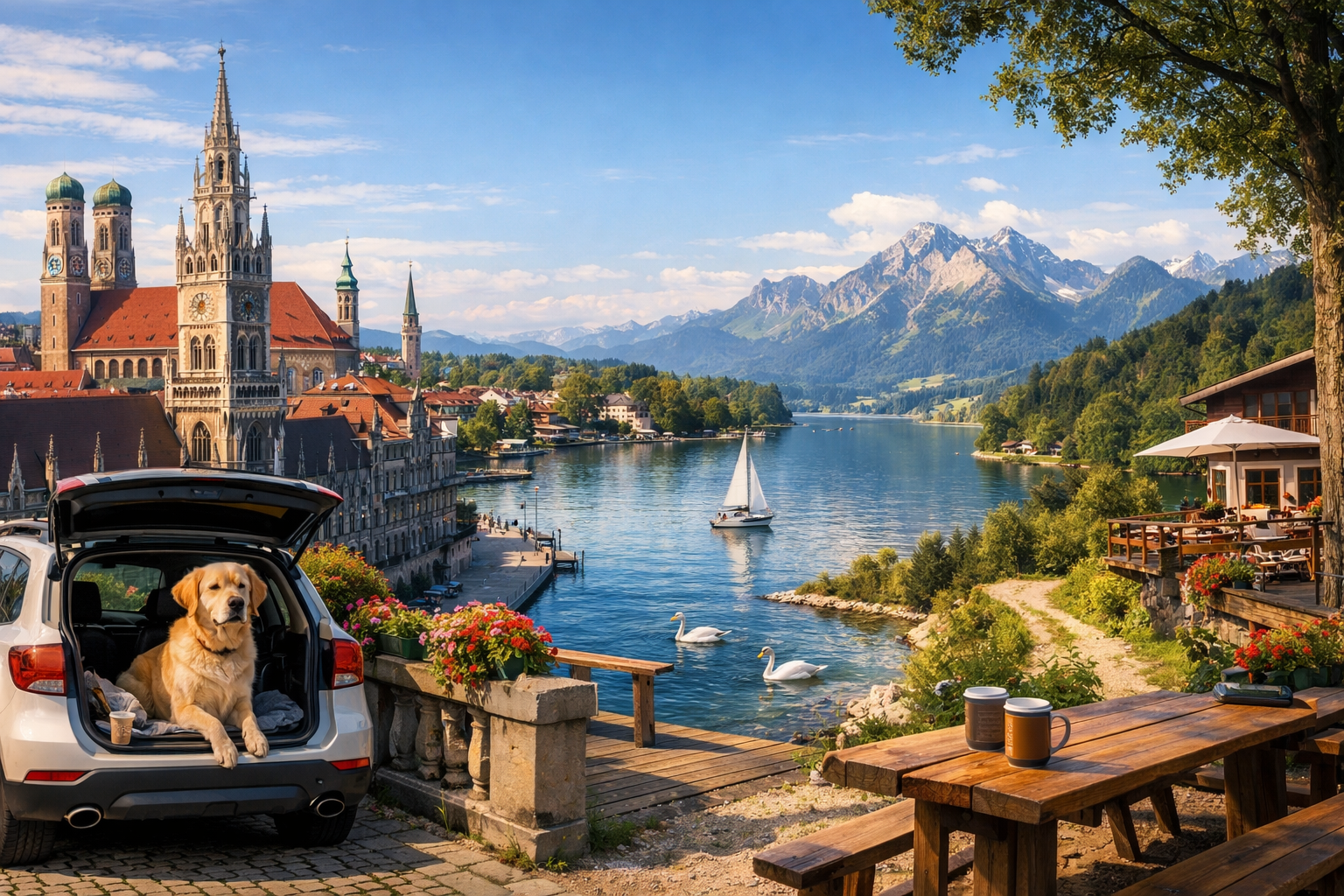
Germany, Bavaria. A road trip with a pet through Munich, Lake Starnberg, and the foothills of the Alps with walks along promenades, forest trails, and open terraces

Germany, Bavaria. A road trip with a pet through Munich, Lake Starnberg, and the foothills of the Alps with walks along promenades, forest trails, and open terraces

Bavaria is made for a pet-friendly road trip, from Munich’s leafy promenades to the sparkling shores of Lake Starnberg. Wander forest trails in Bernried, pause on sunny lakeside terraces, and follow the road into the Alpine foothills before circling back to the city.

🧭 DAY-BY-DAY ROUTE

Ready-made country and city routes with daily plans, sights, transport and accommodation. Buy PDF guides for independent travel.

🧭 DAY-BY-DAY ROUTE


Day 1 — Munich: arrival, the English Garden, and a calm city rhythm

  • 🚗 After arriving in Munich, it makes sense not to overload the first day with long drives: pick up the car, check into a pet-friendly hotel with parking, and ease both yourself and your animal into the trip. The best starting point for this route is the English Garden, one of the largest urban parks in Europe, where broad avenues, water canals, lawns, and long walking axes let you settle into the Bavarian rhythm without rushing. The southern part of the park is livelier, with views of the Eisbach, the Chinese Tower, and pedestrian paths, while farther north the space becomes noticeably quieter: it is easier there to enjoy a long relaxed walk with a dog without weaving through crowds of tourists. From April to October it is especially pleasant to walk here in the morning and toward evening, when the light is softer, the grass brighter, and the city air smells less like asphalt and more like foliage and water.

  • ☕ For lunch and breaks, choose places with open terraces or beer gardens, where it is usually easier to settle with a dog than indoors. However, in Munich the rules of each individual café may differ: some comfortably accept dogs at outdoor tables, some ask that the animal stay under the table, and others do not allow them inside the halls. That is why this route is deliberately built around open spaces and promenades, so the trip stays comfortable and does not require constant negotiation at every entrance.

  • 🐾 Pets and rules for the day: the most realistic option is dogs, as well as cats and ferrets in carriers during transit and check-in. For the walking part of the route, traveling with a dog is the most comfortable option. On Munich public transport within MVV, a dog travels free if the owner has a valid ticket; each additional dog, if not in a basket or bag, requires a child ticket. The dog must be on a leash, and if it may pose a risk to passengers, it must wear a muzzle; fighting breeds are not allowed for transport. On DB trains, small animals up to the size of a domestic cat may travel free in a closed carrier; larger dogs that are not transported as hand luggage are charged at half fare and must be on a leash and wear a suitable muzzle. Within Munich, city restrictions apply in certain areas: dogs are not allowed on playgrounds, marked play and sunbathing lawns, or swimming and beach areas on municipal grounds; in some pedestrian zones and inside the Altstadtring, large dogs must be kept on a leash no longer than 2 meters. Always recheck the current conditions of the carrier and local city rules before your trip.

  • ✈️ If you are arriving by plane: Lufthansa allows only dogs and cats in the cabin if the total weight of the animal with a soft carrier does not exceed 8 kg, and the carrier fits dimensions up to 55×40×23 cm; the pet must be registered in advance, at least 72 hours before departure. Special containers meeting airline and IATA requirements are used for transport in the cargo hold; the fee depends on the container size and route. Air transport rules, breed restrictions, and age limits for animals change, so pet booking and document checks are essential before buying the final ticket.

  • 📄 Documents and veterinary requirements: for entry into Germany and movement within the EU, dogs, cats, and ferrets usually require a microchip, valid rabies vaccination, and an EU pet passport or equivalent veterinary documents depending on the country of departure. Additional forms may be required from non-EU countries, and when returning through certain countries, proof of rabies antibody titer may be needed. The basic rule: visit your vet before the trip, check the country of entry and any possible transit countries, as well as requirements for the animal’s age, vaccination timing, and certificate format.

  • 🏥 Veterinary support nearby: for emergencies, it is convenient to keep AniCura Tierklinik Haar, Keferloher Str. 25, 85540 Haar, in your route notes — a clinic with 24/7 emergency service. Even if you do not need it, it is best to save the address offline in advance. For walks with a dog in the city, it is also useful to carry a collapsible bowl, extra water, waste bags, and a short leash for high-traffic areas.


Day 2 — Munich → Starnberg: lake promenade, villas, water, and a long evening walk

  • 🚗 The drive from Munich to Lake Starnberg usually takes about 35–50 minutes by car depending on your starting point and traffic. It is best to leave after a morning city walk and without a strict schedule: the road is short, and the main point of the day is not the kilometers but the change of scale. Even on the approach, the urban backdrop dissolves, and the trip shifts into a softer, almost resort-like mode: lake air, piers, walking lines along the water, boats, green slopes, and light that in good weather constantly changes from silvery to almost alpine blue.

  • 🚶 Starnberg itself is best not as a checklist of sights, but as a place for a beautiful slow walk. The promenade and lakeside stretches offer that rare kind of отдых where both people and dogs feel comfortable: even paths, lots of air, visual openness, and the ability to pause often. From here it is pleasant to look across the lake surface, the distant shores, and Bavaria’s changeable sky. This is one of those days when the route does not need to be packed with museums: the main thing is to walk, observe, have a late lunch on an open terrace, and give your animal not a stressful excursion but a full shared day.

  • 🏖️ For traveling with a dog, access to water is especially important. Around Lake Starnberg, the rules vary by municipality and by specific swimming areas: dogs are not allowed on some official beaches and sunbathing sections, while in other places access on a leash may be possible, and elsewhere there may be quieter stretches that dog owners use for a brief approach to the water. Before every stop by the shore, you need to confirm the local rules on site using signs and with the area administration. Do not assume that every equipped beach is automatically dog-friendly.

  • 🐾 Pets and rules for the day: dogs are the best fit for this type of lakeside walk; cats and ferrets are possible only if the animal calmly tolerates the car and short stops, but the day is objectively designed around a companion dog. In the car, use a secured harness, transport crate, or divider net — this is not only about comfort, but also about safety on Bavarian roads. In walking areas near the water and in populated places, keep the dog on a leash; at restaurant terraces, clarify in advance whether the animal may stay next to the table. If you plan a short segment by S-Bahn or regional train between Munich and Starnberg, DB and MVV rules apply: small animals in a carrier, large dogs on a leash, paid according to the carrier’s rules, and muzzled when necessary.

  • 🏨 For accommodation by the lake: when booking, always confirm the permitted animal type, number of pets per room, weight limit, extra fee amount, restaurant access rules, and whether the animal may be left in the room without the owner. Many accommodations in Germany are formally pet-friendly, but at the same time ask that pets not be left alone or allow it only for a short time and only if the animal behaves calmly. If you plan an indoor dinner or a museum visit, choose a hotel that confirms its unattended pet policy in advance.

  • 🩺 Practical veterinary tip of the day: after walks near the water, check paws, coat, and ears, especially if the dog swam or walked through wet grass and forest edges. In the warm season, tick protection is relevant in Bavaria. It is useful to keep a towel in the trunk and a separate mat in the car so the next drive stays dry and comfortable.

Day 3 — Lake Starnberg: Bernried, Buchheim Museum from the outside, park, and forest trails by the water

  • 🚗 Today it is better not to plan long drives: from Starnberg to Bernried along the western shore of the lake it is usually about 25–35 minutes by car. It is a very beautiful stretch for a calm driving day: small settlements, green sections, glimpses of the water, and the feeling that the route runs not “from point to point,” but along one long living backdrop.

  • 🌲 Bernried is especially good for traveling with a pet thanks to its combination of lakeshore, park spaces, and quiet paths. Near the Buchheim Museum in Höhenrieder Park, the landscape itself already works as an attraction: forest paths, open clearings, lake views, and that distinctly calm Bavarian depth of scenery where even a short walk feels like a small reset. The museum is known for its collection and unusual architecture by the water, but for a pet-focused route the emphasis should be on the outdoor walking environment and the blend of art, nature, and fresh air.

  • 🏛️ If you want to combine the route with a cultural pause, a convenient format is this: one person goes into the museum briefly, while the other stays outside walking the dog in the park and along the shore, then you switch. Beforehand, be sure to check the museum’s current rules for admitting animals inside. Even if pets are not allowed in the exhibition spaces, the trip here is still worthwhile: the grounds around the museum complex and the approach to it are very scenic.

  • 🐾 Pets and rules for the day: dogs are ideal; cats and ferrets only as calm car passengers, but in walking terms this location is still a dog place. On park paths it is best to keep the dog on a leash, especially in high season when there are many families, cyclists, and runners around. In natural areas and on quiet trails, it is important to consider not only other visitors but also possible farm animals on neighboring land. If your animal is reactive, use a shorter leash and avoid narrow trails during peak hours.

  • 🍽️ For lunch, choose cafés with outdoor seating. In the indoor spaces of museums, cafés, and historic sites, animal rules may differ even within the same area. Do not assume “automatic entry”: ask on site, especially if the dog is large. For large dogs, it is useful to carry a muzzle even when it is not constantly required: it may be requested on transport, at a pier, or at the entrance to certain public spaces.

  • 🩺 Veterinary logistics: if you are staying overnight in the lake area and want a backup address, save the contacts of the nearest practices in Starnberg and the 24-hour AniCura Tierklinik Haar in eastern greater Munich as the most reliable emergency option. For a proper pet trip in Bavaria, this matters more than an overloaded sightseeing list.

Day 4 — Alpine foothills: an easy driving day through southern Bavaria, forest edges, panoramas, and terraces

  • 🚗 The most atmospheric outing from the Lake Starnberg area is toward the gentle Alpine foothills south of the lake, without trying to “conquer the mountains” in one day. This route works well as a scenic drive along rural roads and through small villages toward the Bavarian pre-Alpine region, for example through areas with panoramic stops and short forest walks. The idea of the day is not switchbacks and not hiking, but a light road trip: 1–1.5 hours of total driving between stops, scenic pauses, coffee or an early lunch on a terrace, then a walk along a forest edge or a rolling trail.

  • ⛰️ The foothills here do not overwhelm with height, but create the backdrop: green folds of relief, pastures, isolated farms, forest lines, and distant Alpine silhouettes in clear weather. This is an ideal day for a pet that struggles in the city but feels good in slow movement and on natural surfaces. Choose short, non-technical trails: 3–6 km in total is quite enough to keep the journey genuinely easy. After rain, some stretches may be slippery, so soft shoes and a towel for paws are essential.

  • 🐾 Pets and rules for the day: dogs are once again the best fit here. In natural and rural areas, keep the dog on a leash, especially near cyclists, children, horses, and farm animals. If you are walking on a forest trail, do not allow your dog to run up freely to other dogs or people: in Bavaria, predictable and respectful behavior from owners is valued. Cats and ferrets can accompany this kind of day only if they are very calm about car travel and harness outings, but the route is still designed primarily for dogs.

  • 🍺 For breaks, choose open terraces at rural restaurants, alpine cafés, or lawn seating at country inns. These stops are usually the most comfortable way to travel with a pet: there is space under the table, water, shade, and less indoor noise. But even in very friendly Bavaria, rules for entering the indoor hall, viewpoint, farm shop, or private property with a dog may differ. Anything concerning animal access must be confirmed directly on site.

  • 🚙 Safety on the road: in warm months, do not leave your pet alone in the car even “for a couple of minutes,” especially in the sun. Plan fuel stops, toilet breaks, and shaded stops in advance. A comfortable rhythm for this kind of day is a 30–40 minute drive, then a walk, water, and rest. This day should leave you with enough energy for the return to Munich, not turn into an ordeal.

Day 5 — Return to Munich: Nymphenburg from the outside, a final walk, and departure

  • 🚗 The return from the lake area and foothills to Munich usually takes about 45–75 minutes depending on your starting point and traffic conditions. For the final day, it is better not to plan a dense program in the center: it makes more sense to choose Nymphenburg Palace Park and the surrounding area as a beautiful, airy, and fairly calm end to the trip. There is no need to force a museum tempo here — the palace perspective itself, the canals, avenues, and broad green spaces provide a worthy finale to the route.

  • 🏰 Nymphenburg is especially good after several days by the lake because it preserves openness and a natural rhythm while bringing back the feeling of great history. This place is not about bustle, but about long straight perspectives, reflections in the water, light on the facades, and an unhurried pace. If the weather is mild, it is easy to arrange a final 1.5–2 hour walk here and then head to the airport or to an overnight stay before departure.

  • 🐾 Pets and rules for the day: the outdoor walking spaces suit dogs as long as leash rules and local park regulations are followed; access inside the palace, museum halls, and certain pavilions for ordinary animals must be checked separately, and in most cases you should not count on admission to the interior exhibition spaces. If you want to see the exhibits indoors, plan on taking turns. On departure day, it is especially important not to overload your pet with long lines and continuous urban noise — a short beautiful walk is better than one more “must-see attraction.”

  • ✈️ Before departure: check the airline’s rules again for pet check-in, carrier type, airport arrival time, and document set. For Lufthansa, pet transport booking is confirmed in advance, and payment is usually made at check-in. For dogs and cats in the cabin, weight and soft-carrier size limits apply; for transport in the cargo hold, a container meeting airline and IATA requirements is needed. At Munich Airport, taxis are available at the terminals; if you do not want to return the rental car too early, leave enough time for car return, a final walk before entering the terminal, and a calm passage through all formalities.

  • 📌 Final route reminder: rules for animal transport and accommodation, as well as access to beaches, parks, and public transport, may change. Before traveling, confirm conditions with the carrier, hotel, and the administration of each area, visit your vet, and check entry and transit country requirements. For this 5-day tour, it is best to choose pet-friendly hotels with parking, use a leash in the city, and be mindful of cyclists and farm animals in natural areas.

Flight tickets

eSIM for travel

Buy PDF guide

Buy PDF guide — 10.90 USD

PDF — 10.90 USD