
Buy PDF guide

Buy PDF guide — 4.28 USD

PDF — 4.28 USD

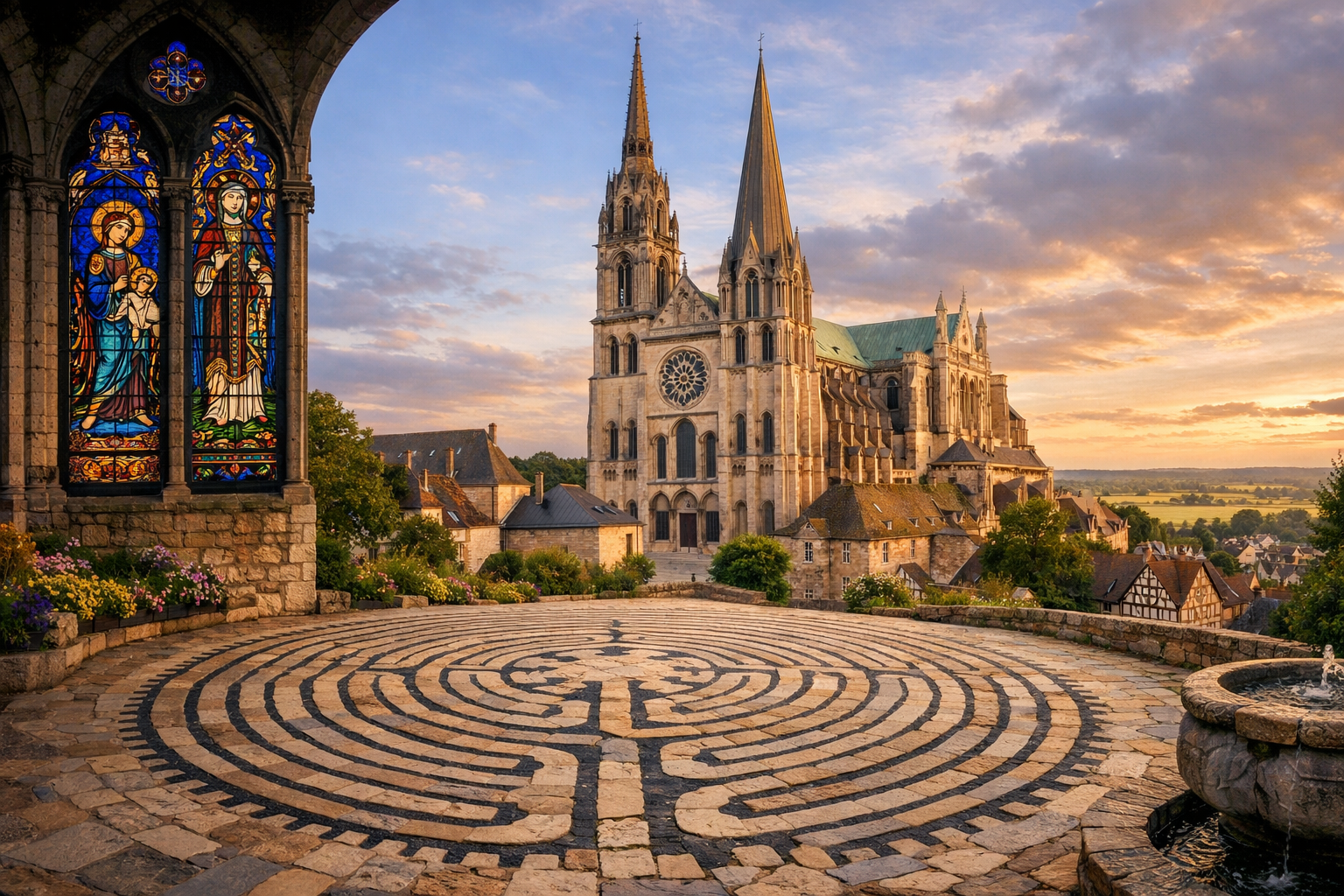
France, Chartres. Symbols of Chartres Cathedral. Stained glass windows, medieval architecture, the labyrinth, and the historical symbolism of the cathedral in a journey for connoisseurs of sacred art and architecture.

France, Chartres. Symbols of Chartres Cathedral. Stained glass windows, medieval architecture, the labyrinth, and the historical symbolism of the cathedral in a journey for connoisseurs of sacred art and architecture.

In Chartres, the cathedral rises above the lower town like a masterpiece of sacred architecture, famed for its luminous stained glass and powerful medieval form. Step inside to trace the labyrinth and discover a world of symbolism, where every stone and window speaks to connoisseurs of art, faith, and history.

🧭 DAY-BY-DAY ITINERARY

Ready-made country and city routes with daily plans, sights, transport and accommodation. Buy PDF guides for independent travel.

🧭 DAY-BY-DAY ITINERARY


Day 1 — Chartres: cathedral, stained glass, and the labyrinth as a path of contemplation

  • 🚆 Transfer: Paris → Chartres. The most realistic option for a short trip is the train from Paris-Montparnasse to Chartres, followed by a walk to the historic center. From Chartres station to the cathedral it is usually about a 10–15 minute walk at an easy pace, so the route is convenient to plan without a car. If you are flying into Paris, it is wise to allow extra time for the transfer to the station and possible schedule changes.

  • 🚶 Begin your journey at Cathédrale Notre-Dame de Chartres, 16 cloître Notre-Dame, 28000 Chartres. This is one of the key works of High Gothic and one of Europe’s most powerful monuments of sacred architecture, where symbolic language is literally built into stone, glass, and spatial dramaturgy. The cathedral is open daily, usually from 8:30 to 19:30, but access to the nave and transepts may be temporarily restricted during services, so it is best to keep your itinerary flexible and respectful of the church’s religious life. Entry to the cathedral itself is usually free, although certain visit formats and special tours may have their own rules.

  • ✨ Visually, Chartres Cathedral creates an almost alchemical impression: massive towers, deep portals, a strict vertical movement of lines, and the legendary Chartres blue in the stained glass create the feeling not simply of a monument, but of a carefully constructed “theology of light.” From a historical point of view, this is an outstanding medieval Christian church and a UNESCO World Heritage site. From the point of view of cultural mythology and esoteric interpretations, the cathedral has long been read as a “stone book” of symbols, where numerical proportions, stained-glass scenes, zodiac motifs, craft emblems, and the route through the labyrinth form a path of inner reflection. It is important to distinguish verifiable architectural and historical material from later mystical interpretations: the latter are interesting as part of intellectual history, but they are not proven knowledge about the site’s “secret energies.”

  • 🌀 A special place in the route belongs to the famous labyrinth in the nave. In practical terms, this is not a “secret object” but a real historic element of the cathedral floor, which is opened for walking on Fridays during certain periods of the year, roughly from 10:30 to 16:45, usually from Lent to the end of October; partial closures are possible on days with services or ceremonies. If your trip falls on a Friday in season, it makes sense to structure the day so that you can walk the labyrinth in silence and without haste. Historically and liturgically, it is an important symbol of the path and of pilgrimage; in modern culture it is often associated with meditative practice, the inner center, and “sacred geometry.” Such interpretations may be taken as a spiritual or cultural framework, but not as a scientifically proven effect.

  • 🎨 After exploring the nave and portals, devote time to the stained glass. It is here that you can see especially clearly how medieval art functioned not only as decoration, but as a complex visual system for conveying ideas. The cathedral windows place biblical scenes, figures of saints, images of trades, and signs of cosmic order side by side, including the months of the year and motifs often discussed in connection with the medieval idea of the harmony of the world. For a traveler interested in sacred symbolism, this is one of the best examples of how religious imagery, urban life, and cosmological thinking coexisted within a single artistic language.

  • 🏛️ Next, it is logical to continue to the Centre International du Vitrail, located in the historic center of Chartres. This is one of the most appropriate places to deepen the theme, because here you can see stained glass not only as an object of admiration, but as an intellectual technology of light, color, and storytelling. In the context of an esoteric journey, this stop matters not as a place of “mystical phenomena,” but as a space for understanding why glass, light, and color so often became material for spiritual interpretations in Europe.

  • 🌆 In the second half of the day, stroll through the old town around cloître Notre-Dame, then descend to the lower town and the banks of the Eure River. This part of Chartres helps you feel the contrast between the elevated “vertical” world of the cathedral and the more earthly fabric of the medieval town. By the water, near the little bridges, old washhouses, and quiet streets, the site’s pilgrim logic becomes easier to read: the cathedral does not stand in isolation, it dominates an entire landscape of memory. In local culture, the lower town and the cathedral surroundings are often woven into stories about ancient sanctuaries, continuity of cults, and “places of power,” but such narratives should be understood as folkloric and interpretive rather than as established historical fact.

  • 🌙 If your trip takes place during Chartres en lumières, be sure to return to the cathedral and nearby monuments after dark. In 2026, the city light installations are scheduled from April 11, 2026 to January 3, 2027, daily from nightfall. For lovers of symbolic travel, this is an especially impressive experience: the light projections do not replace history, but create a modern ritual of contemplating heritage, in which Gothic architecture once again becomes a bearer of light and narrative.


Day 2 — Chartres: museum contexts, intuitive art, and the city’s mystical topography

  • 🚶 Dedicate the morning of the second day to the Musée des Beaux-Arts de Chartres, 29 cloître Notre-Dame, 28000 Chartres, located next to the cathedral in the former bishop’s palace. This museum is especially important for the unhurried “second layer” of the journey: after the powerful symbolic impact of the cathedral, it returns your gaze to the historical materiality of religious culture—to art objects, relics, portraits, the church environment, and the architecture of the former bishop’s residence itself. The museum usually does not keep the same schedule every day: as a rule, it is closed on Mondays, and on other days the hours may vary, including later closing on Thursdays, so you should check before visiting.

  • 🕯️ For an esoteric route, this museum is also valuable because it helps you avoid romanticizing the Middle Ages too simplistically. It is important to remember here: religious imagery, symbolism, and ritual were part of public and church life, not only of “secret knowledge.” This view makes the journey deeper: instead of hunting for sensations, you see how the mystical, theological, artistic, and political were constantly intertwined in European history.

  • 🧩 Then head to Maison Picassiette, 22 Rue du Repos, 28000 Chartres. This is a completely different register of sacred and symbolic experience. The house of Raymond Isidore, covered in mosaics made from broken dishes and glass, is often described as a poetic, naive, spiritual, and almost visionary world. Formally, it is a 20th-century work of art at the intersection of art brut, personal mythology, and self-made architecture. In an esoteric journey, it works as a counterpoint to the cathedral: if Gothic shows the collective canon, then Maison Picassiette shows how individual imagination can create its own universe of signs.

  • 🌟 It is important, however, to remain precise. No scientifically confirmed “anomalies” are associated with the house; its power lies in the artistic experience, in the obsessive wholeness of the image, in the way one person turned everyday material into a total symbolic environment. For some it is an art brut masterpiece, for others an almost pilgrimage site of intuitive art. Both reactions are subjective, and that is exactly its uniqueness.

  • 🚶 After Maison Picassiette, you can return to the center by a calmer route, leaving time for a second entry into the cathedral or for a thoughtful, unhurried walk through the surrounding quarters. For many lovers of sacred architecture, the second visit turns out to be the most important: the first time the cathedral overwhelms with scale, the second allows you to see details. Pay attention to the portals, the figures of kings and prophets, the composition of the facades, and the way the light changes the reading of the space throughout the day. This is a good moment to consciously separate historical accuracy from legends: for example, stories about the hill’s druidic past, hidden geomantic grids, or the cathedral’s special “energy” are widespread in popular culture, but require a critical attitude.

  • 🙏 If you want to give the day a more meditative character, it is better to choose simple and respectful forms of practice: quiet sitting in a permitted area, a contemplative walk, journaling, observing light and symbols. You must not disturb worship, use flash where it is prohibited, loudly discuss “secret practices” inside an active church, or treat sacred space as scenery. For the Christian community, this is first and foremost a living place of prayer, and precisely this attitude makes an esoteric journey mature rather than superficial.

  • 🚌 If you are running out of energy or the weather turns bad, use Filibus public transport; for short trips within the historic core of the city, it is usually more convenient to walk. A car is not necessary within this route: the old center is compact, and the main points have been chosen so that the journey remains slow, focused, and realistic in terms of time.

  • 🌌 End the route in the evening at one of the viewpoints in the old town or near the cathedral, allowing Chartres to reveal itself not as a set of sights, but as a multilayered text. The historical fact is this: you are in one of the most important centers of French Gothic. The cultural legend is this: for centuries, this place has attracted people seeking in architecture not only beauty, but meaning. Between these two poles, the best kind of journey is born—attentive, critical, and still open to the wonder of art.

Flight tickets

eSIM for travel

Buy PDF guide

Buy PDF guide — 4.28 USD

PDF — 4.28 USD