
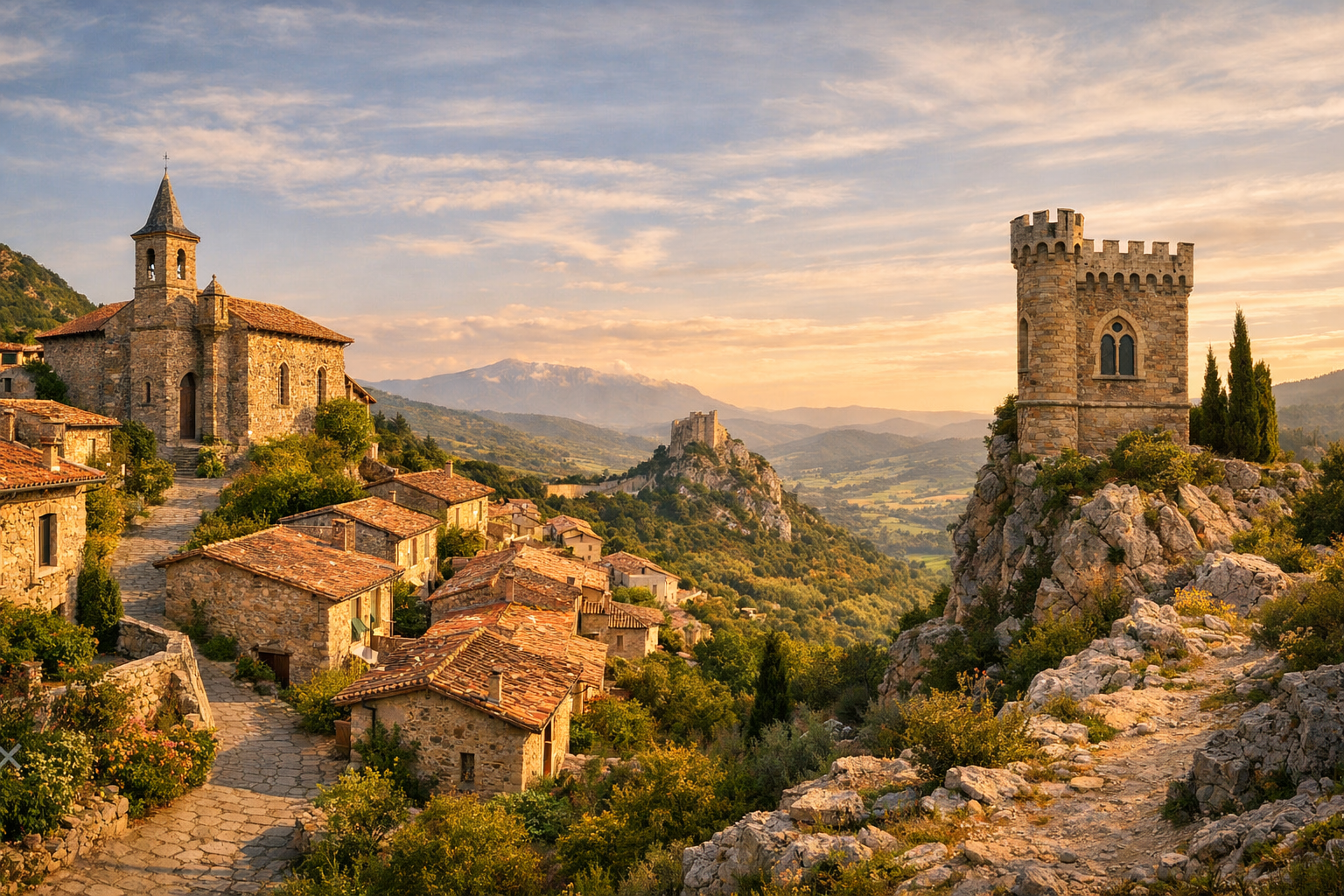
Day 1 — Carcassonne → Couiza → Rennes-le-Chateau
🚆 It is convenient to plan your arrival via Carcassonne. From Carcassonne to Couiza–Montazels station, you can realistically travel by regional TER in about 56–57 minutes with a change in Limoux, and then it is best to allow for a short transfer by taxi or rental car to Rennes-le-Chateau, since the village itself stands on elevated ground and public transport here is limited. If driving from Carcassonne, the road to Rennes-le-Chateau usually takes about 1 hour toward the Upper Aude Valley.
🏰 The main stop of the day is the Domaine de l’Abbé Saunière in Rennes-le-Chateau: the Sainte-Marie-Madeleine church, Magdala Tower, Villa Bethania, and the adjoining terrace with views over the valley. This is a real historical site closely associated with the village priest Bérenger Saunière, who transformed the parish and built this unusual complex in the late 19th and early 20th centuries. A verifiable fact is that Saunière really did invest substantial funds into restoring the church and creating his estate, and the site now operates as a museum and visitor space. The legends begin where people talk about “secret documents,” treasure, hidden codes, the line of Mary Magdalene, the Templars, and esoteric symbols: all of this belongs to local myth, cultural narrative, and a long-standing tourism tradition, but is not recognized by historical scholarship as proven fact.
⛪ Inside the Sainte-Marie-Madeleine church, pay attention to the unusual iconography and decorative details that made the place so famous among lovers of mysticism. The best-known element is the figure of the demon Asmodeus at the entrance. Historically, it is important to understand that this is not “proof of an occult cult,” but rather distinctive religious decor of its era and part of the later interpretive history of Rennes-le-Chateau. This is exactly where it is best to keep balance: look closely, read the museum explanations, compare the symbols with Catholic tradition, and separately with later esoteric interpretations, many of which arose only in the second half of the 20th century.
🌄 After visiting the museum and church, leave time for an unhurried walk through the village. Rennes-le-Chateau really is set on a rocky outcrop with a sweeping panoramic view, and this dramatic landscape largely explains why the place became so easily surrounded by stories of hiding places, initiations, and “power spots.” It is important, however, not to enter private property or try to look for “hidden entrances” outside permitted areas: the whole culture of respectful visiting here is built on the idea that myth can be explored without intruding on residents’ private lives.
💤 It makes sense to spend the night in Couiza so you do not have to do late drives on mountain roads. It is a convenient base for the next days of the route: from here it is relatively close to Alet-les-Bains, Rennes-les-Bains, Bugarach, and Château d’Arques.