
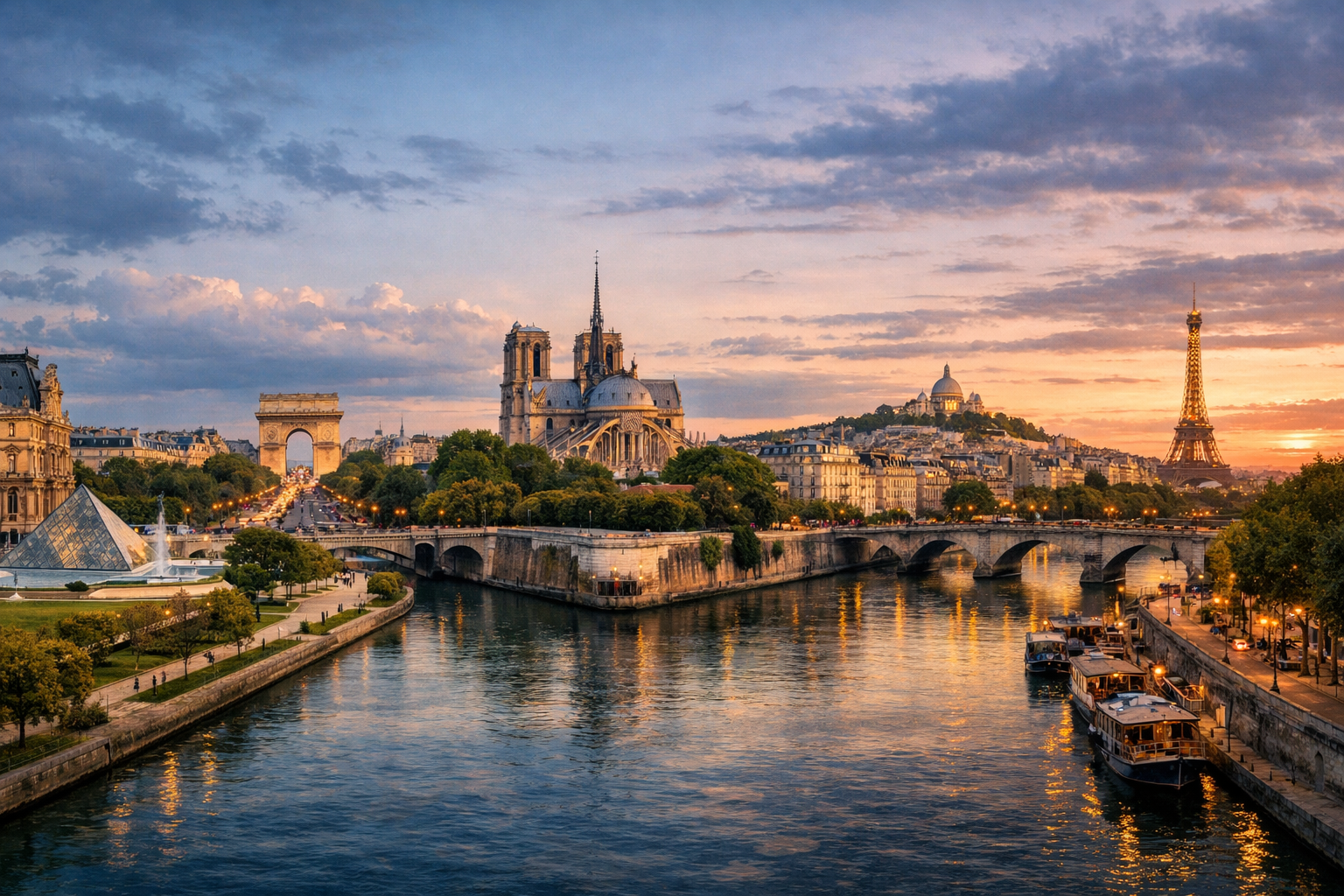
Day 1 — Right Bank: Louvre, Tuileries Garden, Place de la Concorde, Champs-Élysées, and the Arc de Triomphe
✈️ It’s best to plan your arrival in Paris for early morning or before noon so that the first day still feels full but not overloaded. For a short weekend, the most convenient place to stay is in the 1st arrondissement or near Les Halles: from here, you can walk to most of the main points of the route and use the metro only when needed. After check-in, give yourself 45–60 minutes for a shower, coffee, and a short rest — this will make the walk feel less like a race and more like a beautiful, gentle entry into the city.
🚶 Start in the Louvre area. Even if you don’t go inside the museum right away, the space around it already makes a powerful impression: the строгие фасады бывшего королевского дворца, the glass pyramid in the Cour Napoléon, the Arc de Triomphe du Carrousel, and the feeling that you are standing in the very heart of European history. The Louvre is where Paris reveals itself not as scenery, but as a grand stage on which monarchy, revolution, empire, and modernity have all taken turns. If you want, you can set aside 2–2.5 hours for a short, focused visit inside with a pre-booked entry time: for a weekend format, it’s better not to try to “see the whole museum,” but to choose 1–2 wings and a few key halls.
🚶 From the Louvre, it is natural to continue into the Tuileries Garden — one of the most classic and photogenic parks in Paris. This is not just a green pause between landmarks, but a true rhythm of the city: straight alleys, pools reflecting the sky, chairs by the water, neat perspectives, and a sense of Parisian elegance without unnecessary noise. It’s pleasant not to rush here: buy a coffee, sit for a while by the pool, watch people, and give yourself time to feel the vacation rather than just “complete the program.” The walk from the Louvre pyramid through the Tuileries to Place de la Concorde takes about 25–35 minutes without stops, but with photos and an easy pace, plan for about an hour.
🚶 Then the route stretches into the most recognizable axis of Paris: from Place de la Concorde onto the Champs-Élysées. It is better to see this avenue not as a collection of shops, but as the ceremonial line of the capital — broad, grand, with a magnificent perspective and a sense of urban scale. It is beautiful to watch how the atmosphere changes here: from the garden solemnity of the Tuileries to the almost cinematic shine of shop windows, theaters, flags, and streams of people. Walking from Place de la Concorde to the Arc de Triomphe is about 2 km, or roughly 30–40 minutes without long stops. If you get tired, pause at a café halfway down the avenue and don’t turn the walk into a marathon.
🏛️ The final point of the day is the Arc de Triomphe at Place Charles de Gaulle. This is one of those Parisian monuments that works most powerfully closer to evening: the stone takes on warmer tones, the lights of the avenue gradually come on, and from the terrace of the arch, an almost perfect geometry of the city opens up — the avenues radiate in all directions, and Paris feels both strict and endless at once. Beneath the arch is the Tomb of the Unknown Soldier with its eternal flame, which gives the place not only grandeur but also depth. Allow 45–75 minutes for the ascent, security check, stairs, and time to enjoy the views.
🌙 It’s best to finish the first evening without long transfers: either with a calm dinner in the Opéra area or the 1st arrondissement, or with a short metro ride from Charles de Gaulle – Étoile back to the hotel. For a weekend trip, it is more important to save energy for the next day than to try to “squeeze out” the program until midnight.