
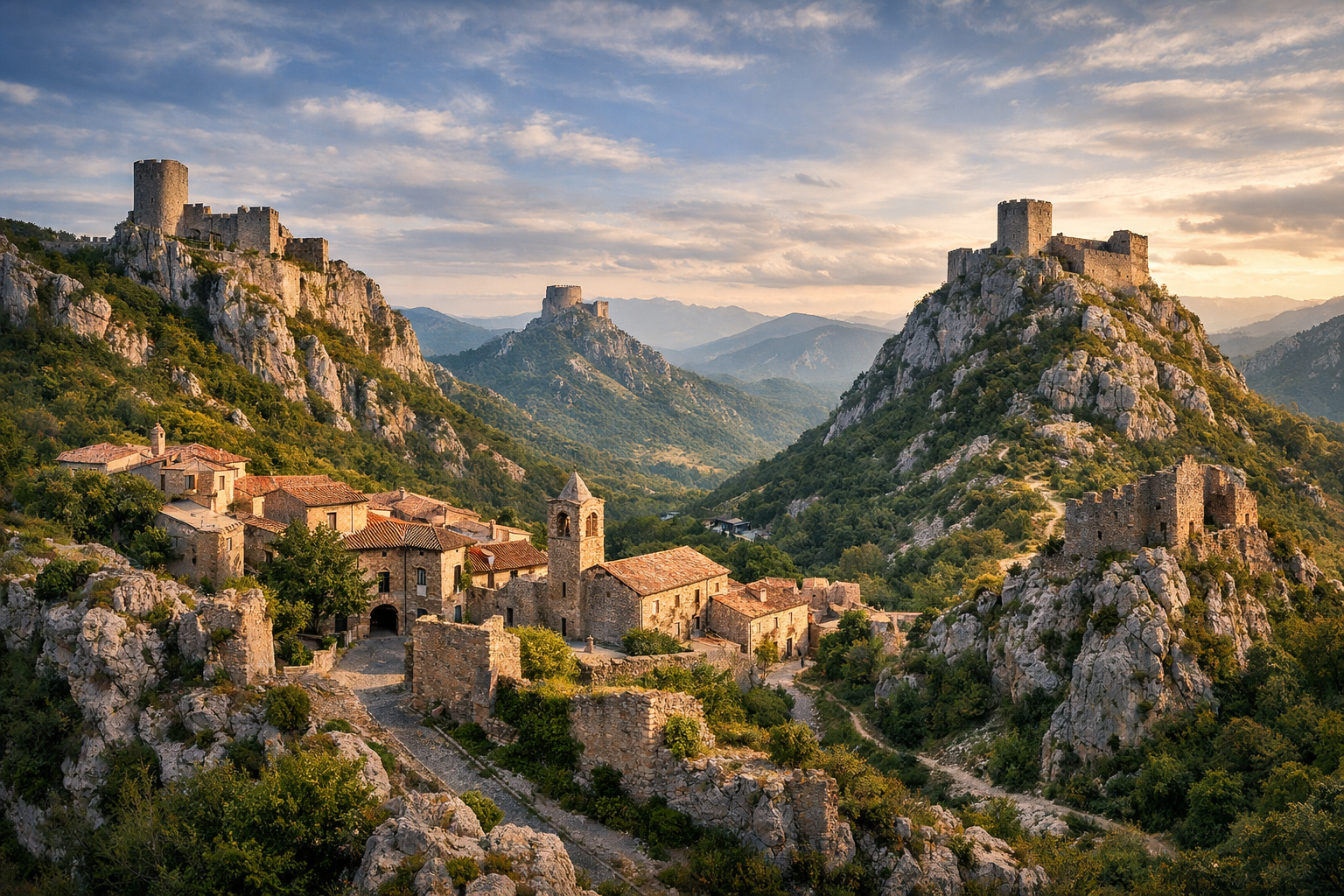
Day 1 — Carcassonne: the medieval citadel, walls, and the context of Cathar history
🚆 Arrival via Carcassonne Sud de France airport or Carcassonne railway station. If arriving by air, the city is easy to reach by taxi, flight-timed transfer, or rental car; for this itinerary a car is especially recommended, because many key esoteric and Cathar sites are scattered across the hilly countryside of Aude and Ariège.
🚶 Begin your journey with Cité de Carcassonne — a powerful medieval fortress with a double ring of walls, towers, and a castle core that helps explain the world in which the Cathars, their opponents, and participants in the Albigensian Crusade lived. Historically, this is not a “Cathar temple” or an occult center, but above all a strategic royal fortress, later restored by Viollet-le-Duc. Yet it is here that the tension of the 13th century is felt especially clearly: the conflict between southern French religious otherness, royal authority, and inquisitorial control. A walk through the streets of the citadel, along the ramparts, and at the foot of the Basilica of Saint-Nazaire sets the right tone for the whole trip: this is not an itinerary about sensations, but about complex history, memory, symbols, and how legend grows around real places.
🏰 Be sure to visit Château Comtal and the inner ramparts. This is the best introductory site for understanding the “royal fortresses of Languedoc,” a group that includes Carcassonne, Peyrepertuse, Quéribus, Puilaurens, Termes, Lastours, and other hilltop citadels of the region. The factual side here is verifiable: fortifications, architecture, sight lines, the defense system. As for talk of “coded signs in the stone” and “the fortress’s secret esoteric messages,” it is better understood as a later interpretation popular in tourist and occult literature, not as proven history.
🕯️ In the second half of the day, you can visit the Musée de l’Inquisition within the citadel itself. This place fits the itinerary well because it helps reflect not only on the Cathar theme, but also on mechanisms of religious persecution, judicial pressure, and the formation of the “dark aura” around the Middle Ages. At the same time, it is important to understand that the museum narrative here is partly built as an immersive popular story, not solely as a strict academic exhibition. It is best seen as a complement to the context, not as the only historical source.
🌆 In the evening, stay inside or at the foot of the Cité. At sunset, the walls of Carcassonne are especially expressive: the stone turns warm golden, and the silhouette of the towers begins to work almost like a theatrical set for legends about the Cathars, the “treasures of heretics,” and hidden manuscripts. This is a good moment to state an important rule for the whole tour: legends, esoteric interpretations, stories about “power spots,” energies, and mysterious phenomena are considered here as part of local culture, folklore, and modern mythology, not as scientifically confirmed fact.