
Buy PDF guide

Buy PDF guide — 6.43 USD

PDF — 6.43 USD

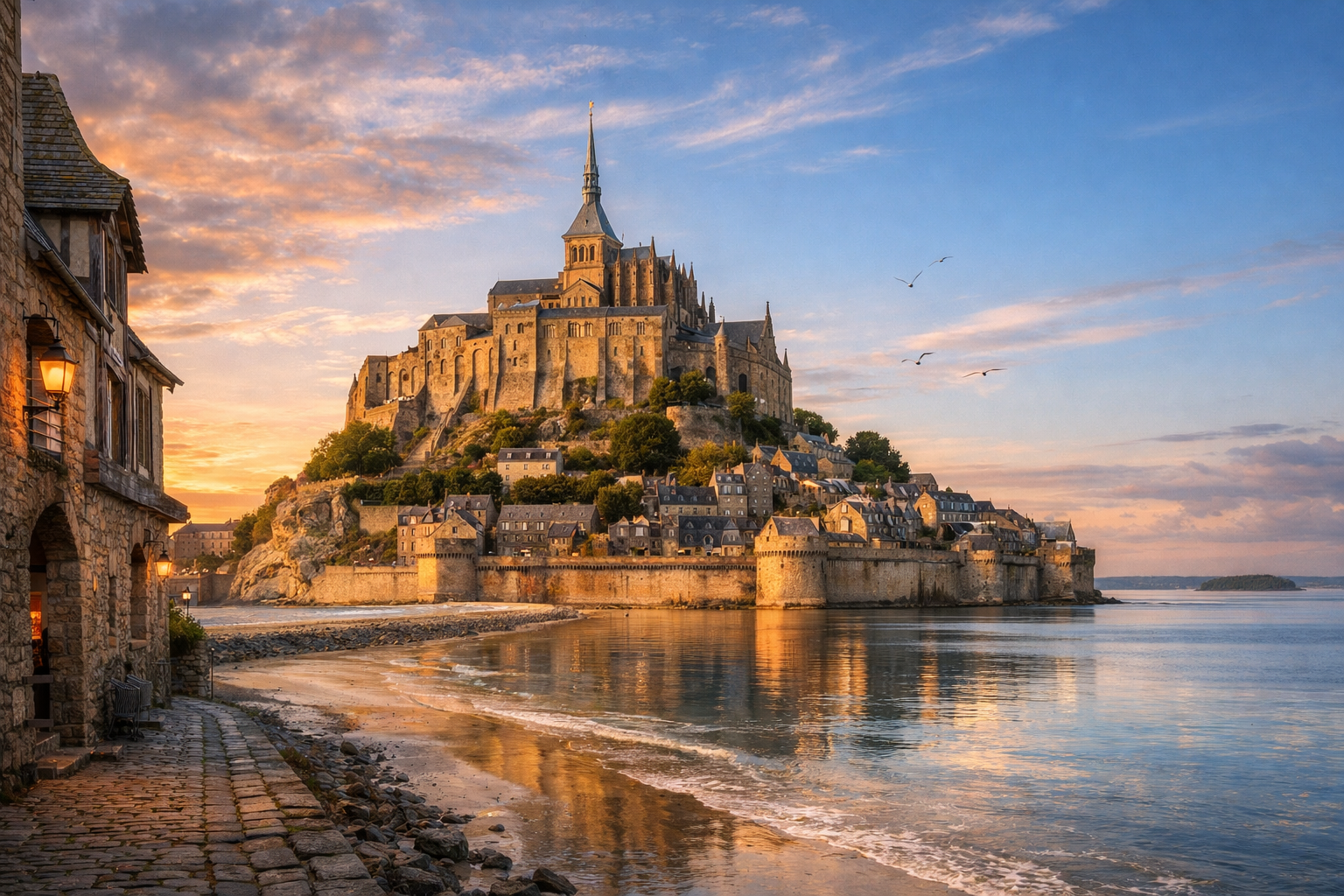
France, Normandy. Mont-Saint-Michel — an island between sky and sea. The abbey, tides, and medieval architecture create an atmospheric route for contemplation, photography, and знакомства with European spiritual tradition.

France, Normandy. Mont-Saint-Michel — an island between sky and sea. The abbey, tides, and medieval architecture create an atmospheric route for contemplation, photography, and знакомства with European spiritual tradition.

Discover Normandy through Mont-Saint-Michel, the dreamlike island rising between sky and sea. From Avranches to the abbey and out across the sweeping bay, this route blends dramatic tides, medieval beauty, and a quiet sense of Europe’s spiritual past.

🧭 DAY-BY-DAY ROUTE

Ready-made country and city routes with daily plans, sights, transport and accommodation. Buy PDF guides for independent travel.

🧭 DAY-BY-DAY ROUTE


Day 1 — Avranches: manuscripts, the archangel, and preparation for Mont-Saint-Michel

  • 🚆 Route base: it is most convenient to arrive in Avranches or Pontorson, and from there continue to Mont-Saint-Michel. For a slow-paced esoteric route, Avranches is especially good as the “city of memory” of Mont-Saint-Michel: this is where the abbey’s medieval manuscripts, saved after the French Revolution, are kept. From Avranches to Mont-Saint-Michel by car is usually about 30–40 minutes, so it makes sense to devote the first day to tuning into the theme of the route, acclimatization, and getting acquainted with the spiritual context of the place without rushing.

  • 🚶 The main point of the day is Scriptorial d’Avranches, the museum of Mont-Saint-Michel manuscripts, Place d’Estouteville, 50300 Avranches. This is not an “esoteric attraction,” but a real museum through which the spiritual history of the region is especially well revealed. Here you can see the context of monastic book culture, understand how the intellectual and liturgical life of the abbey was formed, why the image of Archangel Michael became so powerful in the Western European religious tradition, and how the sacred space of Mont-Saint-Michel was connected not only with pilgrimage, but also with book copying, theology, and visual symbolism. For an esoterically inclined traveler, this is an important introduction: not a promise of “energies,” but a deep encounter with real traces of medieval spiritual imagination.

  • 🕯️ Historical fact: the cult of Archangel Michael at Mont-Saint-Michel is linked to an early medieval tradition about Saint Aubert, bishop of Avranches, to whom, according to church tradition, the archangel appeared and commanded him to establish a sanctuary on the rock. The legend of the apparition is part of religious memory and local Christian culture; by itself it is not a scientifically verifiable event. However, this very tradition lies at the origin of the shrine and makes Avranches an important point of the route no less than the island itself.

  • 🌿 After the museum, it is worth taking a walk in Jardin des Plantes, Place Carnot, 50300 Avranches. This is not an occult site, but a historic city garden with an impressive view of the bay and Mont-Saint-Michel itself. In the context of the route, it works as a place of contemplation: from here it is convenient to watch the rock emerge on the horizon almost like a mirage. In literary and tourist descriptions, such panoramas are often called “magical,” but it is more accurate to speak of a rare combination of landscape, light, humid air, and tidal geography that truly produces a strong emotional impression.

  • 💤 It is best to spend the evening calmly: an early dinner, rest, and preparation for an early departure or move to Mont-Saint-Michel the next day. If you want to reach the abbey during quieter hours and take strong photographs of empty staircases, stone terraces, and naves, an early start really matters here. For the inner logic of an esoteric tour, the first day is not about a “miracle,” but about tuning perception: manuscripts, the tradition of Michael, the view of the bay, and the understanding that Mont-Saint-Michel is first and foremost a real historical shrine, and only then an object of romantic legends.


Day 2 — Mont-Saint-Michel: the abbey, the medieval cosmos, and the island’s nighttime atmosphere

  • 🚆 Transfer: Avranches → Mont-Saint-Michel area — usually about 30–40 minutes by car or taxi; from the parking lots and tourist center to the foot of the island, allow additional time. From the parking lots to the entrance of the abbey, it usually takes about 45–60 minutes in total, including the free Le Passeur shuttle or the walk along the causeway and the ascent through the village.

  • 🚶 The main point of the journey is Abbaye du Mont-Saint-Michel, 50170 Le Mont-Saint-Michel. This is one of the most important monuments of medieval religious architecture in Europe, rising on a rocky island in a tidal bay. Historically it is a major pilgrimage center, and architecturally it is a rare fusion of monastery, fortress, and vertical symbolic landscape. Here the medieval idea of ascent is especially tangible: the path goes from bottom to top, through the gate, street, stairs, and halls, toward higher and quieter spaces. In esoteric interpretation, many see this as an “initiatory route,” but this is precisely a modern symbolic reading. The verifiable fact is that the composition of the abbey truly creates an experience of gradual ascent, disciplined movement, and changing states — from market bustle to monastic austerity.

  • 🕯️ Inside the abbey, the cloister, terraces, refectory, and halls associated with monastic life and book culture are especially important. These spaces do not require mystification: the geometry of light itself, the austere stone, the height above the bay, and the sense of separation from the mainland already create an almost timeless atmosphere. In the European esoteric and romantic tradition, Mont-Saint-Michel was often interpreted as an “axis” between sea, sky, and stone, a place at the boundary of elements and spiritual trial. This is a cultural interpretation, not a proven “phenomenon of power,” but it explains why the place has for centuries attracted not only pilgrims and historians, but also artists, symbolists, photographers, and those seeking a solitary experience.

  • ⛪ It is also worth visiting the parish church of Saint-Pierre on Mont-Saint-Michel itself. Today it is an active place of worship, so it is especially important here to keep quiet, not disturb prayer, and pay close attention to signs about photography. For the route, this is an important “gentle” point: unlike the grand verticality of the abbey, the church offers a more intimate experience of a living religious tradition. To speak honestly and without exaggeration, the spiritual intensity of this place is connected not with miracles, but with the duration of continuous veneration, ritual, and memory.

  • 🌊 In the second half of the day, leave time not only for interiors, but also for observing the bay, the light, and the tidal landscape. It is the tides that made the image of Mont-Saint-Michel so powerful: at times the island looks like an almost inaccessible rock among waters and shimmering surfaces, and at other times it becomes more accessible by the causeway and surrounding paths. In popular culture, this has given rise to many stories about an island that “appears” and “disappears,” about mirages and the special energy of the tide. The accurate way to put it is this: the drama of the place is explained by the exceptional geography of the bay, rapidly changing light, weather, and the rhythm of the water; mystical interpretations belong to the realm of folklore and personal experience.

  • 🌙 If you still have the energy, a very beautiful end to the day is to stay on the island or in the nearby mainland area and return to the views of Mont-Saint-Michel in the evening. After the daytime crowds, the place changes dramatically: the stone darkens, the windows glow, and the silhouette of the abbey becomes almost theatrical. It is at this time that the not-touristic but archetypal image of the “island-monastery” is felt best. For photographers and those seeking a contemplative rhythm, this may be the strongest moment of the entire trip.

Day 3 — Mont-Saint-Michel Bay: the pilgrimage path, crossing the bay, and completing the route

  • 🚶 Devote the third day not to another long museum block, but to the landscape of the bay itself. The best esoteric gesture here is not to look for “secret places of power,” but to pass through the ancient motif of pilgrimage with the body: wind, sand, the rhythm of steps, humid air, the open horizon. If weather, season, and physical condition allow, you can choose a walk across the bay only with a certified guide. Independent outings onto muddy areas and sands are dangerous because of tides, channels, quicksand zones, and terrain features.

  • 🥾 Historical fact: crossings through the bay are indeed connected with the centuries-old pilgrimage practice of approaching Mont-Saint-Michel. Modern walks across the bay are above all a natural and cultural experience and a way to understand how the shrine was perceived before the appearance of modern infrastructure. Romantic stories about “initiation through sand and water” are a beautiful interpretation, but not a historical term. Nevertheless, this is exactly the kind of route that best completes the theme of the island between land, sea, and sky.

  • 🌾 If a full crossing of the bay does not fit your time frame or safety requirements, choose a gentler option: a walk along the causeway, nearby footpaths, and viewpoints on the mainland side. Visually this gives no less: you see how Mont-Saint-Michel gradually changes scale and seems now close, now distant, as if it does not belong to a single plane of reality. This impression is often what gives rise to “mystical” descriptions in guidebooks and personal accounts.

  • 🐉 For an additional, lighter stop, you can visit Alligator Bay, 62 Route du Mont Saint-Michel, 50170 Beauvoir. This is not a sacred site, but within the route it can work as a cultural counterpoint: the image of the dragon, serpent, and reptile is deeply embedded in European religious symbolism, including the iconography of Michael as the conqueror of chaos and evil. It is important not to substitute one for the other: the park is a modern family space, not a “museum of occultism,” but if you wish, it can be understood as a final visual rhyme to the archangelic theme.

  • 🧭 End the route with a calm lunch and departure via Pontorson, Avranches, or toward Rennes. This three-day tour is good precisely because of its compactness: it does not sprawl across all of France, but keeps attention on one of the strongest sacred landscapes in Europe. The final idea of the journey is simple: Mont-Saint-Michel is valuable not because supernatural forces supposedly demonstrably operate here, but because the history of pilgrimage, medieval architecture, manuscript culture, tidal geography, legends of the archangel, and a very powerful human experience of the boundary between the elements all converge here with extraordinary density.

Flight tickets

eSIM for travel

Buy PDF guide

Buy PDF guide — 6.43 USD

PDF — 6.43 USD