
Buy PDF guide

Buy PDF guide — 8.57 USD

PDF — 8.57 USD

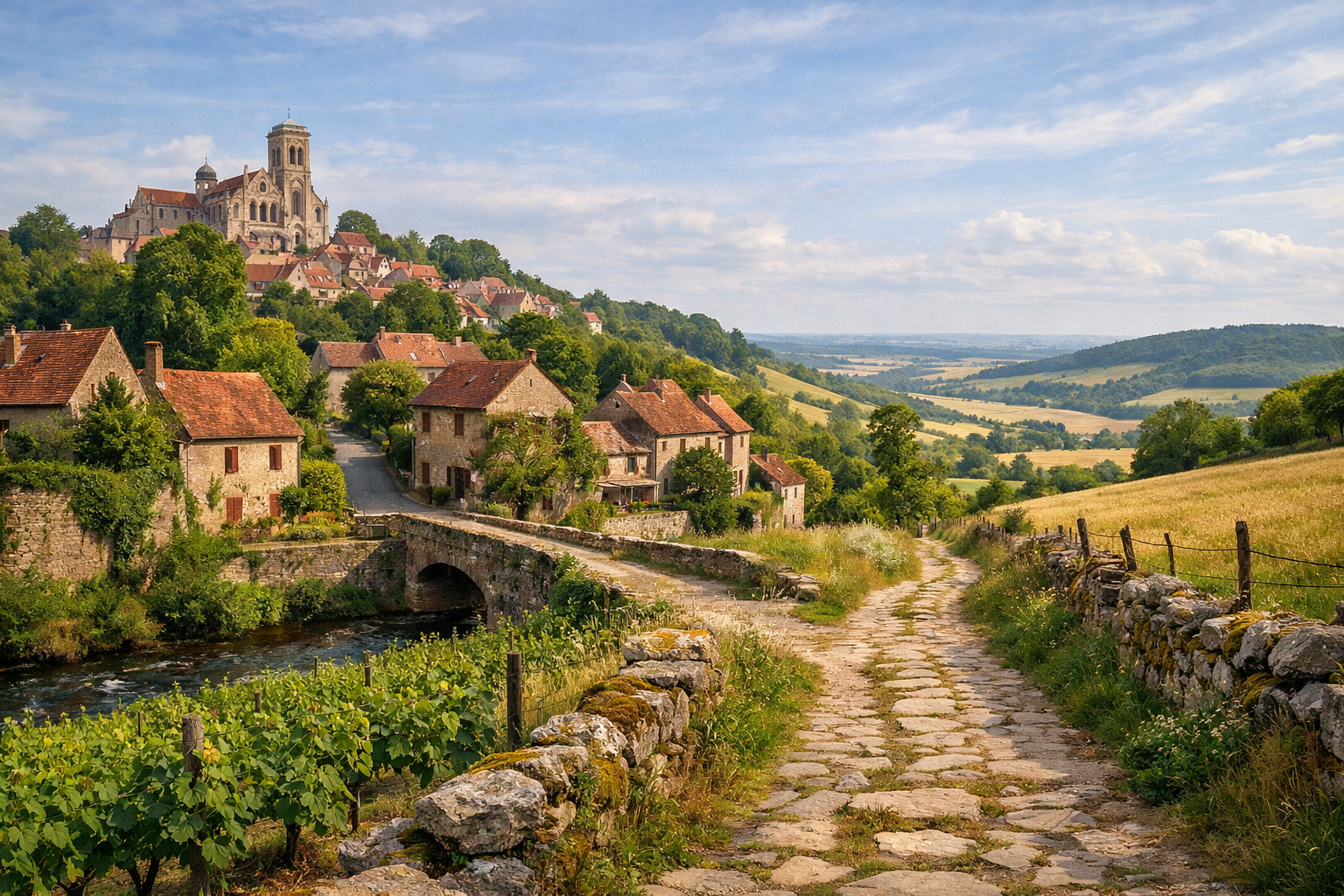
France, Burgundy. Vézelay and the pilgrims' road. The Basilica of Vézelay, quiet villages, and stretches of ancient pilgrimage roads for a peaceful journey and a digital detox.

France, Burgundy. Vézelay and the pilgrims' road. The Basilica of Vézelay, quiet villages, and stretches of ancient pilgrimage roads for a peaceful journey and a digital detox.

Follow the ancient pilgrims’ road through Burgundy, from the hilltop basilica of Vézelay to the quiet lanes of Asquins, Avallon, and La Pierre-qui-Vire. Along the way, peaceful villages, wooded paths, and timeless stone landscapes invite you to slow down and truly switch off.

🧭 DAY-BY-DAY ROUTE

Ready-made country and city routes with daily plans, sights, transport and accommodation. Buy PDF guides for independent travel.

🧭 DAY-BY-DAY ROUTE


Day 1 — Vézelay: the basilica, the “eternal hill,” and the silence of a pilgrim departure point

  • 🚆 Transfer: Paris-Bercy → Sermizelles-Vézelay by TER, usually about 2h 20m–2h 50m depending on the service; then during operating hours a local navette/shuttle runs to the lower part of the village, after which you still have the climb on foot up to Vézelay itself. For a journey at a calm pace, it’s better to allow nearly half a day for the road, check-in, and a first slow outing without overwhelming yourself with impressions.

  • 🚶 Vézelay is one of the most atmospheric places in Burgundy, where the real history of pilgrimage, Romanesque architecture, and centuries of symbolism quite literally layer over one another. Since the 11th century, the hill of Vézelay has been associated with the pilgrimage tradition and is considered a historic starting point of one of the routes to Santiago de Compostela. The main focal point here is the Basilica of Sainte-Marie-Madeleine, a recognized masterpiece of Burgundian Romanesque art. For an esoterically minded traveler, this place matters not because supernatural forces are supposedly “proven” to be present here, but because the architecture and visual program of the church convey a medieval attempt to express the cosmos, the path of the soul, light, trial, and transformation. Special attention should be paid to the narthex and the sculpted tympanum: even without religious training, they are perceived as a stone map of the spiritual world, where order, fear, mission, and mystery come together in a single visual text.

  • 🌞 In Vézelay’s cultural memory, the summer light phenomenon inside the basilica is especially famous: around the summer solstice, the midday light aligns along the nave into a distinct axis of light. This is a real observable architectural-light phenomenon that often inspires mystical interpretations among visitors. It is important to separate fact from interpretation: the light pattern itself is explained by the building’s orientation and the position of the sun, while talk of an “initiation code,” “secret knowledge of the builders,” or a “planetary-scale place of power” belongs to the realm of symbolic and esoteric interpretations rather than scientifically confirmed conclusions.

  • 🚶 After the basilica, the best plan for the day is not to rush, but to walk along rue Saint-Pierre and the surrounding quiet lanes, letting the place reveal itself gradually. Vézelay is small, but that is exactly its strength for a digital detox: instead of a long checklist, what works here is a slow gaze — stone facades, old gates, the silence of the slopes, rare voices, and panoramas over the valleys of the Vézelien. Toward evening, you can choose a short meditative walk to the edge of the hill to see how the village seems to float above the landscape. In esoteric culture, such elevated sanctuaries were often perceived as points of transition between the “ordinary” and the “ascending” path; historically, however, this is simply a very well-situated sacred hill whose topography heightens the impression of pilgrimage arrival.

  • 🙏 Practice of the day: enter the basilica not as a museum, but as a living sacred space. Speak softly, do not disturb prayer and services, check which areas discourage photography, and keep in mind that part of the day in religious places follows the liturgical rhythm. For a digital detox, it is helpful to leave your phone in airplane mode at least for the duration of the visit and the first evening walk.


Day 2 — Asquins and a stretch of the route: the pilgrims’ road, Saint-Jacques Church, and the landscape as an inner practice

  • 🚶 The morning is best devoted to a calm walk out of Vézelay toward Asquins — a settlement at the foot of the hill historically linked with pilgrimage movement. The walk itself is not long and is realistic for an unhurried route: this is not a sports trek, but a contemplative walk along one of the stretches associated with Via Vézelay / GR 654. On roads like these, what matters is not a mileage “tick,” but the rhythm of the way: step, pause, breath, repetition. That is why ancient pilgrimage roads are so often reinterpreted today not only in a religious sense, but also in psychological, meditative, and even symbolically esoteric ways.

  • ⛪ The Church of Saint-Jacques in Asquins is an authentic point of pilgrimage memory. Historically, Asquins served as a gathering place for pilgrims arriving from different directions before they climbed to Vézelay or continued onward. For this thematic route, that matters: here you can see how the “mysticism of the road” arises not from fantasy, but from the real centuries-old practice of people moving in search of repentance, meaning, a vow, or a change of fate. In local culture, the Way of Saint James is often surrounded by stories of signs, inner illuminations, special dreams, and encounters, but such experiences always remain subjective and cannot be presented as verifiable facts.

  • 🌿 After visiting Asquins, it makes sense to walk a little farther along a rural stretch of the route and then return to Vézelay or rest below, without trying to do too much. The landscape here is an important part of the experience: gentle slopes, fields, small woods, and the gradual unfolding of the hill of Vézelay help explain why places like this gained a reputation over the centuries as “threshold” spaces. In esoteric imagination, such areas were often seen as zones of transition, purification, and attunement. Scientifically, this does not prove any special “energy,” but culturally and psychologically it is easy to explain: the repeated rhythm of footsteps, distance from noise, the dominant outline of the sanctuary on the horizon, and the religious memory of the landscape truly have a strong effect on perception.

  • 📚 In the second half of the day, you can return to Vézelay and visit the Musée Zervos. Although it is not an esoteric museum in the direct sense, it works well on this route as an intellectual pause: the collection reminds us that the 20th century rediscovered an interest in archaism, myth, form, ancient civilizations, and primal symbols. For a thoughtful journey, this is a useful counterpoint to the medieval sacredness of the basilica: here it is no longer pilgrimage, but the cultural archaeology of the image.

  • 💤 It is best to leave the evening as empty as possible. This route is conceived not as a hunt for sights, but as a gentle immersion. The ideal end to the day is an early dinner, notes in a paper notebook, watching twilight, and avoiding screens at least after 20:00.

Day 3 — Avallon and the Cousin Valley: archaeological layers, local legends, and the silence of old stones

  • 🚆 Transfer: Vézelay/surroundings → Avallon, by taxi or local road transport usually about 20–30 minutes, depending on the departure point and schedule. Avallon is convenient as a practical base: it is easier to reach, has more services, and the town itself remains intimate enough for a calm pace.

  • 🏛️ The morning can begin with the Musée de l’Avallonnais Jean Després. For an esoteric route, this is not a random stop: archaeological and regional museums help ground any stories of “ancient mystery” in real material — prehistoric finds, local history, the world of objects, traces of cults, and burial practices. Such a visit is useful as intellectual hygiene: it reminds us that there is a difference between archaeology, religion, folklore, and modern mystical interpretations, and that difference deserves respect.

  • 🚶 Then it is worth walking through old Avallon and mentally — and, if you wish, literally — descending toward the theme of the Cousin valley. The town stands on a granite spur and has long been perceived as a threshold between settled land and the wilder landscape of the Morvan. In places like this, legends almost inevitably arise: about ancient stones, forgotten sanctuaries, underground traces of the past, and “mute” paths. Such stories should be presented carefully: they are part of local cultural imagination, not proven sacred geography. But it is precisely this liminality — a fortress above water, an old town, forested directions all around — that makes Avallon a good link in an esoteric route.

  • 🌲 In the second half of the day, you can choose a gentle walk toward natural areas connected with the Cousin valley, or simply limit yourself to contemplative spots within the town itself. The principle of safety matters here: do not head onto wild trails without an offline map, take the weather into account, do not rely on late buses, and do not enter private land. In rain, the stone steps and forest paths of the region can be slippery. For a journey in the spirit of digital detox, it is better to choose a short walk with long pauses than an ambitious forced march.

  • 🌘 The thematic practice of the day is to observe how the feeling of a “mysterious place” is created by the combination of relief, history, and personal state. There is no need to look for a miracle as an event; here it is more interesting to notice how old towns and natural thresholds trigger a special kind of attention. This is the honest form of mystical travel without inventing supernatural facts.

Day 4 — La Pierre-qui-Vire: monastic silence, a legendary stone, and the route’s finale in the Morvan

  • 🚗 Transfer: Avallon → Abbaye Sainte-Marie de la Pierre-qui-Vire, usually about 25–35 minutes by car/taxi along the forest roads of the Morvan. This is the most secluded day of the route, and that is exactly why it works well as the finale: after the basilica, the pilgrimage road, and the old town, you move into a deeper silence.

  • ⛪ La Pierre-qui-Vire Abbey is a real 19th-century Benedictine monastery set in powerful forest surroundings. The very name, “The Stone That Turns,” refers to a local stone phenomenon and the imagery that formed around it. The historical fact is that the monastery has indeed existed here since 1850 and remains a place of prayer, work, and hospitality. The legendary layer is connected to the stone itself and to the broader cultural motif of the “rocking” or “living” boulder, which in Europe was often credited with ancient sacred meaning, druidic memory, or special power. Such versions cannot be affirmed as established ancient cult truth without reliable archaeological data; it is more accurate to say that this is a widespread type of folk and esoteric interpretation of unusual stones.

  • 🕯️ For the final day, this place is especially valuable not for sensation, but for its mode of presence. The monastery has a liturgical schedule, hospitality, a shop, and a library atmosphere; if you wish, you can plan your visit around Mass or Vespers, provided this is done respectfully and without tourist fuss. Even for a nonreligious traveler, the meaning of such a space is clear: the repetition of hours, work, forest, stone, water, limited signal, and the absence of a noisy flow create a rare opportunity to “switch your inner speed.”

  • 🌲 The forest and rocks around the abbey are often described as a “place of power” — such wording appears regularly in tourist texts and personal stories. Within this route, it is important to state the boundary clearly: this is the language of personal experience and cultural mythology, not a scientifically confirmed property of the territory. But as a way of describing concentrated silence, the depth of the landscape, and the feeling of separation from everyday life, this vocabulary is understandable. If you want to live the day more deeply, you can try a simple practice: walk in silence for 30–40 minutes without taking photos, and then write down not “what I saw,” but “what changed in the pace of my attention.”

  • 🙏 It is worth ending the route without haste: a light lunch, a short walk, return to Avallon or to the station for onward departure. If you are leaving the same day, it is better not to schedule a tight connection: rural transfers and local mobility in this region require extra time.

Flight tickets

eSIM for travel

Buy PDF guide

Buy PDF guide — 8.57 USD

PDF — 8.57 USD