
Buy PDF guide

Buy PDF guide — 8.57 USD

PDF — 8.57 USD

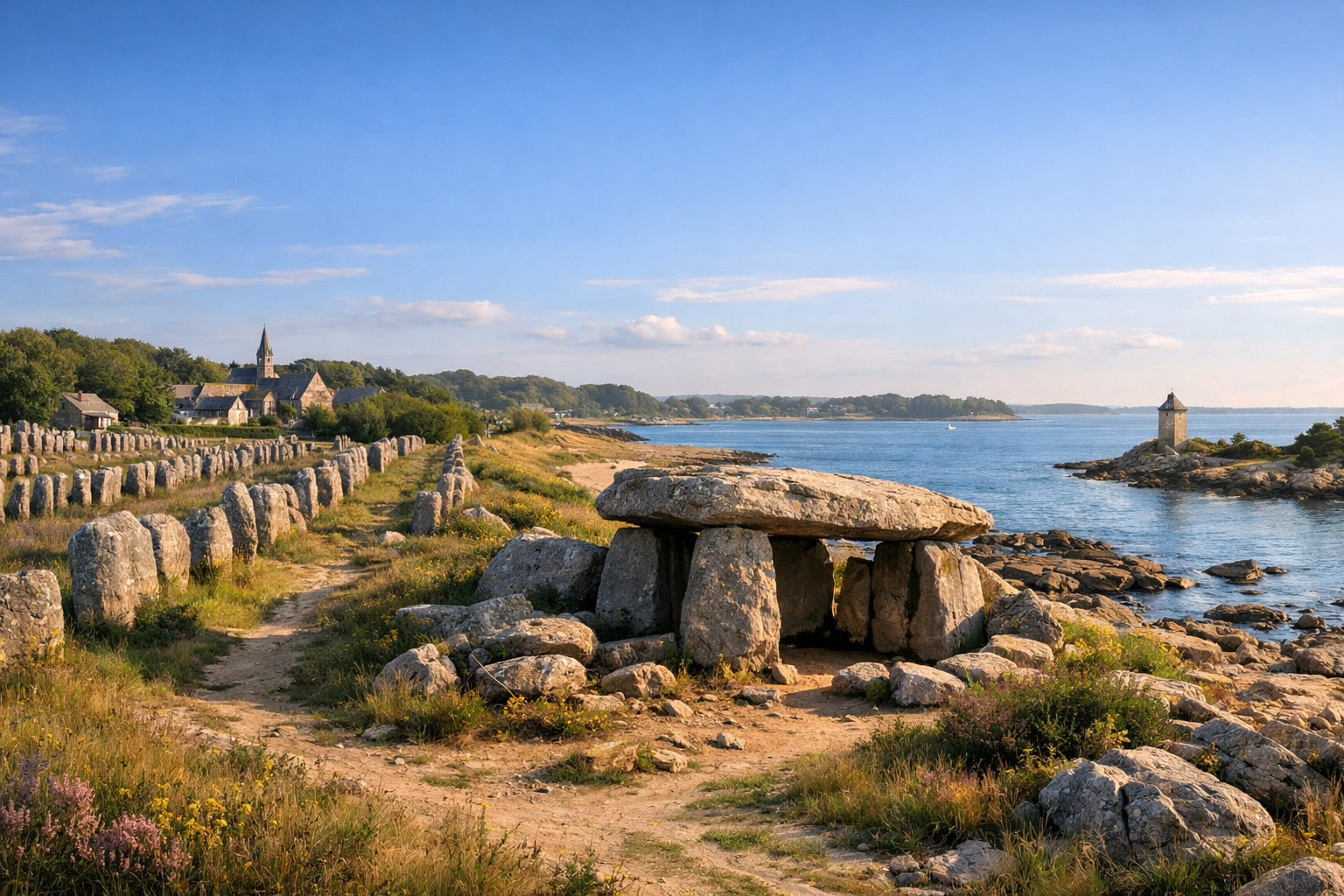
France, Brittany. The megaliths of Carnac. Huge rows of menhirs, dolmens, and the coast of Morbihan in an itinerary for lovers of archaeology, ancient mysteries, and meditative walks.

France, Brittany. The megaliths of Carnac. Huge rows of menhirs, dolmens, and the coast of Morbihan in an itinerary for lovers of archaeology, ancient mysteries, and meditative walks.

In Brittany, the megaliths of Carnac rise in vast, haunting rows, where menhirs and dolmens turn the landscape into one of Europe’s great archaeological mysteries. Follow the coast from Auray and Sainte-Anne-d’Auray through Carnac and Locmariaquer to the Gulf of Morbihan for ancient sites, sea air, and meditative walks.

🧭 DAY-BY-DAY ITINERARY

Ready-made country and city routes with daily plans, sights, transport and accommodation. Buy PDF guides for independent travel.

🧭 DAY-BY-DAY ITINERARY


Day 1 — Auray and Sainte-Anne-d’Auray: tuning into Brittany, pilgrimage mysticism, and a gentle introduction to the theme

  • 🚆 It is most convenient to plan your main arrival via the Auray railway station, from which Sainte-Anne-d’Auray and Carnac are already relatively short transfers by taxi, bus, or rental car. For a 4-day route, it makes sense to set up one compact base in the Auray/Carnac area so you do not waste energy constantly changing hotels.

  • 🚶 Begin the journey with Sainte-Anne-d’Auray, one of Brittany’s most important pilgrimage centers. This is not a megalithic site but a Christian sanctuary, yet it is precisely here that you can best feel how different layers of sacred geography overlap in Brittany: prehistoric landscapes, medieval religiosity, local visions, vows, and processions. Historically, the place is linked to the cult of Saint Anne and the development of pilgrimage in the 17th century; architecturally, the basilica, the monumental square, and the calm space for contemplative walking are important here. In esoteric and mystical interpretations, such sanctuaries are sometimes described as “nodes of spiritual memory,” though this should be understood as a cultural interpretation rather than a proven fact.

  • 🚶 After visiting the basilica and the square, take time to walk through the grounds slowly and without rushing: in Brittany, it is precisely the slow pace that helps you read the landscape better. It is appropriate to see this place as a threshold before Carnac: not as a sensation, but as a tuning point for a region where faith, folklore, and stone have coexisted for centuries. It is important to keep quiet, especially in prayer areas and during services, and to take photos inside only where this is explicitly permitted.

  • 🌿 In the second half of the day, take a gentle walk around Auray. The old town, with its stairways, stone facades, and southern Brittany atmosphere, is not an esoteric center in the strict sense, but it helps you enter the context of Morbihan: rivers, tidal rhythms, old trade routes, and proximity to the coast. It is best to keep the evening calm: an early dinner, sleep without overload, and preparation for the most eventful archaeological day of the route.


Day 2 — Carnac: alignements du Ménec, Maison des Mégalithes, Musée de Préhistoire, and Saint-Michel tumulus

  • 🚗 The drive from Auray to Carnac usually takes about 20–25 minutes by car, and from the Sainte-Anne-d’Auray area about 25–35 minutes depending on traffic. By public transport, the route requires more flexibility, so for this trip a car or taxi is especially convenient.

  • 🚶 Start the morning at Maison des Mégalithes, the official interpretation center at the alignements du Ménec. This is the right starting point: first context, then contemplation. The main thing to understand here is this: the Carnac rows are one of the largest megalithic complexes in Europe, dating to the Neolithic, not a “lost civilization” in the popular sensational sense. Modern archaeology speaks of the complex ritual and social function of such structures, but far from all questions have final answers. That is exactly why Carnac so strongly attracts people interested in ancient mysteries.

  • 🚶 Then move on to the alignements du Ménec. The immense rows of menhirs here make a powerful impression not because of a single monument, but because of rhythm: the stones are arranged in a repeating sequence, and the landscape seems to turn into a prehistoric text that we no longer know how to read completely. For lovers of esoteric routes, Carnac is often interpreted as a “place of power,” a “stone mandala,” or an ancient astronomical system. These ideas exist in popular culture and in local stories, but they are not considered scientifically proven. What is factually confirmed is the exceptional antiquity of the complex, its scale, and its multilayered history of research.

  • 🚶 It is also important to remember the access rules: free approach depends on the season and the protection regime of the site, and some zones can be visited only via organized paths or with guided accompaniment. Do not climb over barriers, do not try to touch vulnerable stones, and do not enter closed parts of the field: this is simultaneously a matter of safety, respect for the monument, and preservation of the archaeological landscape.

  • 🏛️ After the megaliths, head to the Musée de Préhistoire de Carnac. This museum is especially important precisely for an esoteric route because it brings the journey back from the realm of beautiful fantasies into the realm of material evidence: grave goods, everyday objects, finds from nearby monuments, and explanations of chronology and the local Neolithic. The best effect comes from the combination: first you stand among the stones and allow for mystery, then in the museum you see that behind the mystery are real people, rituals, crafts, and collective memory.

  • ⛰️ Toward evening, climb up to Tumulus Saint-Michel. This is one of the most spectacular viewpoints in Carnac and an important megalithic monument of the region. Historically, it is a large tumulus later crowned by a chapel; visually, it is especially clear here how the prehistoric site and the Christian layer have fused into a single landscape. In folkloric and occult interpretations, such hills are often perceived as special points of intersection between the “earthly” and the “heavenly,” but for an accurate description it is important to separate symbolic language from verifiable data. The practical point of the visit is simple: it is an ideal place for a quiet sunset, sea wind, and a meditative walk without haste.

Day 3 — Locmariaquer and western Morbihan: Grand Menhir Brisé, Table des Marchands, Er Grah

  • 🚗 From Carnac to Locmariaquer it is usually about 20–25 minutes by car. This is a very logical outing without an exhausting transfer: you remain within the same cultural and geographical circle, but you see a different facet of megalithic Brittany.

  • 🚶 The Locmariaquer megalith site is an essential continuation of Carnac for those who love not only the effect of scale, but also concentration of meaning. Here, three key monuments are gathered on one site: Grand Menhir Brisé, Tumulus d’Er Grah, and the dolmen de la Table des Marchands. In essence, it is an open-air textbook of Neolithic monumentality.

  • 🪨 Grand Menhir Brisé, now lying broken, has a particularly strong effect on the imagination. Even in its ruined state, it reminds us of the almost unthinkable engineering and organizational effort of Neolithic communities. In esoteric circles, it is sometimes described as a “fallen axial stone” or a symbol of the disruption of an ancient cosmic order. This is a beautiful but speculative interpretation. The verifiable fact is different: before us is one of the most impressive megalithic monuments in Brittany, linked to a larger ensemble and giving a sense of the scale of construction in the 5th millennium BCE.

  • 🚶 Table des Marchands creates an entirely different impression: here, not only the size matters, but also the feeling of entering an ancient collective tomb. This place is especially appealing to those drawn to themes of initiation, passage, the boundary between worlds, and the archetype of the underground sanctuary. Such interpretations are possible as a cultural reading of the monument, but not as a scientific conclusion. From an archaeological point of view, it is a funerary monument that helps explain the ritual practices of the Neolithic in Armorica.

  • 🚶 Tumulus d’Er Grah completes the composition of the day. Its massiveness and elongated form make it easier to feel that megalithic Brittany is not only about solitary standing stones, but also about complex ensembles linked to burial, territory, and collective organization. Allow at least 1.5–2 hours for the visit without rushing. After Carnac, Locmariaquer is usually perceived more deeply: less visual noise, more concentration, and more intellectual pleasure.

  • 🌊 Dedicate the second half of the day to a coastal walk around Locmariaquer or nearby views over the Gulf of Morbihan. This is an important part of an esoteric route precisely because water, tides, stone, and the open horizon create the contemplative pause without which the megaliths turn into just a list of sites. In local culture, the sea and the megaliths are often united into a single image of ancient Brittany, full of legends about drowned lands, saints, giants, and memorial stones.

Day 4 — Larmor-Baden and the Gulf of Morbihan: Gavrinis, island perspectives, and a quiet finale

  • 🚗 From Carnac to the departure port in the Larmor-Baden/Port-Blanc area it is usually about 30–40 minutes by car. A trip to Gavrinis needs to be planned in advance, since the visit depends on boat logistics, weather, season, and excursion schedules.

  • ⛵ Gavrinis is one of the strongest possible finales for such a route. It is a megalithic cairn on an island in the Gulf of Morbihan, known above all for the exceptional ornamentation of its interior slabs. Unlike Carnac, where the main thing is the scale of the landscape, here the intimacy of sacred space dominates: a narrow passage, an inner chamber, stone surfaces with signs that seem at once like geometry, writing, and pure ritual. Scientifically, this is not writing in the usual sense, but decorative-symbolic carving from the Neolithic era; however, it is precisely such monuments that most often become the center of mystical interpretations.

  • 🌀 In esoteric descriptions, Gavrinis is often called a place of initiation, a “stone temple,” or a space of altered perception. It is more accurate to put it this way: the visual and acoustic impression really is very strong, and the combination of an island approach with immersion into an ancient chamber easily gives visitors a subjective feeling of threshold, mystery, and special concentration. These experiences are real as personal experience, but they do not prove any supernatural properties of the place.

  • ⚠️ Practically, it is important to keep several things in mind: access is only within the framework of an organized visit, weather in the gulf changes quickly, stable footwear is necessary, and people with pronounced claustrophobia may find the tight interior spaces uncomfortable. It is also not worth counting on complete freedom with timing — island sites are always subject to boat schedules and excursion slots.

  • 🌿 After Gavrinis, finish the journey with a slow walk along the shores of Morbihan. If you want something more secular but still contemplative as an aftertaste, you can add a short detour toward the region’s park landscapes, or simply remain on the coast and let the route end without unnecessary density. The idea of the finale is not to “collect a few more sites,” but to allow Brittany to dissolve into memory: stone rows, sea wind, ancient tombs, legends about the powers of the earth, and the sober understanding that the grandeur of these places does not need sensational embellishment.

Flight tickets

eSIM for travel

Buy PDF guide

Buy PDF guide — 8.57 USD

PDF — 8.57 USD