Buy PDF guide

Buy PDF guide — 25.71 USD

PDF — 25.71 USD

FLORENCE AND THE RENAISSANCE

FLORENCE AND THE RENAISSANCE

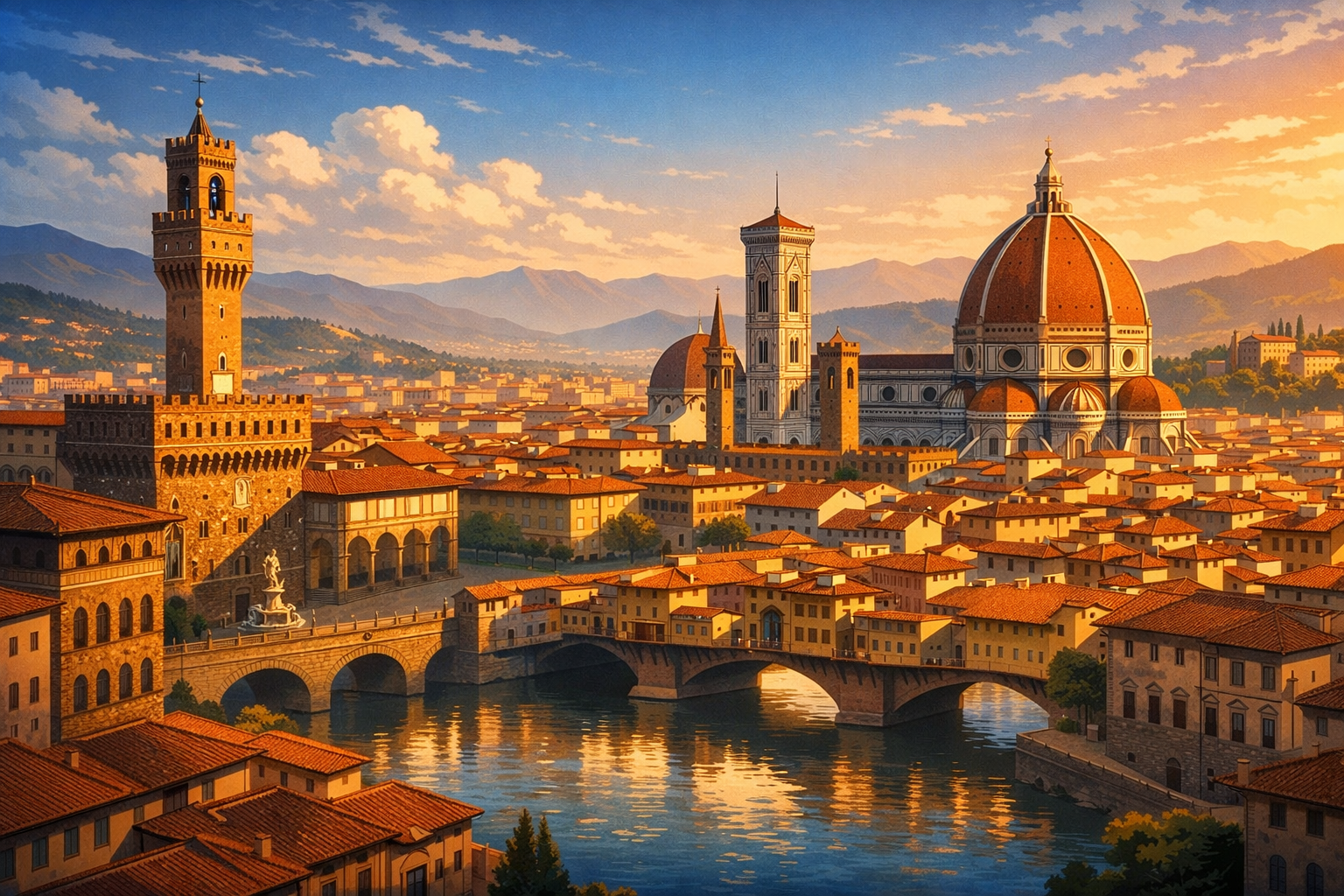
Start in Florence, where Renaissance masterpieces fill world-class museums and sunlit squares. Climb to Fiesole for its ancient theater and sweeping views, then make day trips to Siena, Pisa, and Arezzo before returning to golden evenings along the Arno.

🧭 DAY-BY-DAY ITINERARY

Ready-made country and city routes with daily plans, sights, transport and accommodation. Buy PDF guides for independent travel.

🧭 DAY-BY-DAY ITINERARY


Day 1 — Arrival in Florence and your “entry” into the city: Piazza del Duomo

  • ✈️ Arrival at Peretola Airport (FLR) and transfer by T2 tram to the center (≈ 30–35 minutes to the San Marco/Santa Maria Novella area). Check in, rest, an evening walk to Piazza del Duomo: the space where the “alphabet” of the Florentine Renaissance comes together—the rhythm of the cathedral’s marble cladding, Giotto’s campanile, and the baptistery with Ghiberti’s “Gates of Paradise.”

  • 🚶 A quick eye warm-up: watch the proportions and lines of the façades, how Brunelleschi “leads” the gaze to the dome. On the square, the links between the religious center and the urban fabric are easy to “read”—this will help in the following days.


Day 2 — Uffizi Gallery and Piazza della Signoria: a “manifesto” of the republican city

  • 🏛️ Morning at the Gallerie degli Uffizi: the Botticelli room (Primavera, The Birth of Venus), Leonardo, Michelangelo (Doni Tondo)—a collection that shows how humanist thought changes the language of painting and sculpture. Book an entry time slot in advance so you can spend at least 3–4 hours inside.

  • 🚶 Afterward—Piazza della Signoria: Florence’s open “civic stage.” The Loggia dei Lanzi as a stone theater, Palazzo Vecchio as a symbol of governance and civic identity. Compare the museum quiet of the Uffizi with the energy of the square—this makes it clearer how art and power are intertwined in the fabric of the city.

Day 3 — Accademia + San Marco: the sculptural ideal and monastic quiet

  • 🏛️ Galleria dell’Accademia (Via Ricasoli): Michelangelo’s “David” is not just a hero but an image of civic virtue. Notice the “non-finito” in the Prisoners—an alive trace of the author’s thought about form being “freed” from the stone.

  • 🏛️ Museo di San Marco (Piazza San Marco): cells with frescoes by Fra Angelico—an intensely personal, intimate dimension of the Renaissance. Set the scale of David against the intimacy of the monastic spaces—two sides of the same era.

Day 4 — Palazzo Vecchio + Bargello: power, interiors, and Renaissance sculpture

  • 🏛️ Palazzo Vecchio: follow the route as an “interior dramaturgy”—courtyards, the Hall of the Five Hundred, the apartments. From the upper platforms, views open onto the square ensemble.

  • 🏛️ Museo Nazionale del Bargello: Donatello, Verrocchio, Giambologna—a key to understanding 15th–16th-century sculpture. Compare bronze and marble, follow the theme of the “hero” and civic virtues.

Day 5 — Duomo complex: Museo dell’Opera + cathedral/dome/campanile

  • 🏛️ Museo dell’Opera del Duomo: originals of the façade sculptures, the “Gates of Paradise,” Donatello’s “Magdalene,” Michelangelo’s “Bandini Pietà.” The museum helps you “assemble” the look of the complex from the authentic works.

  • 🚶 If possible, climb Brunelleschi’s dome (by time slot) or Giotto’s campanile: the panorama explains the relief, the density of the neighborhoods, and the logic of the city’s axes. Evening—rest.

Day 6 — Oltrarno: Palazzo Pitti + Boboli Gardens and artisan workshops

  • 🏛️ Palazzo Pitti and the Palatine Gallery: state rooms, “princely” taste, collections of 16th–17th-century painting. Then—Giardino di Boboli: one of the first major examples of the formal Italian garden; topography, terraces, and visual axes as an extension of the palace architecture.

  • 🚶 Walk through Oltrarno (Santo Spirito, San Frediano): workshops, bronze, “commesso fiorentino” inlay. This is the “living” environment of craftsmanship that nourishes the city’s style.

Day 7 — Santa Croce + Museo Galileo: Renaissance art and science

  • 🏛️ Basilica of Santa Croce: necropolis of the greats (Michelangelo, Machiavelli, Galileo), chapels with Giotto cycles; the 19th-century façade is an interesting reinterpretation of historical motifs.

  • 🏛️ Museo Galileo (Piazza dei Giudici): instruments, globes, the city’s scientific thought—a reminder that the Renaissance changed not only art, but also the way of knowing the world.

Day 8 — Fiesole: the ancient theater, museum, and the “panorama of Florence”

  • 🚌 Transfer: Florence → Fiesole (by bus, ≈ 25–35 minutes).

  • 🏛️ Area Archeologica (theater, baths, temple) and the Archaeological Museum: here you can see the “pre-Renaissance” tuning layer—an ancient urban-planning code of the region. From the viewing terraces—one of the best panoramas of Florence: compare the “ideal” center with the hilly Tuscan landscape.

Day 9 — Siena (day trip): Piazza del Campo and the cathedral

  • 🚆/🚌 Transfer: Florence → Siena (train with a transfer or direct bus, ≈ 1h 15m–1h 35m).

  • 🏛️ Museo Civico in the Palazzo Pubblico (the frescoes “Allegory and Effects of Good/Bad Government”) and the Duomo Complex (treasury, Piccolomini Library). Siena’s bowl-like Piazza del Campo is a contrast to Florence’s “elongated” squares; feel the different “urban temperaments” of the two republics.

Day 10 — Pisa (day trip): Piazza dei Miracoli

  • 🚆 Transfer: Florence SMN → Pisa Centrale (regional train ≈ 1h–1h 15m), then on foot/bus to the Piazza dei Miracoli.

  • 🏛️ Opera della Primaziale Pisana complex: the cathedral, baptistery, Campo Santo, and Museo dell’Opera del Duomo. Compare Pisa’s “different” marble language with the Florentine tradition—interesting differences in modeling and decorative techniques.

Day 11 — Arezzo (day trip): Piero della Francesca and Renaissance palazzi

  • 🚆 Transfer: Florence SMN → Arezzo (regional train ≈ 1h–1h 20m).

  • 🏛️ Basilica of San Francesco (the Bacci Chapel with Piero della Francesca’s “Legend of the True Cross”) and the Museum of Medieval and Modern Art (in Palazzo Bruni Ciocchi). Piero’s geometry, light, and “mathematics” are another angle on the Renaissance.

Day 12 — The Medici and the finale: Medici Chapels, San Lorenzo Market, and a farewell evening

  • 🏛️ Cappelle Medicee at San Lorenzo: Michelangelo’s architecture and sculpture (New Sacristy). A walk around the San Lorenzo district—from Medici traces to the lively market.

  • 🧘 Time buffer for shopping/cafés and a slow stroll along the Arno. Compare your impressions with Day 1: the Renaissance “comes together” into a coherent picture—from the museum hall to the city square.

Flight tickets

eSIM for travel

Buy PDF guide

Buy PDF guide — 25.71 USD

PDF — 25.71 USD