
Buy PDF guide

Buy PDF guide — 10.90 USD

PDF — 10.90 USD

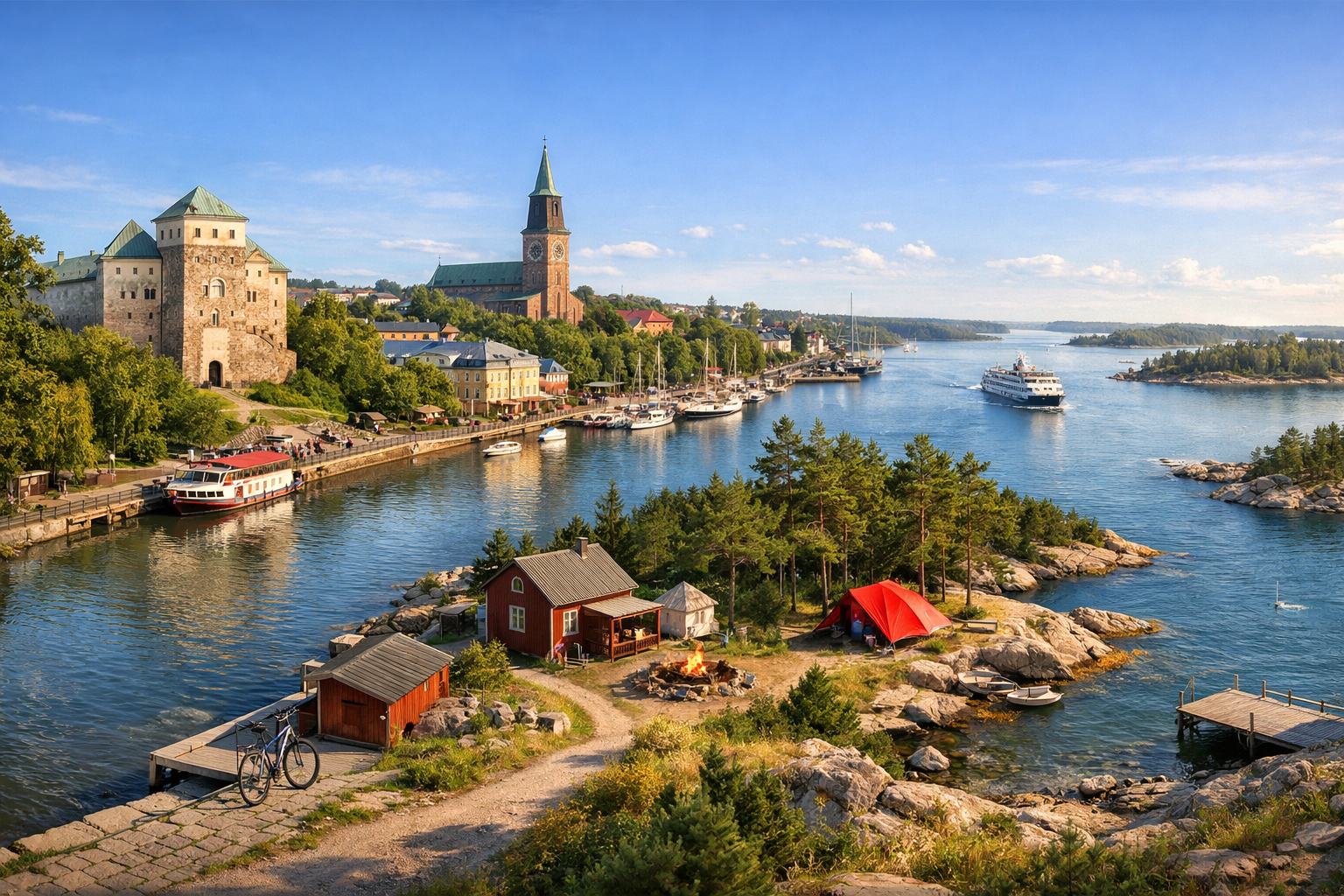
Finland, Turku and the archipelago. A budget summer route through the country's oldest city, islands, ferries, and bicycle paths with accommodation in a hostel or campsite.

Finland, Turku and the archipelago. A budget summer route through the country's oldest city, islands, ferries, and bicycle paths with accommodation in a hostel or campsite.

Discover Finland’s summer side on a budget, starting in Turku, the country’s oldest city, then heading through Ruissalo, Pargas and Nauvo by ferry and bike. Expect sea air, pine-lined island roads and simple nights in a hostel or campsite before looping back to Turku.

🧭 DAY-BY-DAY ROUTE

Ready-made country and city routes with daily plans, sights, transport and accommodation. Buy PDF guides for independent travel.

🧭 DAY-BY-DAY ROUTE


Day 1 — Turku: the old town, the Aura riverfront, and a budget-friendly introduction to the city

  • 🚶 Turku is the oldest city in Finland and a rare place where modern northern everyday life naturally intertwines with very deep history. Here, there is no need to rush between distant districts: the budget format actually works in the traveler’s favor, because the main impressions are gathered compactly along the Aura River. Start the day with a leisurely walk along the banks of the Aurajoki: wooden piers, old river vessels, terraces, bicycles, a student atmosphere, and soft maritime light create that very summer picture of southwestern Finland that makes this place worth visiting even without big expenses. The main idea of the first day is not to try to “see everything,” but to enter the rhythm of the city on foot, so you don’t overpay for transport and at the same time feel Turku as a living city rather than a museum.

  • ⛪ Be sure to walk to Turku Cathedral — the symbol of the city and one of the country’s most important historic buildings. The area around the cathedral is especially good for a first introduction: old quarters, bridges over the Aura, green slopes, and convenient walking connections to museums and the waterfront. If you want an inexpensive but rich cultural block, you can choose one paid sight for the day and leave the rest free: for example, limit yourself to walking around the cathedral from the outside, along the old streets, and along the river line toward the castle side. This format is especially sensible in summer, when the long daylight hours let you see a lot without extra spending.

  • 🍲 For budget food in central Turku, it’s best to rely on soup lunches, pizza buffets, chain supermarkets, and small lunch buffet cafés. A rough spending guide: breakfast from a supermarket or bakery — about €5–9, a lunch buffet or soup of the day — about €11–15, a simple takeaway dinner or food from a shop — €6–12. In Finland, food outside promotions and chain formats is not cheap, so the most economical strategy is a hearty lunch during the day and a light shop-bought dinner in the evening. This is especially convenient if you are staying in a hostel or campsite and can store food.

  • 💤 In the budget version of the route, it makes sense to choose a base in Turku for all or almost all nights, so you don’t spend money on constant moves between the islands. The most convenient option for the first day is an inexpensive hostel near the river and port area, from where it’s easy to reach the castle, Forum Marinum, and bus lines on foot. Checking in, resting after the journey, and getting an early night are more important here than overloading yourself with sights: islands, ferries, and cycling days still lie ahead.


Day 2 — Turku and Ruissalo: an island of nature, beaches, trails, and a water bus

  • 🚌🏝️ Devote the second day to Ruissalo — a large island near Turku that is ideal for a budget summer route. This is exactly the kind of place where expensive excursions are simply unnecessary: the main value here is nature, sea air, oak forests, bike paths, beaches, and the feeling of a light northern summer-cottage idyll. You can reach the island by Föli bus or, in season, by water bus from the center, which turns an ordinary transfer into an inexpensive trip on the water. Ruissalo is great because it offers two scenarios at once: a relaxed beach-and-walking day or an active day with a bicycle and larger loops around the island.

  • 🚴 If you want to get the most for the least money, take a Fölläri city bike or your own rental bike for the day and ride through the island’s cycling network. Ruissalo is known for its old oak groves, historic villas, quiet roads, and routes where you can ride without feeling rushed. Here, the pleasure lies less in “ticking off points” and more in stopping by the water, watching the shipping channel, having a picnic, and simply rolling through the green island. To save money, it’s convenient to bring food from a supermarket in Turku: water, sandwiches, berries, yogurt, and ready-made salads cost noticeably less than constant café stops.

  • 🌿 Ruissalo has marked walking routes, viewpoints, beach areas, and a summer atmosphere of a “city escape into nature.” This is one of the best days of the route precisely in terms of value for money: transport is comparatively inexpensive, access to nature itself is free, and the day feels full. If you want to strengthen the archipelago feeling, use the water bus at least one way and return by bus — that way the day will be both beautiful and budget-rational.

  • ⛺ The most economical summer format is to spend this night at Ruissalo Camping, if camping or simple accommodation suits you. This lets you avoid paying for the city center and gives a rare chance to wake up literally next to nature and the sea. If camping doesn’t suit you, you can return for the night to a city hostel and keep a single base in Turku. In any case, it’s better to keep the evening calm: shower, laundry, charging devices, and early preparation for a day of islands and ferries.

Day 3 — The archipelago: Pargas and Nauvo as a realistic budget trip to the islands

  • 🚍⛴️ Doing the full large circle of the Archipelago Trail in one day without a car can be too tiring and expensive, so for a budget-friendly and realistic five-day route it’s better to choose the most beautiful and reachable combination by public transport: Turku → Pargas → Nauvo and back. This gives you a real sense of the archipelago — with roads across the water, ferry logic, small island centers, and sea views — without trying to force everything in at once. In the morning, leave Turku by bus toward Pargas/Parainen, and then continue toward Nauvo/Nagu, following the current bus and ferry timetables.

  • 🌊 The main impression of this day is not a museum or a separate “checkmark,” but the very structure of the journey. Southwestern Finland reveals itself here through bridges, island roads, waiting for the ferry, small harbors, yachts, waterside cafés, and an even, calm summer light that makes even a simple bus stop photogenic. Nauvo is especially well suited to an unhurried day: you can walk by the harbor, have an inexpensive lunch, sit by the water, and feel how quickly urban Turku has fallen behind. That is the archipelago’s strength: it doesn’t shout, but gradually draws you into its rhythm.

  • 🚴 If you want more activity, you can combine bus and bicycle: reach one of the archipelago sections by public transport and then ride a local loop around the island by bike. But for a truly budget format, it’s better not to overload this day with expensive rentals in the island area, and instead use either your own bicycle or city rental in Turku where convenient. In the archipelago itself, it is more economical to focus on walks, viewpoints, and a simple island picnic.

  • 🍽️ In terms of spending, this day can be the most unpredictable, because cafés and shops on the islands are often more expensive and the choice is smaller. So the best strategy is to buy water, fruit, sandwiches, and snacks in Turku in advance, and leave only one hot meal or coffee break for the islands. For transport during the day, plan a roughly moderate budget with a reserve for intercity buses; the exact amount depends on the chosen combination. In the evening, return to Turku for the night: this is cheaper and easier than looking for separate accommodation on the islands.

Day 4 — Turku: the castle, the maritime quarter, and a museum day without overload

  • 🏰 After a nature-and-islands day, it’s logical to return to urban history and devote time to the western part of Turku — the castle district and the maritime quarter. Turku Castle makes a strong impression even from the outside: powerful stone masses, open space at the river mouth, the closeness of the port, and the feeling that the city once truly lived facing the sea and defense. Even if you are saving money and don’t want to buy many tickets, simply approaching the castle, walking around it, and following the route along the river line already gives rich historical context.

  • ⚓ Nearby, it is convenient to combine this with Forum Marinum — one of the most logical museums for this route, because it reveals the region’s maritime character itself. If you choose only one paid museum this day, it’s better to take the one that truly complements the theme of the archipelago and ferries rather than duplicates yesterday’s impressions. An alternative for a very strict budget is to leave the museum for the future and limit yourself to a free walk around the museum ships from the outside, the waterfront, the area by Bore, and the long riverside path back to the center.

  • 🛳️ A very atmospheric budget move is to walk on foot along the Aura from the castle toward the center, slowly looking at ships, old industrial fragments, bridges, and urban riverbanks. It is a long but pleasant walk that requires no spending and beautifully ties together history, the sea, and everyday life in Turku. Along the way, you can arrange an inexpensive lunch in the format of supermarket + bench by the water, or stop for a simple lunch.

  • 🌆 In the evening, save your energy for a calm city rhythm: a bit of the center, coffee, perhaps a short walk to the hill by the Art Museum or back to the river. The fourth day in this route is not for sprinting, but for meaningfully leveling out the pace: after the islands, the body often gets tired not from the kilometers, but from the logistics. So a good budget route is not a maximum of sights, but a sensible dosage of impressions.

Day 5 — Turku: the old town museum, a final cycling day, and a gentle end to the route

  • 🏘️ The final day is best devoted to the Turku that cannot be reduced either to the castle or to the archipelago. An excellent option is Luostarinmäki Museum Quarter, a unique wooden quarter that survived the great fire of 1827. This place is especially valuable for a short route: here you can literally walk through the urban scale of old Turku, feel a more intimate and human history, see what everyday life in a craft town looked like, and at the same time not go far away. An alternative for lovers of archaeology and contemporary art is Aboa Vetus Ars Nova, where the city’s medieval layers stand side by side with modern exhibitions.

  • 🚴 If the weather is good, finish the trip with another easy bike ride around Turku. The city is convenient for short urban routes: the river, bridges, green areas, waterfronts, and calm scale make the last day especially pleasant. This is a good moment to complete the places you didn’t have time for at the beginning: for example, stop by Turku Art Museum from the outside, sit in a park, walk through the market, or simply slowly complete your Aura riverbanks gestalt.

  • 🧳 The final day of a budget trip is always better planned with a buffer rather than “to the minute.” Leave time for packing, a shower, and the road to the railway station, bus station, or Turku airport. If you are flying out from Turku Airport, build in a reserve and check the airport bus line or taxi price in advance in case of an early departure. If you are leaving by train or intercity bus, also check current platforms and timetables on the day of departure.

  • 💙 This five-day route is good because it does not fall apart into a random set of points. It is built around one strong idea: Turku as the gateway to the Finnish archipelago. There is history, water, bicycles, public transport, ferries, island geography, and a rare feeling of northern summer that does not require a luxurious budget. If you don’t try to cover too much and instead let the route flow smoothly, the trip turns out both affordable and truly memorable.

Flight tickets

eSIM for travel

Buy PDF guide

Buy PDF guide — 10.90 USD

PDF — 10.90 USD