
Day 1 — Rovaniemi: arrival, the forest rhythm of Lapland, and the first aurora outing
🚗 The base of the trip is Rovaniemi, the most convenient family hub for a winter journey around the Arctic Circle area. It takes only a few minutes to get from the airport to the city, and Santa Claus Village, the forest areas near Ounasvaara, and suburban dark-sky spots are all reachable without long drives. This format is especially good for an easy road trip: during the day you do not get tired from transfers, and in the evening you still have energy for short aurora hunts, when the cloud and geomagnetic activity forecast becomes clearer.
🏨 After landing, check in early and keep this day as gentle as possible. The right pace helps a family trip in Lapland enormously: dense winter air, early twilight, slippery surfaces, and late-night outings quickly build up fatigue. That is why on the first day it is better to limit yourself to a calm walk around central Rovaniemi, a warm dinner, and early preparation for the evening drive. Be sure to keep blankets, headlamps, a thermos, spare gloves, ice grips or shoes with good traction, and a fully charged phone in the car.
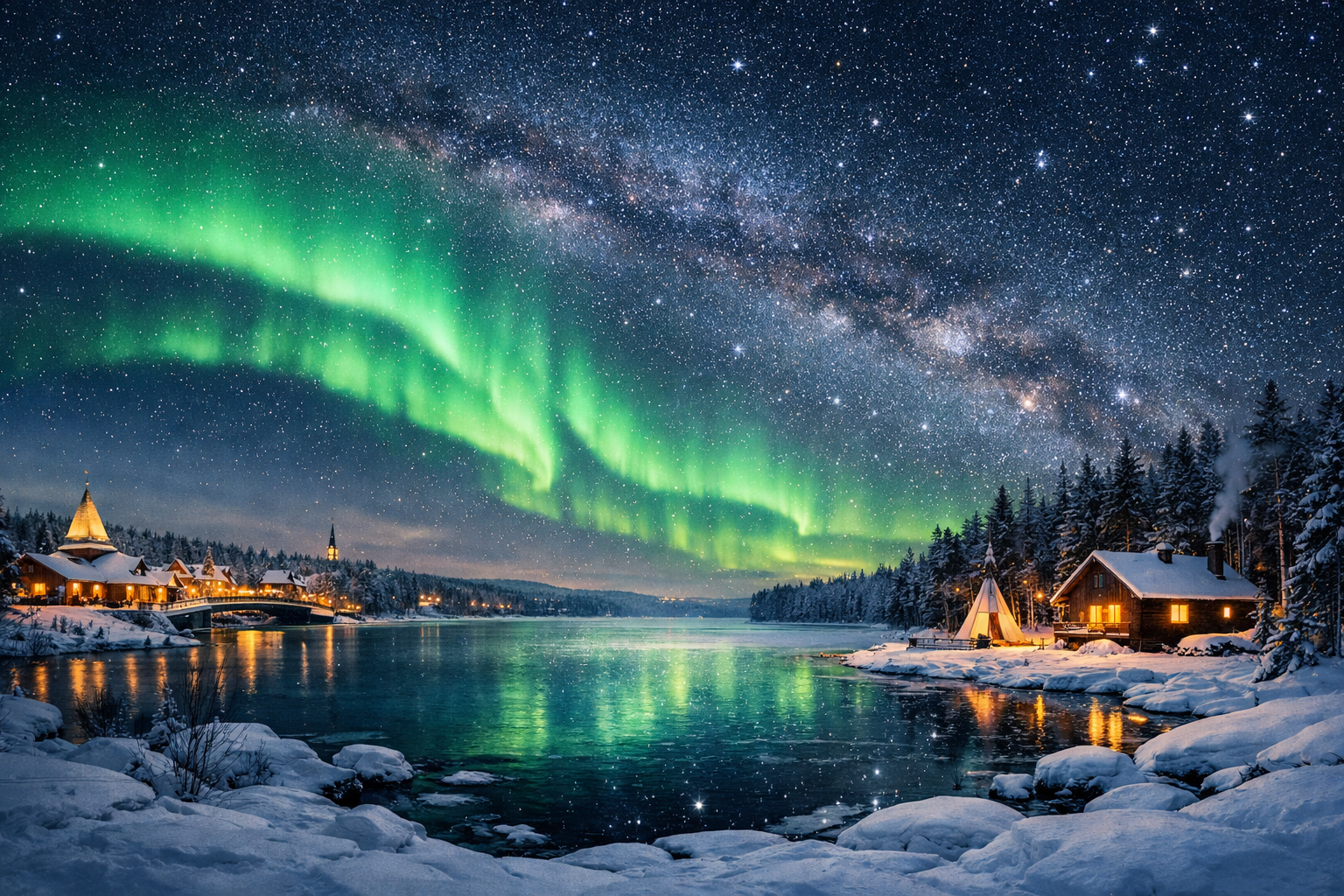
🌌 Dedicate the first evening not to a city program, but to getting acquainted with the Arctic night. The best scenario for a gentle start is a short drive toward Ounasvaara or beyond the city glow to more open areas near the river and forest roads, where there are safe parking spots and no need for a long walk in the dark with children. This is where Lapland winter is felt especially well: the pines stand covered in frost, the snow muffles sound, and the sky above the horizon feels wider than in the city. If the clouds clear, you may already see a dense field of stars and a faint green arc above the northern part of the horizon on the very first evening. But the northern lights can never be guaranteed: even in a good season, visibility depends on clouds, moonlight, and solar activity.
🌙 For a trip focused on the sky, date planning is especially important. From September to March, the chances of having dark hours are high, but the most comfortable family conditions usually fall between late November and March, when snow makes the landscape brighter, roads are maintained more consistently, and nighttime viewing spots feel safer. If you can choose specific dates, aim for a window around the new moon or days with a thin crescent moon: weak moonlight helps you see more stars and makes the aurora look more visually contrasting. At full moon, the landscape becomes fairy-tale beautiful, but faint aurora structures and the Milky Way are harder to distinguish.
⚠️ Before every night outing, check the weather forecast, road conditions, and actual cloud cover using cameras and road condition maps. In Lapland it is usually clouds, more often than weak geomagnetic activity, that take away your chance to observe the sky. If the sky is fully covered, do not try to drive far at any cost: it is better to postpone the hunt for the phenomenon until the next night and devote the evening to rest. For a family tour, this matters more than an exhausting chase after a ghostly window in the sky.