
Buy PDF guide

Buy PDF guide — 25.71 USD

PDF — 25.71 USD

Esch-sur-Alzette

Esch-sur-Alzette

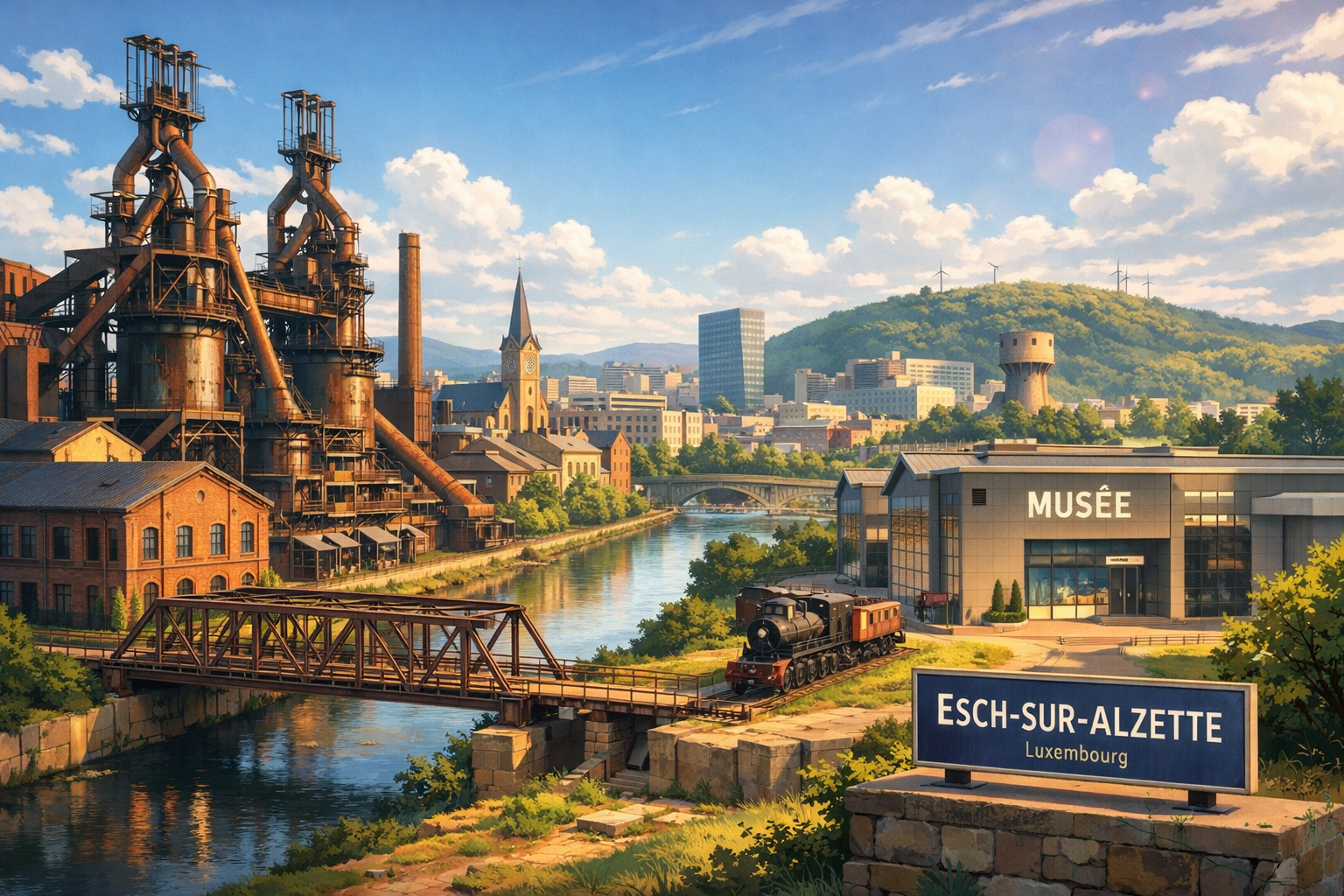
Luxembourg’s Land of the Red Rocks fuses industrial drama with lush valleys and creative flair. From Esch-sur-Alzette, climb Belval’s blast furnaces, descend into Rumelange’s mines, take in Dudelange’s Waassertuerm and Pomhouse, and ride vintage trains through Minett Park to Lasauvage before time-traveling at Titelberg. Loop back to Esch for buzzing streets, bold cuisine, and a taste of reinvention.

🧭 DAY-BY-DAY ITINERARY

Ready-made country and city routes with daily plans, sights, transport and accommodation. Buy PDF guides for independent travel.

🧭 DAY-BY-DAY ITINERARY


Day 1 — Arrival → Esch-sur-Alzette: getting to know the “red cliffs”

  • ✈️ Transfer: Luxembourg Airport (LUX) → Luxembourg Gare (bus No. 29 ≈ 25–30 min) → CFL train line 60 to Esch-sur-Alzette (≈ 25 min). Check-in and a leisurely walk along the pedestrian Rue de l’Alzette: early 20th-century façades, shopfronts and the town hall square create a contrast with Minett’s industrial landscapes.

  • 🚶 In the evening, head up to Gaalgebierg Park: a panorama over the city and the distant lights of Belval with the silhouettes of the blast furnaces sets the tone for the whole trip.


Day 2 — Belval: blast furnaces A/B and the “city of science”

  • 🚶 The Belval blast furnaces (Hauts Fourneaux) are the heart of the industrial landscape. A route across the former works reads like a technological chain: ore and coke bunkers, furnace shell, hot-blast stoves (Cowpers), galleries and a 40-meter viewing platform. Underfoot are paved stretches of the former axis of the pig-iron carriers; around you is the new fabric of the district: Rockhal, university buildings and the Möllerei (former ore factory, now a public space).

  • ☕ Break — a café in Belval Plaza or at the foot of the furnaces; then an architectural walk: steel, glass and corroded metal form a rare “encyclopedia of regeneration” of industrial heritage.

Day 3 — Esch-sur-Alzette: the Resistance Museum and the urban ensemble

  • 🏛️ Musée National de la Résistance et des Droits Humains (Place de la Résistance) — a powerful permanent exhibition about 1940–45, human rights and memory. Read the 1950s architecture as a “stage” for a contemporary narrative: clear volumes and cuts of light emphasize the documentary layers.

  • 🚶 City loop: Rue de l’Alzette → Escher Theater → Art Nouveau neighborhoods. Compare the “bourgeois” center with the workers’ settlements — it helps you understand the social topography of the steel age.

Day 4 — Ellergronn Reserve: the Cockerill mine and nature after industry

  • 🚶 The Ellergronn Nature and Forest Center in the restored buildings of the Cockerill mine: exhibitions on the Minett biosphere and the history of mining “minette” ore. Nearby is the small Cockerill mine museum: the “salle des pendus”, forge, tools and lamps — a rare look at miners’ everyday life.

  • 🌿 A loop trail through the reserve: red spoil-heap slopes, pits and wet hollows — a “landscape palimpsest” where industry gives way to restored nature.

Day 5 — Rumelange: the National Museum of Iron Ore Mines (underground train)

  • 🚆 Transfer: Esch-sur-Alzette → Rumelange (on the CFL line via Noertzange or by direct TICE buses ≈ 20–35 min).

  • 🏛️ Musée National des Mines de Fer Luxembourgeoises (galleries of the former “Walert” mine): underground drifts, a museum train, the evolution of technology from hand drilling to mechanization. Excellent “technical basics” on ventilation, supports and ore logistics.

Day 6 — Dudelange: Waassertuerm + Pomhouse (CNA) — water, light and image

  • 🏛️ The National Audiovisual Centre (CNA): the Waassertuerm water tower with its external spiral staircase and the Pomhouse (former pump house) are landmark examples of careful adaptive reuse of industrial structures for culture. The viewing platform and intimate exhibitions create a counterpoint to the scale of the Belval furnaces.

  • 🚶 Walk through Dudelange’s central neighborhoods: the city’s railway past is legible in the layout and materials — brick, metal, cinder blocks.

Day 7 — Minett Park Fond-de-Gras: historic trains and the “museum village” of Lasauvage

  • 🚂 The historic “Train 1900” (seasonal/on operating days) links Pétange and Fond-de-Gras; within the park, the narrow-gauge mining train Minièresbunn runs. This is a living museum of technology: depot, compressor rooms, “hanging room” and loading platforms — a rare open-air industrial archaeology complex.

  • 🏛️ Lasauvage: the Espace Muséologique (Sentinelle Castle) with a reconstruction of a WWII shelter, and the Musée Eugène Pesch with a mineral collection and a “training” adit. The atmosphere of a company town provides tangible social context for the industrial south.

Day 8 — Prënzebierg — Giele Botter: a geological trail through former quarries

  • 🥾 The “Giele Botter” geotrail (Differdange): a walk through a former quarry pit that today is home to orchids, amphibians and lakes. Info stations explain how the ore layers formed and what open-pit mining looked like.

  • 📷 At sunset, the red terraces and mirror-like water create striking shots of “landscape regeneration” — the perfect contrast to Belval’s steel verticals.

Day 9 — Titelberg: a Celtic oppidum and a Roman vicus

  • 🚶 The Titelberg archaeological site (Lamadelaine/Pétange): a plateau with remains of a fortified Celtic town and a later Gallo-Roman settlement. The rampart topography, traces of workshops and residential domus houses let you “assemble” the region’s pre-industrial history — a great link to exhibits in Luxembourg City (MNHA) and the tour’s industrial line.

  • ☕ Return via Fond-de-Gras: a short stop at the historic station — a “time loop” from the Iron Age to the railway.

Day 10 — Esch-sur-Alzette: culture on the ruins of industry

  • 🎭 Kulturfabrik (former slaughterhouse): the creative core of the south, a vivid example of a “second life” for industrial buildings. A walk through street art and courtyards, then coffee and a sketch of the final logistics.

  • 🛍️ Free time: local shops on Rue de l’Alzette, the park by the stadium, and the viewpoints of Gaalgebierg.

Day 11 — Luxembourg City (optional): archaeology and fortifications

  • 🚆 Train to Luxembourg Gare (≈ 25–30 min). Visit the MNHA (Marché-aux-Poissons): the Vichten mosaic and Celtic-Roman period collections help you “finish reading” what you saw at Titelberg. Timewise: half a day; the rest for the casemates and the old town.

Day 12 — A final touch in Belval and departure

  • 🚶 A short morning loop around Belval: once again up to Blast Furnace A’s viewing platform and to the Möllerei — to закрепить the “picture” of industrial metamorphosis.

  • ✈️ Transfer: Esch/Belval → Luxembourg Gare (≈ 25–35 min) → LUX airport (bus 29 ≈ 25–30 min). Allow a 2–2.5 hour buffer for travel and formalities.

Flight tickets

eSIM for travel

Buy PDF guide

Buy PDF guide — 25.71 USD

PDF — 25.71 USD