
Buy PDF guide

Buy PDF guide — 10.90 USD

PDF — 10.90 USD

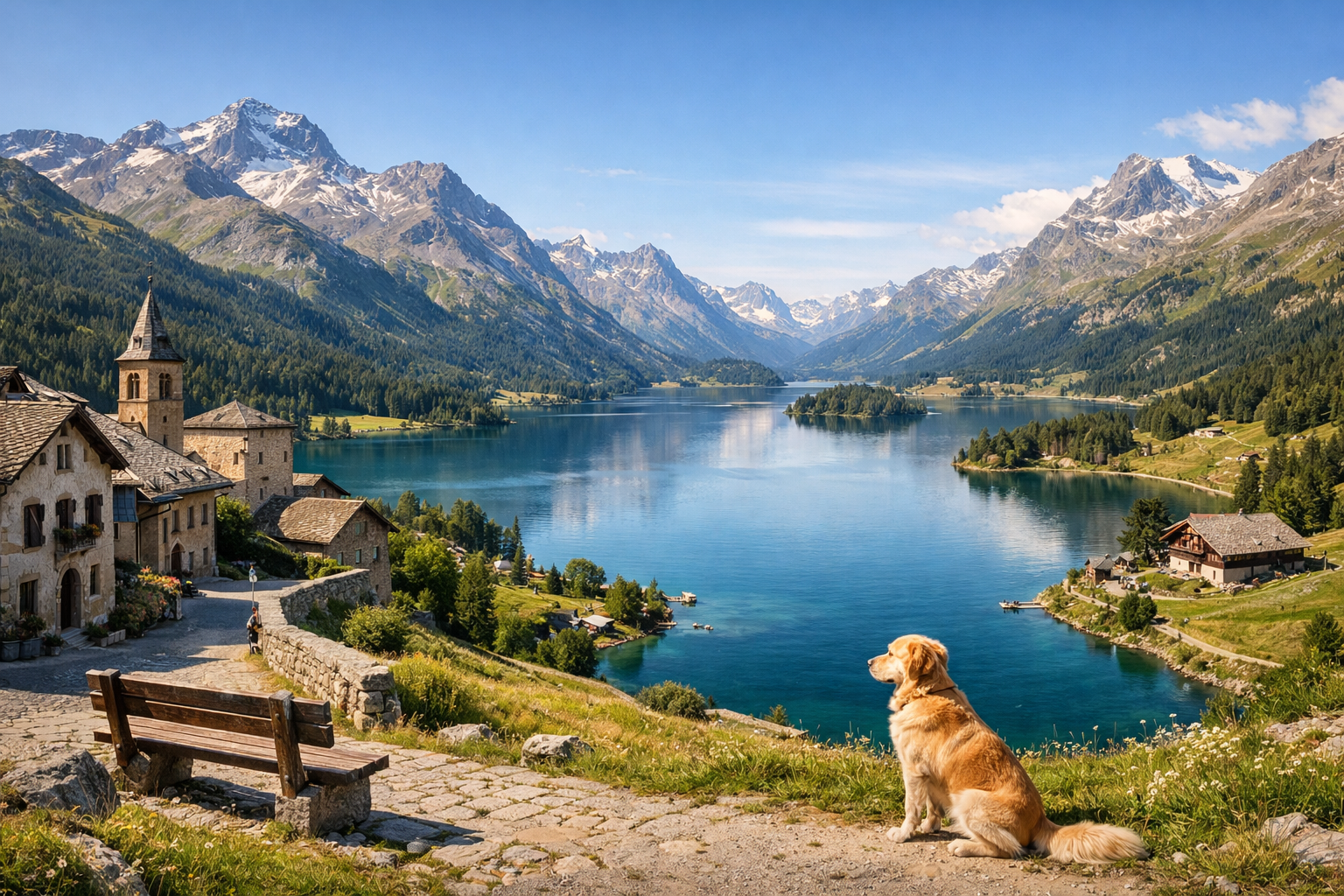
Engadin and Lake Sils with Dog

Engadin and Lake Sils with Dog

Engadin and Lake Sils is where alpine glamour meets wild, open space, from the polished charm of St. Moritz to the quiet beauty of Sils-Maria. Follow scenic trails and lakefront paths through crisp mountain air, with plenty of room for your dog to roam beside you.

🧭 DAY-BY-DAY ROUTE

Ready-made country and city routes with daily plans, sights, transport and accommodation. Buy PDF guides for independent travel.

🧭 DAY-BY-DAY ROUTE


Day 1 — Transfer to Engadin: Zurich → St. Moritz

  • ✈️ If your arrival in Switzerland is planned via Zurich, set aside an easy day for adapting after the flight and then continuing on to Engadin. The most realistic and convenient public transport route is by train via Chur: the trip from Zürich HB to St. Moritz usually takes about 3 hr 14 min. This is already part of the journey, not just a transfer: after the flatter sections, the route gradually moves into the valleys of Graubünden and then climbs into a high-alpine region with lakes, larches, and the bright, almost crystal-clear air of Upper Engadin. By evening, it’s worth checking into a hotel in St. Moritz, giving your pet a long but unhurried walk by the lake or toward Stazerwald, and not planning any demanding activities for the first day.

  • 🐾 Pet-friendly format for this day: for private travel to Switzerland, the basic entry rules for dogs, cats, and ferrets include a microchip, a valid rabies vaccination, and a recognized veterinary passport; the first rabies vaccination is considered valid only 21 days after vaccination, and the microchip must be implanted before vaccination. For animals from certain countries with rabies risk, additional documents and antibody titration may be required, and in some cases of direct air entry, a separate permit may also be needed. Before departure, обязательно recheck the rules specifically for the country of departure, the airline, and the connection itinerary.

  • 🚆 Trains and transfers with a pet: in Swiss public transport, small dogs and other small animals up to 30 cm at the shoulder may be carried free of charge if they travel in a suitable container, basket, or pet carrier as hand luggage. Larger dogs usually need a dog ticket at a reduced fare or a day/monthly/annual dog pass. On platforms and in carriages, it’s best to keep your dog on a short leash; if the animal is anxious, sensitive to crowds, or doesn’t like stairs and noise, plan your transfers with extra time. A similar logic applies on PostAuto buses: small animals in a carrier travel free, others require a ticket, and the dog must be on a leash or in a container. Muzzle requirements on regional transport and with individual operators may vary, so they should be checked again before the trip.

  • 🏨 For the first base, it is convenient to choose a hotel in St. Moritz, where it is easier to sort out logistics, buy pet food, go to a pharmacy, and, if necessary, quickly reach a veterinarian. For pet-friendly accommodation, always clarify before booking: which animals are accepted, whether there is a limit on the number of pets per room, whether large dogs are allowed, what the nightly surcharge is, whether the animal may be left in the room without the owner, and whether there are restrictions on access to restaurant areas. In Switzerland, these conditions vary by property, so they should not be considered universal.


Day 2 — St. Moritz and gentle acclimatization by the lakes

  • 🚶 It’s best to dedicate the second day to gentle acclimatization. St. Moritz is often associated with glamour and winter sports, but in summer and the shoulder seasons it is especially good precisely as a spacious alpine resort for long walks with a dog. In the morning, you can walk along Lake St. Moritzersee, then head toward the quieter Stazerwald and Lake Staz. This is a very good day for a pet: no long transfers, an even rhythm, water nearby, and the chance to stop often. The light here is special — the lake surface reflects the peaks, and walks among larches and meadows create that very feeling of Engadin that people come here for.

  • 🐕 What matters for the dog on this day: the region is well suited to calm valley routes, but even on easy trails you need to take into account the altitude, bright sun, and dry air. Be sure to bring water, a collapsible bowl, and time for rest breaks. If your dog has no experience in the high mountains, it’s best not to do long elevation gains in the first 24 hours. On routes around villages and meadows, watch the signs and seasonal restrictions carefully, and near pastures with livestock, pass calmly without letting the dog approach cows and calves. In such places, a leash is not a formality but a safety measure.

  • 🩺 Veterinary support: there are veterinary services in St. Moritz and neighboring settlements of Upper Engadin, which is why this base is convenient for traveling with a pet. In practical terms, this means that if there is paw irritation, tick bites, GI issues after the journey, or stress, you won’t need to travel to another major city. Even so, the clinic opening hours and the availability of emergency care should always be checked in advance, especially if you are traveling on weekends, in the shoulder season, or late in the evening.

  • 🦟 Natural risks: in the warm season, ticks are possible in valley and forest areas, so parasite protection and a daily coat check after walks are essential. In open meadows, watch your dog’s paws because of gravel and dry sections of trail, and by the shores, make sure the dog does not get chilled after swimming in windy weather. Swimming in the lakes is possible not everywhere and not always equally convenient: choose calm, uncrowded areas and respect other visitors.

Day 3 — Sils-Maria and Lake Sils: Chastè and the village rhythm

  • 🚆 In the morning, the transfer from St. Moritz to Sils/Segl Maria by bus or train with a connection usually takes about 25–40 minutes depending on your starting point and the timetable. Sils-Maria itself feels completely different: quieter, more intimate, more literary. This is not a place that invites rushing. The village seems made for slow travel with a dog: stone houses, narrow lanes, old facades, views of the water, and a gentle rhythm of walks without urban tension. It is from here that Lej da Segl — Lake Sils — opens up especially beautifully, one of the most poetic places in all of Engadin.

  • 🌿 The main walk of the day is to the Chastè peninsula and its bays. This is one of the most beautiful and at the same time accessible walking options in the area: the bays are about a 20-minute walk from Sils. The trail does not feel extreme, but it offers an almost ideal combination of forest, water, light, and silence. Along the way, you hear the wind in the pine needles, the shore appears and then hides again behind the trees, and by the water you get those very views that make Lake Sils feel not just like an alpine lake, but like a whole small world — austere, transparent, and surprisingly peaceful.

  • 🐾 Pet conditions on the walk: for dogs, this is a very good day if your pet enjoys long but unhurried routes. Whether access is allowed depends not so much on the trail as a tourist site, but on local land-use rules, grazing season, the presence of birds, and the animal’s behavior. As a basic rule, keep the dog on a leash in the village, near people, on narrow trails, and in places where you may encounter livestock. If your pet is reactive, prone to chasing birds, or does not cope well with passersby and cyclists, choose the morning hours. For cats and small animals, this kind of route is generally not suitable unless they travel in a special carrier and are accustomed to being outdoors.

  • 🏨 If you want one night right by the lake, you can choose a base in Sils Maria. For hotels and guesthouses in this area, be sure to ask: do they accept dogs of all sizes, are there breed restrictions, are pets allowed in the breakfast area, how much is the nightly surcharge, and can the animal be left in the room for a short museum visit or dinner. In alpine hotels, this is often decided individually and in advance.

Day 4 — Easy valley walk: Val Fex or Furtschellas without overload

  • 🥾 The fourth day is best devoted to one beautiful but manageable walk. The best principle for a trip with a dog in Engadin is not to chase the number of panoramas, but to choose a sustainable pace. Depending on the weather and your pet’s condition, you can do an easy route through Val Fex or use the lifts in the Sils–Furtschellas area as a way to reduce elevation gain. Val Fex is especially good for those seeking gentle valley beauty: grassy slopes, wooden houses, streams, pastures, and a rare sense of quiet. Here Engadin reveals itself not as a postcard, but as a living alpine landscape where everything is held together by the rhythm of the season, water, and light.

  • 🚠 Cable cars and pets: there are real rules in the region for transporting dogs on mountain railways and cable cars, but they may differ by specific operator and season. In Engadin, there is a separate seasonal dog pass for a number of mountain railways, and on some lifts and gondola lines, dogs are usually transported subject to local conditions. In practice, traveling with a dog in a cabin almost always requires confident control of the animal, a short leash, and for large or nervous dogs, a muzzle may be required at the request of staff or under internal rules. Before using any specific line — Corvatsch, Furtschellas, and others — be sure to recheck the conditions on the day of travel.

  • 🐄 Important trail restrictions: there may be pastures with livestock in the valley, and this is a key factor for a route with a dog. If passage is open, walk calmly, giving the animals a wide berth and not provoking them with running, shouting, or sharp leash jerks. If there is a notice on site that passage with dogs is restricted, you need to change the route without argument. For active breeds, it is especially important not to let the dog off leash where there are cows, young stock, or horses.

  • 🧺 Gear for the day: a medium-length leash, harness, collapsible bowl, water, waste bags, a towel for paws, tick protection, and if you plan to use a bus or cable car, at least carry a muzzle as backup. Even if it is not required, in Switzerland people highly value an owner’s readiness to follow the rules and not create discomfort for other passengers.

Day 5 — Culture and final day: Silvaplana / Sils → St. Moritz → departure

  • 🏛️ The final day can be made beautiful and not tiring: return to St. Moritz, combine a walk along the promenade with one museum, and then leave calmly toward Zurich. From St. Moritz to Zürich HB by train, you usually need to allow about 4 hr 05 min, so it is sensible to plan departure for the second half of the day or closer to evening. If the weather is clear, the last hours in the region are best spent by the water: the colors of the lakes change almost minute by minute, and the finale of the trip turns out very cinematic — the cold gleam of the water, the dark line of the forest, the sound of bells on the slopes, and the feeling that Engadin does not end, but simply remains somewhere behind you.

  • 🎨 For a route with a dog, it is better to choose the cultural part selectively. A convenient option is the Segantini Museum in St. Moritz, and in Sils Maria — the Nietzsche-Haus or Sils Museum. But it is important to understand: animals are usually not allowed inside museum buildings, except service and assistance dogs under special rules. Therefore, a museum visit should be planned only if a second person can walk the dog outside or if your accommodation is right nearby and the hotel conditions allow you to leave the pet in the room for a short time. You should not assume this on your own — permission from the hotel must be requested in advance.

  • 🐾 Final pet notes before departure: check whether the dog is tired from the series of walks, whether there are any rubbed spots on the paws, signs of dehydration, ticks, or stress after transport. The same transport rules apply for the return journey as on arrival: small animals in a suitable carrier usually travel free, larger dogs need a ticket; on buses and at stops, the dog must be on a leash or in a container. For air travel, the rules are set by the airline: permitted types of animals, weight limits, carrier dimensions, transport in the cabin or cargo hold, and requirements for a water dispenser, absorbent material, and documents may differ very substantially.

  • 📌 This five-day route is good because it remains compact and realistic: one main alpine base, short local transfers, plenty of walking time, and minimal fuss. For traveling with a dog, Engadin is especially valuable not for the number of “checkmarks,” but for the quality of the environment — wide valleys, lakes, clear logistics, and the feeling that here you do not have to fight the route, but can truly relax together.

Flight tickets

eSIM for travel

Buy PDF guide

Buy PDF guide — 10.90 USD

PDF — 10.90 USD