
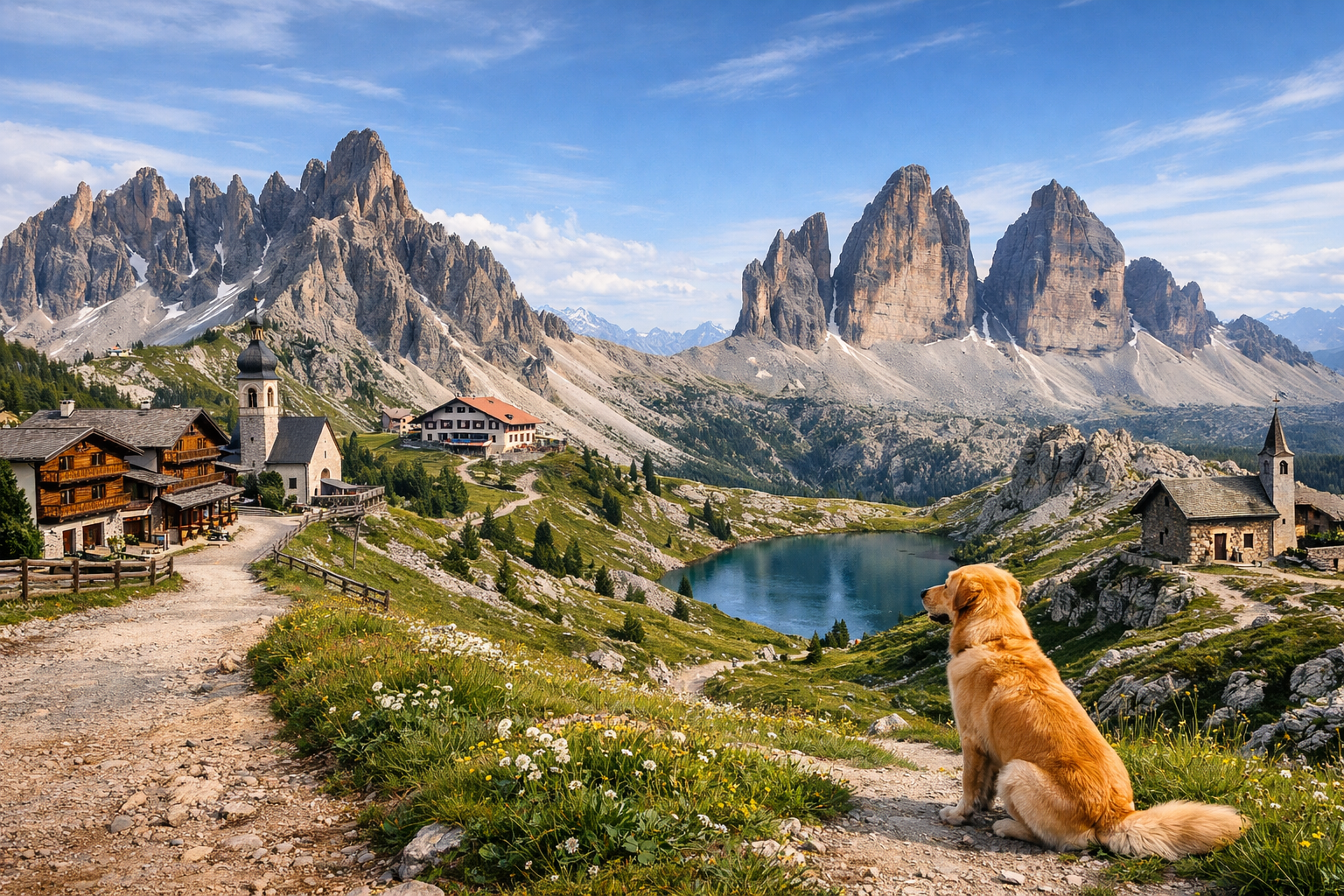
Day 1 — Bolzano → Castelrotto / Siusi allo Sciliar: a gentle introduction to the Dolomites
✈️ The logic of the route start is simple and convenient: arrival in Northern Italy, then a short transfer to the Alpe di Siusi area, where on the very first day you do not need to storm mountain passes, but can calmly adapt to the altitude, temperature, and walking rhythm with your dog. For a medium-sized dog up to 25 kg this is especially important: after a flight, it is better not to plan long hikes, but to make it an acclimatization day with a short walk through the village of Siusi allo Sciliar or Castelrotto, with green lawns, wide streets, easy water breaks, and no steep elevation gain.
🚆 If you are traveling without a car, a convenient base is Bolzano as a transport hub, and then a regional bus to Seis am Schlern / Siusi allo Sciliar or Kastelruth / Castelrotto. In South Tyrol, dogs are usually allowed on public transport, but medium and large dogs need a separate ticket; the dog must be on a leash and wear a muzzle, while small animals in a carrier are treated as luggage. In practice, it is best to double-check fares and details before the trip, because rules and prices may vary depending on the line and operator.
🐾 The travel format for this day: dogs, cats, and other common pets are allowed only where this is explicitly permitted by the operator or accommodation. This route is designed specifically for a medium-sized dog up to 25 kg. Conditions in hotels and rifugios vary greatly: some allow only small pets, while others accept dogs of any size on request. Be sure to confirm before booking: do they accept medium-sized dogs, is there an extra nightly fee, can the animal be left in the room without the owner, and is the dog allowed in the breakfast area and restaurant.
📋 According to current rules for traveling to Italy with a pet, you should rely on the official veterinary requirements valid on the date of departure. The basic set for a dog: microchip, valid rabies vaccination, and an accompanying document — an EU pet passport for movement within the EU or a veterinary certificate/documents for entry from a non-EU country. If the route begins with a flight, airline rules on weight, carrier size, cabin transport, or cargo hold transport differ, so they cannot be generalized: for a dog up to 25 kg, transport often requires not the cabin, but the rules of the specific airline. Before buying a ticket, always check weight limits, container dimensions, breed restrictions, and the deadline for submitting a request to transport an animal.
🌿 For the evening, a first walk through the historic center of Castelrotto or Siusi is ideal: neat Tyrolean houses, pastoral views of the Schlern massif, a calm rhythm that makes it easy to slip into vacation mode. This is the kind of Dolomite beauty that does not require heroic effort: bell towers, wooden balconies, the smell of pine, and soft light over the meadows. For a dog, this is also an ideal starting scene — no overheating, lawns for short stops, and an easy way for the owners to assess its condition after the journey.
🩺 A veterinary backup plan for the first part of the route: in the South Tyrol region, it is easier and safer in the valleys to rely on clinics in larger towns and save the offline contacts of the nearest vet in advance. For Alta Badia, the official tourism resource lists a veterinary contact in Pederoa, and for other valleys it makes sense to ask the tourist office or accommodation about the nearest clinics immediately upon check-in.