
Buy PDF guide

Buy PDF guide — 8.90 USD

PDF — 8.90 USD

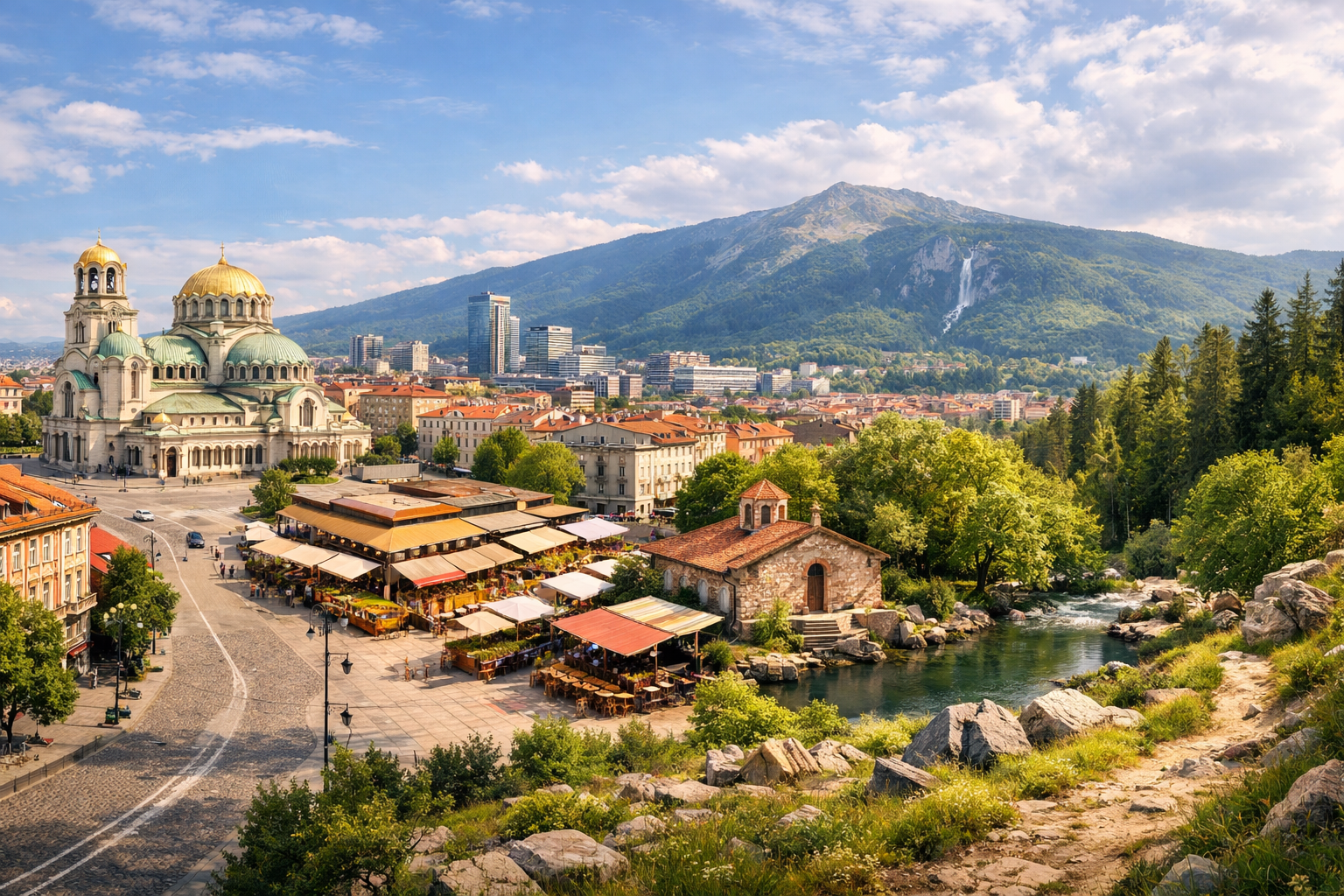
Bulgaria, Sofia. Sofia without big expenses — the city center, markets, local cuisine, modern neighborhoods, parks, and an independent trip to nature at the foot of Vitosha.

Bulgaria, Sofia. Sofia without big expenses — the city center, markets, local cuisine, modern neighborhoods, parks, and an independent trip to nature at the foot of Vitosha.

Discover Sofia without overspending: wander the compact city center, browse lively markets, and enjoy hearty Bulgarian cuisine at local spots. Mix grand boulevards with creative modern neighborhoods, relax in green parks, and slip away on your own to the scenic foothills of Vitosha.

🧭 DAY-BY-DAY ITINERARY

Ready-made country and city routes with daily plans, sights, transport and accommodation. Buy PDF guides for independent travel.

🧭 DAY-BY-DAY ITINERARY


Day 1 — Historic center of Sofia: Serdika, the market hall, baths, and the old town

  • 🚇 If you arrive at Terminal 2, the most budget-friendly and convenient way to get to the city is the metro: Sofia Airport station is next to the terminal, and line M4 goes toward the center. Getting to the Serdika area usually takes about 30–35 minutes including exit time and a short walk, and it is noticeably cheaper than a taxi. For short trips around the city, the 30+ or 60+ ticket is convenient, and if you plan to move around a lot during the day, get a day pass. Estimated transport costs for this day: about 1.86–5.87 BGN per person.

  • 🚶 It’s best to dedicate the first day to the compact center so you don’t waste money or energy on extra transfers. Start at the ancient Serdika complex and the Largo area: this is where Sofia’s layered character is especially tangible, with Roman ruins, socialist monumentality, and the rhythm of the modern city literally just a few steps from one another. The underground and above-ground archaeological fragments of ancient Serdika make the walk feel almost like a museum visit, yet most of the experience is available simply on foot, without expensive tickets.

  • 🏛️ Then walk to the Central Mineral Baths building and the Regional History Museum of Sofia, address: 1 Banski Square. Even if you decide not to go inside, the building itself makes a strong impression: it is one of Sofia’s most beautiful urban facades, with bright ceramics, domes, and the atmosphere of an old European spa town. Nearby you can see the mineral springs area, where locals come with bottles to collect water. If you want to add one paid sight to the day, the museum is a good budget choice: it helps you quickly understand the capital’s history without overload.

  • 🛍️ The next logical stop is the Central Sofia Market Hall, address: 25 Maria Luiza Blvd. This is not only a historic shopping building, but also a convenient place for an inexpensive snack, coffee, and a short break. Inside and around it, you can put together a budget lunch: pastries, yogurt, banitsa, sandwiches, seasonal fruit. For the first day, plan about 8–18 BGN per person for a simple lunch without alcohol.

  • 🥕 After the market hall, walk to Zhenski Pazar, address: Stefan Stambolov Blvd. This is one of Sofia’s liveliest and most authentic urban scenes: stalls with vegetables, fruit, spices, cheese, bread, Balkan pickles, and the bustle of everyday city life. Here you really feel everyday Bulgaria, not just the postcard version for tourists. If you want to keep dinners as budget-friendly as possible during the trip, this is a convenient place to buy fresh products, water, fruit, and small snacks for the next day.

  • ⛪ In the evening, finish your walk in the area of the “Square of Tolerance”: within a very short walking distance, an Orthodox church, a mosque, a synagogue, and a Catholic cathedral stand side by side here. This kind of ending makes the route not only beautiful, but also very meaningful. For dinner, choose a local place away from the most touristy storefronts: Shopska salad, tarator in the warm season, kebapche, moussaka, or food served on a sach usually lets you eat well without straining the budget. Dinner estimate: 12–25 BGN per person.


Day 2 — Vitosha Boulevard, NDK, modern districts, and large parks

  • 🚶 The second day can be planned almost entirely on foot to keep costs down. Start with the pedestrian part of Vitosha Boulevard — this is Sofia’s main strolling artery, where the city feels open, young, and surprisingly relaxed. Even if you are not planning to shop, it is worth coming here for the atmosphere: outdoor terraces, the view of Vitosha Mountain down the street, the rhythm of local life, and a good contrast with the more historic first day. Morning coffee and pastry here usually cost around 5–10 BGN.

  • 🌿 Then head toward the National Palace of Culture and the park area around NDK. This is one of those urban hubs where modern Sofia is especially visible: broad squares, fountains, paths, young people with takeaway coffee, an office rhythm, street musicians, and the feeling of a big but not overloaded city. The location is great for an unhurried walk, photos, and rest without mandatory spending.

  • 🏙️ After NDK, it makes sense to move into the more modern urban zones in the southern part of the center and the districts near pedestrian streets and business axes, where Sofia looks no longer historic, but everyday European. What matters on this day is not a checklist of sights, but a soft contrast: you have already seen the old city, and now you can look at how the capital lives today — with residential streets, design cafés, supermarkets, bookstores, small bakeries, and a calm urban environment.

  • 🌳 In the second half of the day, head to Borisova Gradina — Sofia’s largest and most famous park. This is an excellent budget part of the itinerary: a large green space almost in the center, long alleys, a chance to sit in the shade, take a break without spending money, and simply exhale after the city. From April to October, the park is especially nice: lots of greenery, soft light, local sports activities, and the feeling that the city unexpectedly opens up not only as a capital, but also as a very comfortable place for ordinary life.

  • 🏛️ If you still have energy and interest in an inexpensive museum, the National Museum of Natural History, address: 1 Tsar Osvoboditel Blvd., fits well into the logic of the day. It works especially well for a light itinerary: more compact than many large museums, while still giving you a good cultural bonus without a long transfer. But if you want a truly low-cost mode, this block can be replaced with a longer walk in the park and an earlier dinner.

  • 🍽️ In the evening, it is best to return to the Vitosha Boulevard area or nearby streets, but choose not the grandest restaurants, rather simple local places with daily menus or classic Bulgarian dishes. A good money-saving strategy in Sofia is to have your main meal during the day and take something simpler in the evening: salad, soup, grill, ayran, pastries. Food estimate for the whole day: about 20–40 BGN per person with a moderate budget.

Day 3 — Local cuisine and everyday city life: market, courtyards, museums by choice

  • 🥐 Leave the third day more open and human-scale: no rushing, with a focus on local food, small discoveries, and unhurried Sofia. Start again in the market area or on nearby central streets, but now without the first-day tourist rush. In the morning, you can get banitsa, Bulgarian yogurt, coffee, and walk around the streets near Makedonia Square and the central districts, where the capital reveals itself not through facades but through details — old entryways, inner courtyards, signs, small shops, and everyday Balkan life.

  • 🏛️ For the cultural part, choose 1 inexpensive museum instead of trying to cover everything. A good option is the National Archaeological Museum, address: 2 Saborna Str., if you want to continue the theme of antiquity and Bulgarian history. An alternative is to return to a museum you liked by location or mood the previous day. This approach saves both money and attention: one museum with interest is better than three just for the list.

  • ⛪ Be sure to leave time for a walk around Alexander Nevsky Cathedral, Saint Sophia Church, and the surrounding streets. Here Sofia looks especially noble: wide spaces, stone architecture, golden domes, a calm rhythm, and that rare kind of urban beauty that does not overwhelm with scale, but gradually opens up in light, shadow, and the sound of bells. Even without expensive guided tours, this district gives one of the strongest impressions of the capital.

  • 🌿 If you need another calm free block, stop by City Garden or go deeper into Borisova Gradina again, depending on your mood and the weather. For friends, couples, and solo travelers, this kind of day is especially good because it is flexible: you can talk more, take photos, sit on benches, try food little by little, and not feel tied to a packed schedule.

  • 🍲 The third day is the best one for local cuisine. Look for simple Bulgarian dishes: Shopska salad, sirene, kyufte and kebapche, bob chorba, moussaka, grilled vegetables, lyutenitsa with bread. For a very budget-friendly format, you can combine the market + bakeries + one full café meal in the middle of the day. Then food costs often stay within about 18–35 BGN per person for the whole day.

  • 🌆 In the evening, take one last city walk through the center with no specific goal: Sofia is good precisely because it does not require constant spending to collect impressions. It is pleasant here simply to walk, catch the distant view of Vitosha, watch the city terraces, and feel how the capital gradually becomes understandable and very comfortable for a short, inexpensive trip.

Day 4 — Independent trip to nature at the foot of Vitosha

  • 🚌 Dedicate the last day to Vitosha — this is Sofia’s main natural bonus and the ideal way to finish a budget itinerary. For an easy independent outing, people usually choose public transport to the lower and middle points of the mountain rather than a full-day hike. One of the popular budget options is heading toward Golden Bridges by bus 63 followed by a walk in the natural area; according to the city tourist route description, you need to walk about 1 km from the Dendrariuma bus stop to the Golden Bridges area. This is a realistic format for friends, couples, and solo travelers without special preparation.

  • 🌲 Vitosha is great because it gives you the feeling of a real nature escape without an expensive transfer. After a relatively short time from the center, you find yourself among forest, cool air, trails, viewpoints, and large stone fields. It is especially pleasant to walk here from April to October: the air is drier and cleaner than below, and the walk itself stays easy if you avoid long routes and keep a calm pace.

  • 🥪 To avoid overpaying at cafés on the route, it is better to buy water, pastries, fruit, cheese, nuts, or sandwiches in the city in advance — for example, the evening before or in a supermarket in the morning. That way, the nature day stays truly budget-friendly. Estimated cost for round-trip transport and a simple picnic: about 8–20 BGN per person, depending on how much you buy.

  • 🏞️ If the weather is perfect and you want a slightly more mountain-like feeling without heavy trekking, you can also consider the Aleko area, which people traditionally reach by city transport toward Vitosha. But for the calmest and cheapest scenario, Golden Bridges is usually more logical: less organizational complexity, an easy-to-understand walk, and a good balance between nature and simplicity.

  • ☕ After returning to Sofia in the second half of the day, leave time for a final inexpensive dinner in the center. The best format is to end the trip with something simple and local: salad, grill, soup, dessert, or coffee on a terrace. This day should not be overloaded: Vitosha is valuable precisely as a soft, free, and very Sofia-like finale, where the city shows its main advantage — the rare closeness of a capital city and accessible nature.

Flight tickets

eSIM for travel

Buy PDF guide

Buy PDF guide — 8.90 USD

PDF — 8.90 USD