
Buy PDF guide

Buy PDF guide — 10.90 USD

PDF — 10.90 USD

Baalbek

Baalbek

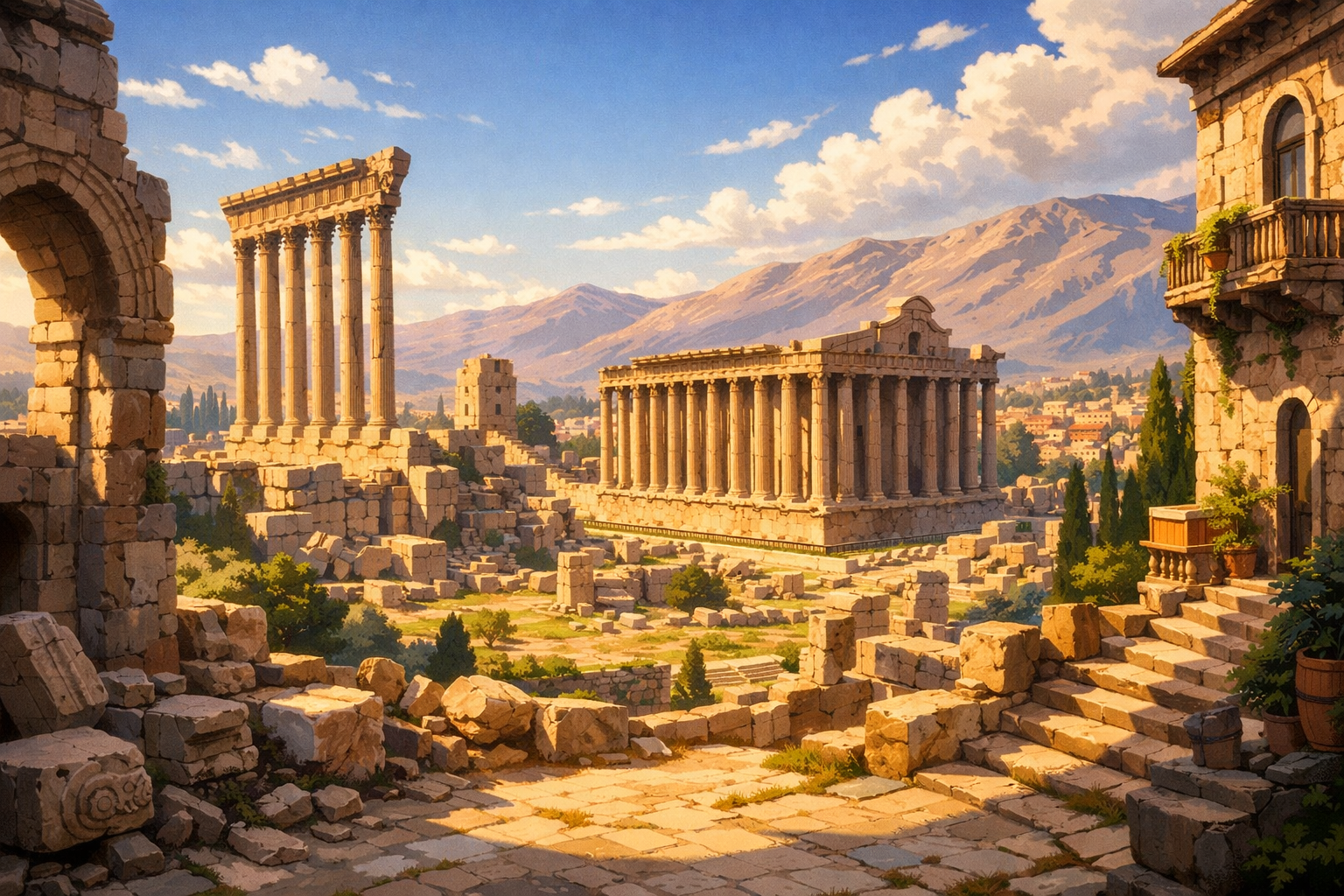
Baalbek is a striking gateway into Lebanon’s ancient past, where colossal Roman temples rise from the Beqaa Valley with unforgettable grandeur. On a five-day journey from Beirut, it offers a rich mix of archaeology, sweeping landscapes, and timeless atmosphere before returning to the capital.

🧭 DAY-BY-DAY ITINERARY

Ready-made country and city routes with daily plans, sights, transport and accommodation. Buy PDF guides for independent travel.

🧭 DAY-BY-DAY ITINERARY


Day 1 — Beirut: arrival, logistics setup, and an archaeological prologue

  • ✈️ Arrival in Beirut and hotel check-in. After the journey, it’s best not to plan anything too demanding: the ideal rhythm is a gentle entry into the country, currency exchange, a SIM card, a short rest, and an early dinner. From the airport to central Beirut, the most convenient option is usually a taxi or a pre-booked transfer; this is more practical than trying to navigate the local transport system immediately after landing.

  • 🚶 In the second half of the day, devote a few hours to the National Museum of Beirut. This is a very important “introductory chapter” before Baalbek: Phoenician, Hellenistic, Roman, and Byzantine artifacts help tune your eye in advance to the plasticity of stone, reliefs, inscriptions, and cult forms. After the museum, Baalbek itself is perceived not as a set of enormous ruins, but as the culmination of a long historical line of the Levant.

  • 🌆 In the evening, take a calm walk around Beirut without overloading the day. The point of the first day is not to “fit in as much as possible,” but to settle into the pace and prepare for the trip to the Beqaa the next day.


Day 2 — Transfer to Baalbek: the Roman acropolis and the first full circuit of the complex

  • 🚗 Transfer: Beirut → Baalbek. The road usually takes about 1 hr 45 min to 2 hr 30 min one way, depending on traffic, road conditions, and the number of stops. If you leave in the morning, you can be at the main archaeological ensemble by midday and not miss the best light.

  • 🚶 Dedicate your first full day in Baalbek not to ticking a box, but to truly reading the space. The archaeological zone of Baalbek is one of the most powerful Roman sacred complexes in the Eastern Mediterranean and a UNESCO World Heritage Site. It is especially important here to feel the drama of the approach: the propylea, the monumental entrance, the hexagonal court, the great court, and then the ascent to the temple platform. The space works like an architectural spectacle on an imperial scale — step by step you are led from the open urban level to an almost cosmic stage of stone, height, and columns.

  • 🏛️ The main focus of the day is the Temple of Jupiter and the ensemble as a whole. Even in its ruined state, the place makes an almost physical impression: gigantic blocks, colossal foundations, the vertical thrust of the columns, and the sense that architectural thought here was working at the very limit of what was possible. After the main axis of the complex, be sure to leave time for the Temple of Bacchus: it is smaller in scale, but in terms of preservation and architectural expressiveness it often has an even stronger impact. Its façade, the depth of its interior, and the richness of its stone carving allow you to see an ancient temple not abstractly, but as an almost complete building that has survived the centuries.

  • ☕ It is reasonable to allow 4–5 hours of pure visiting time for the first day, plus breaks for water, photos, and rest. Baalbek demands unhurried attention: one long thoughtful walk is more rewarding here than trying to rush through everything.

Day 3 — Baalbek: the on-site museum, South Tower, stone details, and sunset light

  • 🚶 A second day in Baalbek is needed precisely to move from the overall impression to the details. Start with the museum on the grounds of the archaeological complex: it helps connect the monumental ruins with actual finds — sculpture, sarcophagi, mosaics, architectural fragments, and the history of excavation. After the colossal scale of the open space, the museum acts like a focusing lens: you better understand what decorated these walls, which cults and images were important here, and how the sacred site lived in different eras.

  • 🗼 Then head up to the South Tower and the viewpoints near the Temple of Bacchus. From above, the logic of the whole ensemble becomes especially clear: not separate buildings, but a gigantic architectural machine set into the landscape of the Beqaa. At this point it becomes visible how subtly the ancient builders worked with perspective, approaches, and spectacle — Baalbek was designed to astonish not only by its size, but also by its scenography.

  • 🌇 After a daytime rest, return to the ruins or to a viewpoint over the city closer to sunset. The warm evening light gives the stone more volume, makes the carving read more softly, and gives the columns that very golden depth for which ancient complexes are best seen not only at midday, but also toward the end of the day. This is the ideal time for a second short circuit of the Temple of Bacchus and the outer panoramas.

Day 4 — Baalbek beyond the main enclosure: the quarry, Hajar al-Hibla, and the city’s sacred layer

  • 🚕 The day is devoted to places that are often skipped, although they are precisely what make Baalbek a truly great engineering and cultural case. Start with the Roman quarry and the Hajar al-Hibla area — the famous “Stone of the Pregnant Woman.” Here you feel especially strongly not the decorative, but the technical side of the ancient megaproject. When you see not only the finished temple, but also the place where giant monoliths were cut out of the rock mass, the scale of the conception becomes almost unbelievable. This is no longer simply the archaeology of cult, but the archaeology of production, logistics, and constructional audacity.

  • 🧭 It is convenient to allow about 2–3 hours for the quarry and a walk through the outer points, including city transfers and rest. It’s better to go by taxi or with a driver: that keeps the route compact and avoids wasting time looking for local transport.

  • 🕌 In the second half of the day, add Sayyida Khawla Shrine to the route. It belongs to a later sacred layer of the city and provides an important contrast to Roman Baalbek. After the pagan and imperial monumentality, there is a different atmosphere here: religious continuity, urban memory, living veneration. This contrast gives the trip more depth — Baalbek opens up not as a “dead museum,” but as a place where antiquity, Islamic history, and contemporary religious life exist side by side.

  • 🌿 Toward evening, you can walk around Ras El-Ain Park — a good pause after stone and sun. The park is useful not as the main goal, but as a place to breathe out, reorganize your impressions, and look at the city no longer as a set of monuments, but as a living environment next to an archaeological giant.

Day 5 — Return to Beirut: final museum context and departure

  • 🚗 Transfer: Baalbek → Beirut. For the return journey, it is also best to allow around 1 hr 45 min to 2 hr 30 min, and even more buffer if you are flying the same day. If your flight is in the evening, you can first go to Beirut, leave your bags, and devote a few hours to a short final cultural stop.

  • 🏛️ As a conclusion to the route, Beirut Museum of Art or a repeat short visit to the National Museum works well if there was little time on the first day. After Baalbek, a museum in Beirut is perceived differently: you begin to recognize motifs, feel the proportions of ancient sculpture more clearly, and see how the local history of Lebanon comes together into a unified architectural narrative.

  • ✈️ Next — transfer to the airport and departure. This five-day format is realistic: it does not require endless transfers, gives you two full days for the main archaeological complex, and leaves room for pauses, light, the road, and a living perception of the place.

Flight tickets

eSIM for travel

Buy PDF guide

Buy PDF guide — 10.90 USD

PDF — 10.90 USD